80 Percent Cheaper, a Billion Users, and a Warning About Coding Agents
Three developments landed this week that share a common thread: AI is getting cheaper and more accessible, but the gap between "it works" and "it works reliably" is still something every business needs to manage. Here's what changed and what it means for your operations.
OpenAI Hits 1 Billion Users and Cuts API Prices Up to 80 Percent
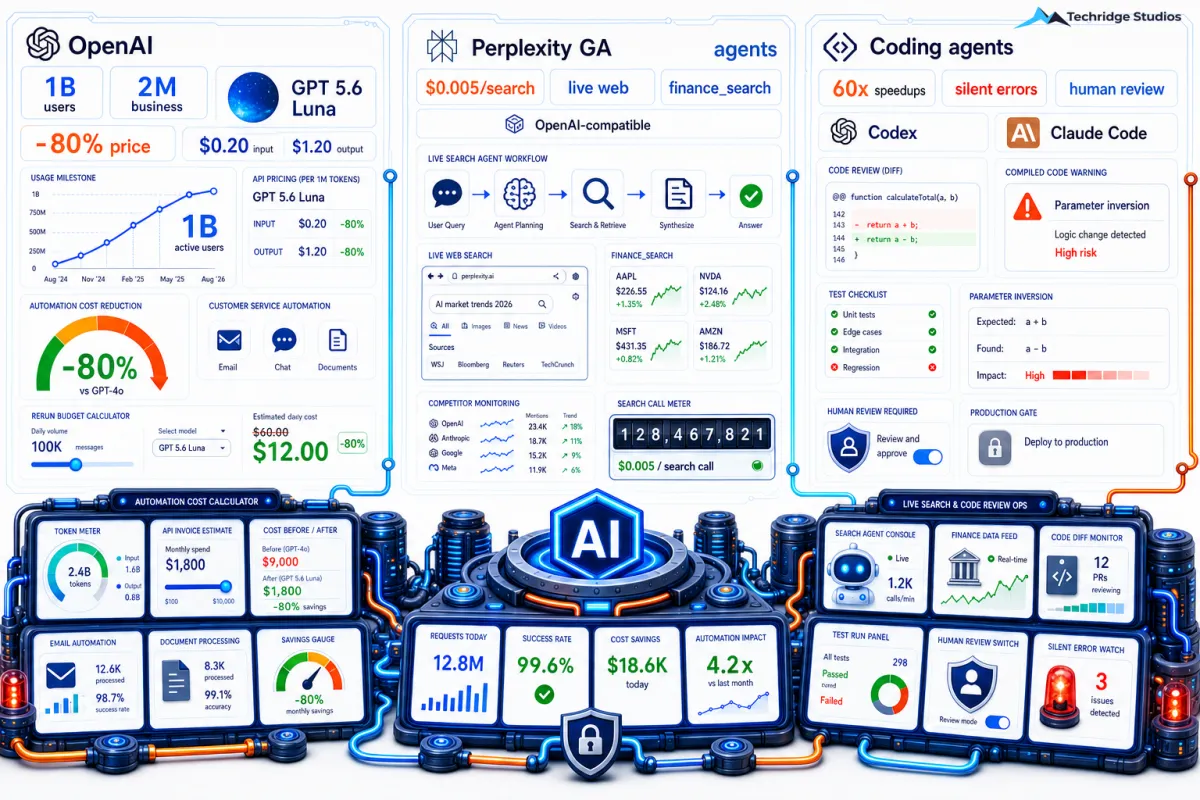
On July 31st, 2026, OpenAI announced it had crossed the 1 billion active user milestone — reaching a scale once held only by platforms like Facebook and YouTube, but doing it roughly two years faster. The figure spans ChatGPT, Codex, and ChatGPT Work, with more than 2 million business accounts now among those users.
The user milestone got the headline, but the more actionable announcement for small businesses was the pricing change. OpenAI cut its GPT 5.6 Luna model from 1 dollar to 20 cents per million input tokens — an 80 percent reduction — and from 6 dollars to 1 dollar and 20 cents per million output tokens. GPT 5.6 Terra was also reduced 20 percent, falling from 2.50 dollars to 2 dollars per million input tokens.
GPT 5.6 Luna is the model most commonly used in business automation workflows. It powers customer service chatbots, document summarization tools, email responders, and internal workflow assistants. A task that cost 50 dollars a month to run through the API at previous rates now costs about 10 dollars. That is not a marginal change — it is the kind of shift that moves a project from unaffordable to line-item-able.
The practical action: open your OpenAI usage dashboard, look at your token consumption over the last 30 days, and apply the new rates. If you have an AI automation you shelved because the projected monthly cost was too high, recalculate using the current price. Many projects that did not pencil out at 2025 rates are viable today.
Perplexity Opens Its Agent Platform to Everyone
Perplexity AI moved its agent platform into general availability in early August 2026. The platform lets developers and businesses build autonomous agents that combine AI reasoning with live web search — meaning agents that can look things up in real time, not just answer from a static training dataset.
The pricing is accessible: half a cent per search call. That is $0.005 per query, making it practical to build workflows that search the web dozens or hundreds of times per day without accumulating significant infrastructure cost. The platform is also OpenAI-compatible, which matters for any team that has already built workflows on ChatGPT's API. Compatibility means you can layer in Perplexity's search capabilities without rebuilding your existing stack from scratch.
One notable addition in the general availability release is the finance_search tool — a structured data feed for public company financials, earnings, analyst estimates, and market data. For SMBs doing market research, competitor tracking, or financial analysis on clients or prospects, this brings data that previously required expensive subscriptions into an AI workflow at search-call pricing.
The broader implication is that autonomous agents — AI systems that act on your behalf by looking things up, synthesizing information, and producing outputs — are no longer limited to enterprise contracts. Small teams can now build agents that monitor competitors, track industry news, pull financial data, and produce summaries, all at a cost per run that makes daily or hourly automation viable.
Coding Agents Are Fast. They Are Also Documented to Make Confident, Silent Errors.
A field report from OpenAI and academic research partners released in late July 2026 documented eight real-world scientific software projects where coding agents were deployed. The raw performance results were significant: agents produced speedups of up to 60 times on software tasks that had taken human programmers weeks or months. The projects used OpenAI's Codex in five cases and a combination of Codex and Claude Code in three others.
The caveats in the report were equally important. Researchers described the agents as "eloquent, convincing, and confidently wrong in ways that are easy to miss." In one documented case, an agent rewrote a scientific program in Rust and produced code that compiled and ran without errors — but had inverted a key control parameter, causing the program to use the reciprocal of the intended values throughout. The output looked correct. The logic was wrong.
For businesses using AI coding tools — and the majority of development teams now use some form of AI-assisted coding — this distinction matters. A developer using a coding agent to modernize an internal tool, refactor a pricing calculator, or build a new integration can work dramatically faster. But "works on the surface" and "works correctly under the hood" are not the same thing, and the field report confirms that coding agents do not reliably catch the difference themselves.
The recommended approach is straightforward: treat coding agent output as a fast first draft that still requires human code review before deployment. If your team does not have the bandwidth for that review step, the risk profile of deploying unreviewed agent-produced code into a production environment — whether a customer-facing tool, a financial calculation, or an inventory system — is higher than the speed benchmarks suggest.
What This Means for Your Business
The thread connecting all three stories is expanding access paired with the need for human oversight. AI tools are getting cheaper, more capable, and broadly available — but the evidence that they operate flawlessly without human involvement is still thin.
The 80 percent price cut from OpenAI removes the cost barrier that kept many automation projects on hold. Perplexity's agent platform opens up live-search AI agents to teams of any size. And the coding agents field report is a clear reminder that faster is not the same as accurate.
The single best action you can take this week: pick the one AI automation you shelved in the last six months because of cost, capability, or confidence concerns. Run the numbers using today's prices, test the current tool set against your use case, and decide whether the barrier that stopped you before still applies. In most cases, it no longer does.
Sources
BNN Bloomberg / OpenAI — https://www.bnnbloomberg.ca/business/artificial-intelligence/2026/07/31/openai-says-has-more-than-1-billion-active-users/
Perplexity AI Release Notes — https://releases.sh/perplexity
The Decoder / OpenAI Field Report — https://the-decoder.com/ai-coding-agents-can-modernize-research-software-but-cant-judge-if-the-science-is-right/