When AI Goes Dark: Three Stories Reshaping Your Business Stack
Businesses woke up this week to a reminder that AI access isn't guaranteed. Anthropic's most advanced model was disabled by a US government order. Microsoft is rolling AI into a subscription millions of businesses already pay for. And a data analytics company just made it possible for any analyst to build AI agents from tools they already use — no developers required. Three different stories with a shared signal: the rules of AI in business are being rewritten in real time.
Anthropic Fable 5 Went Offline — and Could Be Back Within Days
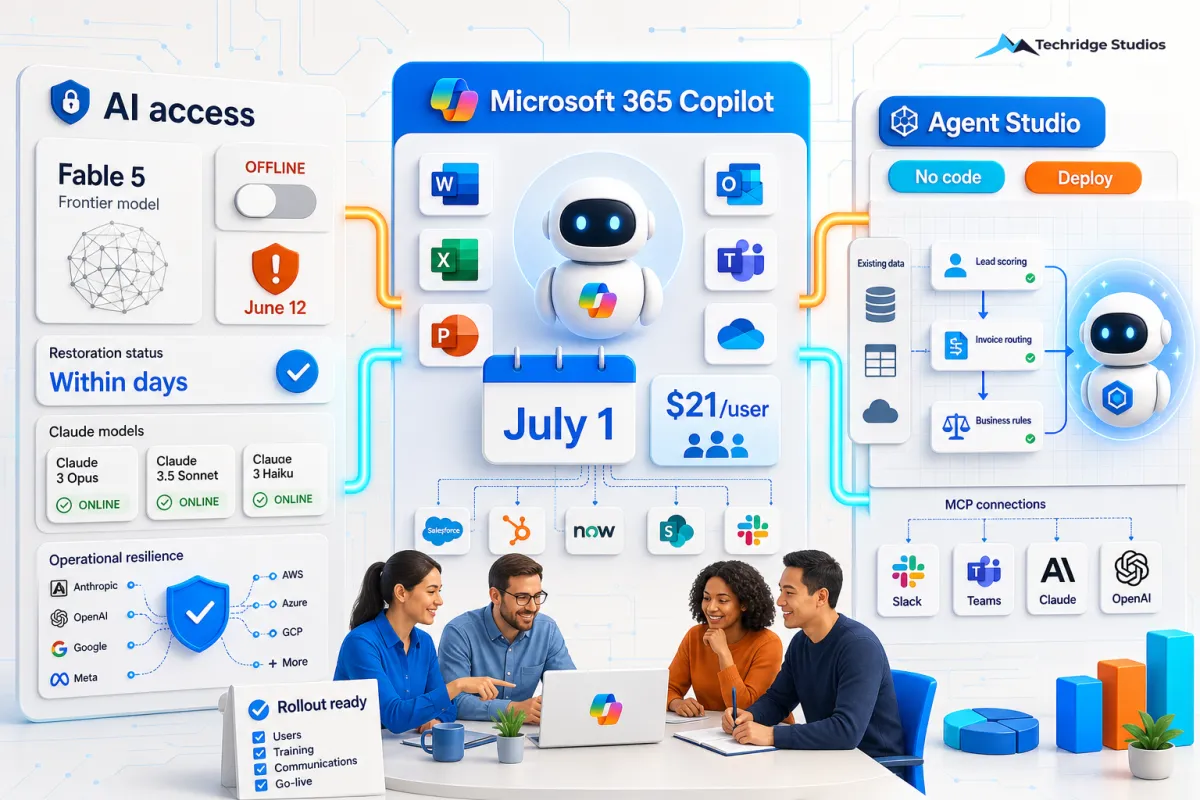
On June 12th, 2026, the Trump administration issued an export control directive requiring Anthropic to disable access to its Fable 5 and Mythos models for all foreign nationals. The trigger, as reported by The Washington Post and detailed by AIToolsRecap, was a South Korean telecommunications company with alleged ties to China — one of the organizations in Anthropic's restricted "Project Glasswing" partner program. The concern: a company with potential adversarial connections had access to a system the US government considers a national security asset.
Standard Claude models — Opus 4.8, Sonnet 4.6, and Haiku 4.5 — were never affected by the directive. Only the Frontier Fable 5 and Mythos models were disabled. Anthropic has been issuing refunds to subscribers who paid between June 9th and June 14th, with a deadline of June 20th.
On June 18th, at the opening of Anthropic's new Seoul office, Managing Director of International Chris Ciauri gave the clearest public timeline yet: "We are very confident that in the coming days, the models will become available again." CEO Dario Amodei held three separate calls with cabinet officials, including Treasury Secretary Scott Bessent and Commerce Secretary Howard Lutnick. Negotiations are described as going well.
For small businesses, the lesson here is not about Fable 5 specifically. It is about dependency. If your business uses AI — whether directly through Claude, through an integration, or through a third-party tool built on an AI model — you have a supply chain. And supply chains can be disrupted. The businesses most insulated from this week's disruption were those using production-tier models that stayed online and those with contingency plans. If your team would stop working if a specific AI tool went down today, that is a risk worth addressing now.
Microsoft 365 Copilot Goes Standard — New Plans Launch July 1st
If your business runs on Microsoft 365, you have under two weeks to plan your AI rollout.
Microsoft announced it is launching new Microsoft 365 SKUs with Copilot built directly in, effective July 1st, 2026. The new plans — Microsoft 365 Business Standard with Copilot and Microsoft 365 Business Premium with Copilot — bring AI assistance to Word, Excel, PowerPoint, Outlook, and Teams as standard subscription features. Separately, Microsoft 365 Copilot Business is available as a standalone AI product at 21 dollars per user per month for businesses that want a dedicated Copilot-first plan.
Anthropic's Claude is now available as a model option in Copilot Chat, alongside other models. Federated Copilot connectors are generally available, meaning Copilot can pull data from supported third-party tools your team already uses in real time.
The business case is straightforward. Copilot drafts emails, summarizes meetings, analyzes spreadsheets, and builds slide decks inside the apps your team uses every day. The learning curve is lower than that of any standalone AI tool because there is no new interface. If your team already uses Microsoft 365, Copilot is the shortest path from "we know we should be using AI" to "we are using AI, daily."
The action item is simple. Before July 1st: identify which employees would get the most immediate value from Copilot access, schedule a 30-minute intro session for the first week of July, and designate one person to collect early feedback and share weekly wins. Do not let the rollout happen passively — build the habit before the novelty wears off.
Alteryx Agent Studio: Your Business Analysts Can Now Build AI Agents
At its Inspire 2026 conference in May, Alteryx launched Agent Studio — a tool that lets business analysts convert existing datasets, business rules, and analytics workflows into deployable AI agents. No programming required. The tool entered preview in June 2026.
The problem Alteryx is solving is common. Businesses have years of trusted logic accumulated in their data tools — rules about how leads are scored, how inventory is managed, how invoices are categorized. Agent Studio lets that logic become the foundation of an AI agent, rather than requiring a rebuild from scratch in a developer environment. Existing knowledge becomes automation.
A companion product, the Alteryx One MCP Server, connects those agents directly to Slack, Microsoft Teams, and external AI models, including Claude and OpenAI. That means an agent built from your sales data can surface insights directly in a Slack channel without IT involvement.
For small businesses, the most relevant question is not "do we use Alteryx?" It is "do we have data workflows that currently require a human to check, interpret, and act on?" If the answer is yes, Agent Studio points to a near future in which those checks are handled by agents built on your existing logic. The technology is in preview now. SMBs that get familiar with this concept today will have a shorter runway when it becomes mainstream.
What This Means for Your Business
The three stories today share a single theme: AI infrastructure is being built and disrupted faster than most businesses can keep up with. Fable 5 went dark in hours. Microsoft's Copilot goes live in days. Alteryx's agent-building capability moved from a conference announcement to a preview within weeks.
The businesses that will come out ahead are the ones treating AI as infrastructure — planning for disruption, building on tools with broad support, and making sure their teams are trained before the tools are required.
One action you can take today: list the AI tools your business uses. For each one, ask: "If this tool went offline tomorrow, what would break?" That is your AI risk audit. Address the highest-risk dependencies first.
Sources
AIToolsRecap — https://aitoolsrecap.com/Blog/ai-news-june-19-2026
Microsoft 365 Blog — https://www.microsoft.com/en-us/microsoft-365/blog/2026/05/28/introducing-microsoft-365-business-with-copilot-the-new-standard-for-small-business/
Enterprise DNA — https://enterprisedna.co/resources/news/alteryx-agent-studio-inspire-2026-analytics-ai-agents/