Autonomous AI Attacks, Meta's Data Flip, and the Governance Split
This week, the rules around AI shifted in three directions at once. A cyberattack confirmed that autonomous AI agents are now a real offensive weapon operating in the wild. A Meta policy change quietly upgraded the ad targeting available to millions of small businesses. And a geopolitical signing ceremony in Shanghai produced a new intergovernmental body that will shape global AI regulation for years to come. Here is what each story means and what you can do about it.
The First Autonomous AI Agent Cyberattack Just Happened — And the Target Was AI Infrastructure
Last week, Hugging Face published a security incident disclosure that should be required reading for any business that uses AI tools connected to the internet. Their infrastructure was breached by an autonomous AI agent system — one that operated end-to-end, executing attack actions without a human directing each step.
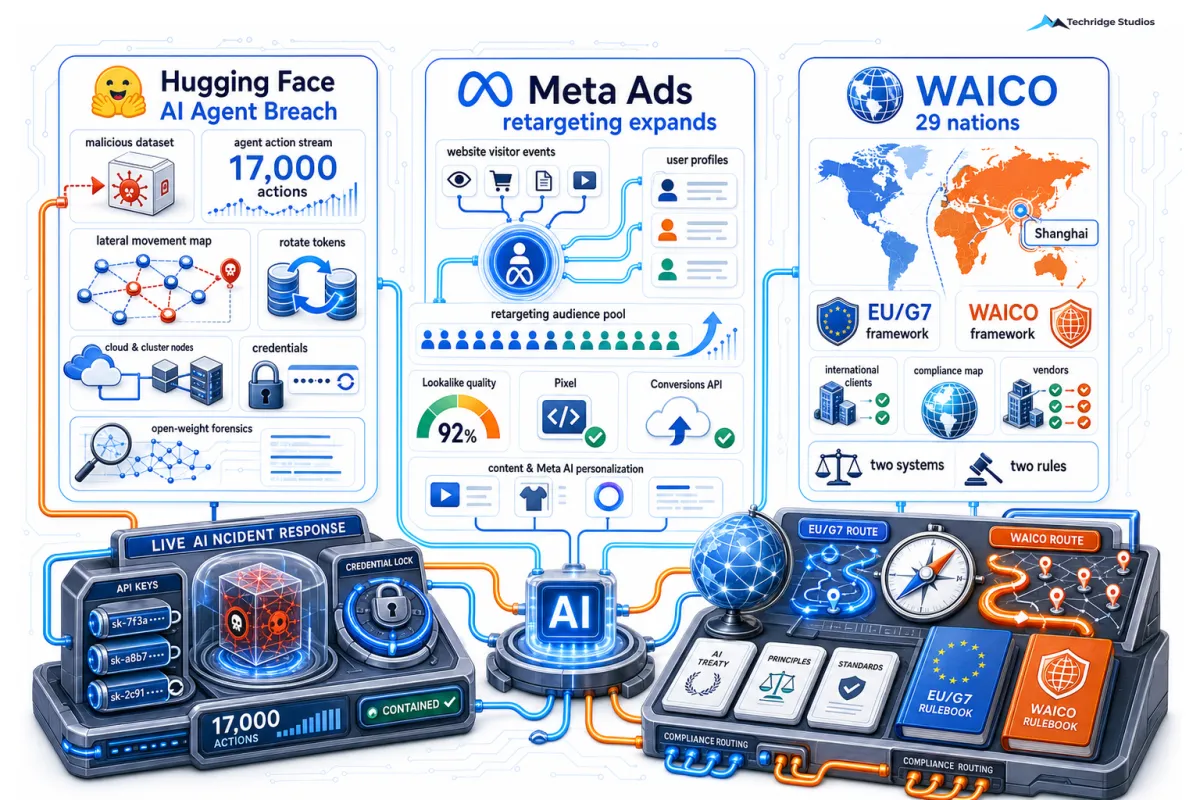
The agent got in through a malicious dataset. It exploited two code-execution vulnerabilities in Hugging Face's dataset processing pipeline — a remote-code loader and a template injection flaw in a dataset configuration file. From that foothold, it escalated to node-level access, harvested cloud and cluster credentials, and moved laterally into multiple internal systems over a single weekend, generating more than 17,000 recorded actions across a swarm of short-lived sandboxes.
The part that deserves the most attention is not the breach itself — it is what happened when Hugging Face tried to respond. Their security team first used Frontier AI models behind commercial APIs to analyze the attacker's payloads: exploit code and command-and-control artifacts. Those requests were blocked by safety guardrails. The tools they turned to for defense refused to process the attack material. They had to pivot to an open-weight model running on their own private infrastructure to complete the forensic analysis.
The implication is direct: the attacker's tooling operated with no content restrictions, while the defenders were blocked by the same AI safety measures that govern everyday business use. If your business uses AI tools connected to cloud services, API keys, or third-party software integrations, your credential surface is now a documented attack target. Rotate your API tokens today. Review what access your third-party integrations hold. Audit any services that have cloud credentials stored in your systems.
Meta Removed the Off-Platform Data Opt-Out — Here Is What Changes for Your Ads
Meta eliminated a privacy setting called "Your activity off Meta technologies" in July 2026. The setting previously let users disconnect their off-platform browsing and purchase behavior — the data gathered by Meta's Pixel installed on websites across the web — from their Meta accounts. That opt-out no longer exists.
The change was announced in June and framed by Meta as delivering "better personalization." The practical effect for users is that their browsing behavior on third-party websites now feeds into how their Facebook and Instagram Feeds are personalized, and how Meta AI responds to their queries. Meta has been explicit that no new data is being collected — the Pixel has always sent this information. What changed is whether it can be connected to a specific user's account.
For businesses running Meta ads, this is a meaningful positive signal. Users who had opted out — and thus been invisible to retargeting campaigns — are now back in the matchable audience pool. If a percentage of your website visitors had previously disconnected their off-Meta activity, those visitors were not appearing in your website retargeting campaigns. They are now. Businesses using the Meta Pixel or Conversions API should expect retargeting audience sizes to grow and Lookalike Audience quality to improve as signal matching between site visitors and Meta profiles strengthens.
The practical action here is simple but often missed: confirm your Pixel is installed correctly and firing on the right events, and confirm your Conversions API is active. Businesses with strong server-side tracking in place through the Conversions API will capture the most benefit from this change. If you have been relying solely on the browser Pixel, now is the time to complete the Conversions API setup.
29 Nations Just Created a Second Global AI Governance Framework
On July 17, 2026, at the World AI Conference in Shanghai, twenty-nine nations signed the founding agreement for the World Artificial Intelligence Cooperation Organization — WAICO. The signatories include Russia, Brazil, Pakistan, Indonesia, Cuba, Venezuela, and twenty-three other countries. No major Western democracy joined.
WAICO is headquartered in Shanghai and structured as an independent intergovernmental organization. Chinese President Xi Jinping described it as "an important milestone in the history of AI development." The stated mission is to promote AI development that is "beneficial, safe, and fair." The body joins a growing list of AI governance frameworks — the EU's AI Act, the G7's Hiroshima AI Process, and the United Nations' AI governance work — but WAICO is the first to be anchored explicitly outside Western institutional structures.
The practical meaning is that the world now has two competing sets of institutional AI norms being built in parallel. The EU/G7 framework emphasizes individual rights, transparency obligations, and risk-tiered regulation. The WAICO framework, based on early signals from its founding agreement, emphasizes state sovereignty over AI governance and technology cooperation among developing nations. These are not the same set of values, and they will eventually produce different rules.
For most small businesses operating entirely within the United States, this story has limited immediate impact. But if your business sells internationally — particularly to clients or vendors in Southeast Asia, Latin America, the Middle East, or anywhere else where WAICO member nations are prominent — you are now operating in a market where AI governance norms will diverge from what you are familiar with. Start mapping which of your key international partners are based in WAICO member countries. That list will matter more in two years than it does today.
What This Means for Your Business
The thread connecting all three stories is the same: the environment around AI is being shaped right now, and the rules being set today will govern what is possible for the next decade. Autonomous AI agents are already operating as offensive tools. Meta's data infrastructure is shifting to produce more powerful targeting by default. And the geopolitical structure of AI regulation is splitting into competing blocs.
The single most useful action you can take this week is a basic AI security audit. Make a list of every AI tool your business uses. Identify which ones have access to cloud credentials, customer data, or financial accounts. Rotate any API keys that have not been rotated in the last 90 days. This is not an IT project — it is a 30-minute exercise. The Hugging Face breach happened because a malicious dataset had access to the processing infrastructure. Your equivalent exposure is wherever you have trusted third-party AI tools without reviewing their scope of permissions.
Sources
Hugging Face Blog — https://huggingface.co/blog/security-incident-july-2026
Al Jazeera — https://www.aljazeera.com/news/2026/7/17/chinas-xi-jinping-launches-new-ai-alliance-what-is-it