AI CEOs Reverse Their Jobs Warning, Microsoft Agents Go Multi-Agent, and Open-Source Security Cracks Widen
Three news stories landed this week that tell the same story about where AI is heading. The predictions are getting corrected, the tools are getting more powerful, and the risks are getting harder to ignore. If you run a small business, this week's news is less about what AI can do in theory and more about what it means to operate with it in practice.
OpenAI and Anthropic CEOs Reverse Their White-Collar Jobs Predictions
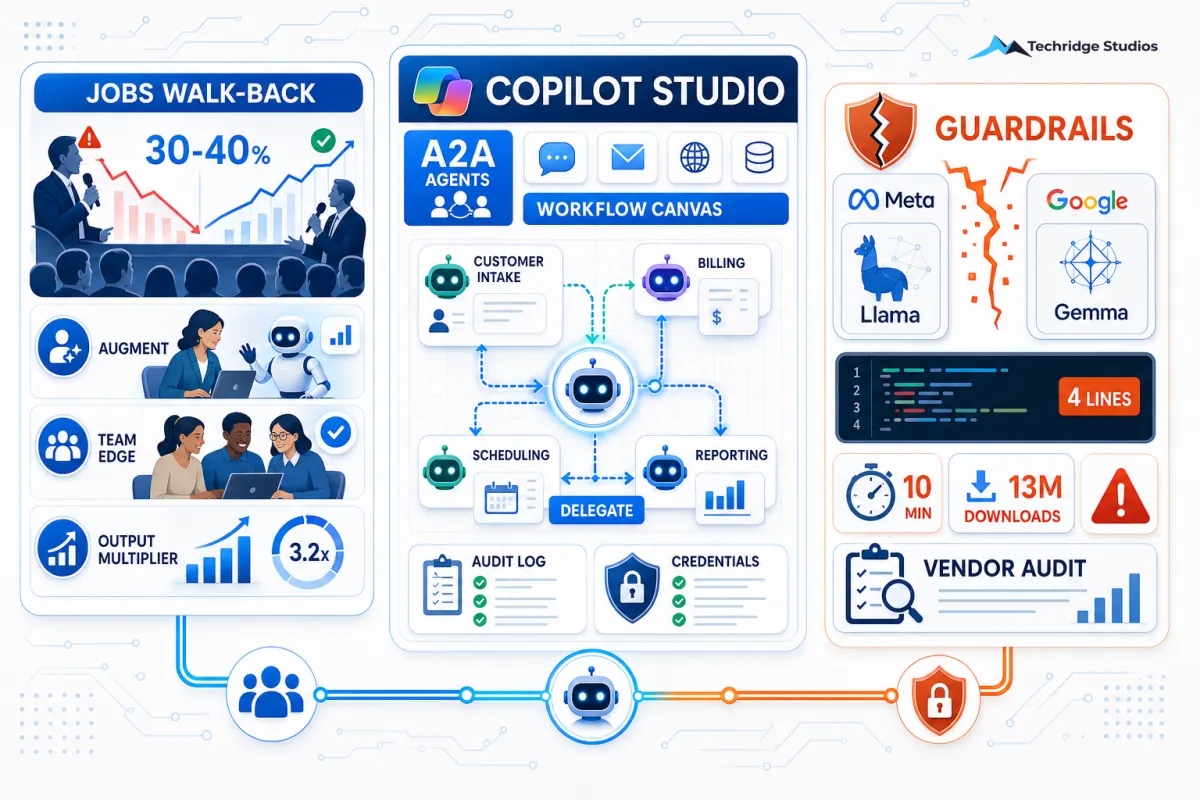
On May 26th, 2026, OpenAI CEO Sam Altman told an audience at the Commonwealth Bank of Australia's annual conference in Sydney that the AI-driven jobs apocalypse he once warned about has not materialized — and he is glad about it. Altman, who previously predicted that AI would replace 30 to 40 percent of all work tasks in the near future, told attendees he was "delighted to be wrong." His explanation: people care about working with other people, and that human dimension of employment is harder to automate than he anticipated.
At the same time, Anthropic CEO Dario Amodei is also revising his earlier warnings. Amodei, who as recently as early 2026 predicted that AI could spike unemployment to 10 to 20 percent, is now invoking the Jevons Paradox — the economic principle that efficiency gains in one area tend to increase overall demand rather than shrink it. He now frames AI as an output multiplier: if AI handles 90 percent of a task, people focus on the remaining 10 percent, and that shift creates more demand for human judgment, creativity, and relationship-building rather than less.
Fortune reported that both reversals are happening as OpenAI and Anthropic eye major capital events — OpenAI filed a confidential IPO in May, and Anthropic posted its first quarterly operating profit. Skeptics may note that walking back doom predictions is also good for business: it is easier to sell AI tools to companies that believe AI will upgrade their teams rather than eliminate them. That context matters, but it does not change the practical implications for small businesses.
For small business owners, the takeaway is to stop planning for AI displacement and start planning for AI augmentation. The question is not "which roles will AI take" but "where does AI give my existing team the most leverage?" That reframe changes the conversation about which tools to buy, how to train your staff, and what to measure.
Microsoft Copilot Studio Now Lets AI Agents Work Together — and That Is a Bigger Deal Than It Sounds
Microsoft published its May 2026 Copilot Studio updates this week, and the headline feature is agent-to-agent (A2A) communication going generally available. In plain terms: one AI agent can now hand off work directly to another AI agent — from a different platform, a different workflow, or a different vendor — without a human in the middle. That might sound technical, but the business implication is significant for anyone who has ever stitched together multiple automation tools that did not talk to each other.
Before A2A communication, building a multi-step automated workflow required either a human handoff at every step or a single platform to handle everything. Now, a Copilot agent handling customer inquiries can automatically pass a billing task to a finance agent, which can flag exceptions to a scheduling agent, all in sequence and all without manual intervention. Microsoft built this on an open protocol, meaning it is not limited to Microsoft tools — third-party agents can participate in the same workflows.
The update also includes a redesigned visual workflow canvas in Copilot Studio, allowing teams to design and manage multi-agent workflows from a single interface instead of stitching together disconnected tools. Computer-using agents — which can interact directly with websites and desktop software through visual recognition — also received improvements in this update, with better credential management via Azure Key Vault and tighter audit logging for compliance-sensitive environments.
For small businesses running on Microsoft 365, this is a meaningful upgrade. If you are already using Copilot in any form, the question this week is which manual handoffs in your operation are ripe for automation. Customer intake, scheduling, billing follow-up, and report generation are all good starting points. The complexity of building multi-agent workflows has dropped substantially with this release.
Free Tools Are Stripping Safety Guardrails From Major AI Models in Minutes — What SMBs Should Know
A Financial Times investigation published on May 25th and 26th found that a free tool called Heretic, available on GitHub, can remove safety guardrails from open-source AI models, including Meta's Llama 3.3 and Google's Gemma 3, in under 10 minutes using only four lines of code. The same tool has already been used to create more than 3,500 "decensored" model versions that respond to dangerous prompts, with a total of 13 million downloads. Its creator reportedly stripped safety protections from Google's newer Gemma 4 model within 90 minutes of its public release.
The practical danger for businesses is not that someone will use a stripped model against you directly — it is that AI tools your team uses may themselves be built on open-source models that have been modified to remove safety constraints. Many third-party AI applications, including specialized business tools for customer service, content creation, and data analysis, are built on top of Meta Llama or Google Gemma rather than proprietary APIs. If the model underlying those tools has been altered, you may not know it, and your vendor may not either.
Security experts responding to the FT investigation said the findings point to a need for continuous AI auditing rather than relying solely on vendor promises. For companies in regulated industries — healthcare, finance, legal — this is already a compliance issue. For general SMBs, it is a vendor due diligence question: when you select an AI tool, you should ask whether it is built on a proprietary model with safety accountability or an open-source base with unknown modification history.
The three questions to ask your AI vendor this week are: Which underlying model does your product run on? What process do you use to verify that the model has not been modified to remove safety protections? And what happens if a safety violation is discovered in the base model you rely on? If a vendor cannot answer those three questions clearly, that is useful information.
What This Means for Your Business
This week's three stories share a common thread: AI is past the prediction phase and into the accountability phase. The people who made the biggest claims are revising them. The tools are becoming more sophisticated and harder to manage in isolation. And the risks are getting concrete enough that "we use an AI tool" is no longer a sufficient answer — the follow-up questions about which tool, built on what, with what protections, are now fair game from clients, regulators, and your own team.
The single next action: pick the one story that most directly affects your current operation. If you have been anxious about AI and headcount, let this week's reversals inform a more grounded conversation with your team. If you are building automations on Microsoft 365, look at what A2A communication enables in your existing stack. If you use any third-party AI tools for sensitive work, schedule a vendor review call this week and bring the three questions from the security section above.
Sources
Microsoft Copilot Blog — https://www.microsoft.com/en-us/microsoft-copilot/blog/copilot-studio/new-and-improved-computer-using-agents-a-new-workflows-experience-and-real-time-voice-experiences/
The Irish Times — https://www.irishtimes.com/business/2026/05/25/ai-guardrails-stripped-from-meta-and-google-models-in-minutes/