How AI Is Changing News, Code, and Business Tools Right Now
Three stories broke this week that touch on where people find information, what AI models are now available to any business on Amazon Web Services, and whether the code your tools are generating is actually safe to ship. None of them is abstract. All three have a direct action attached.
AI Chatbots Are Now Where People Find News — And Almost Nobody Clicks Through
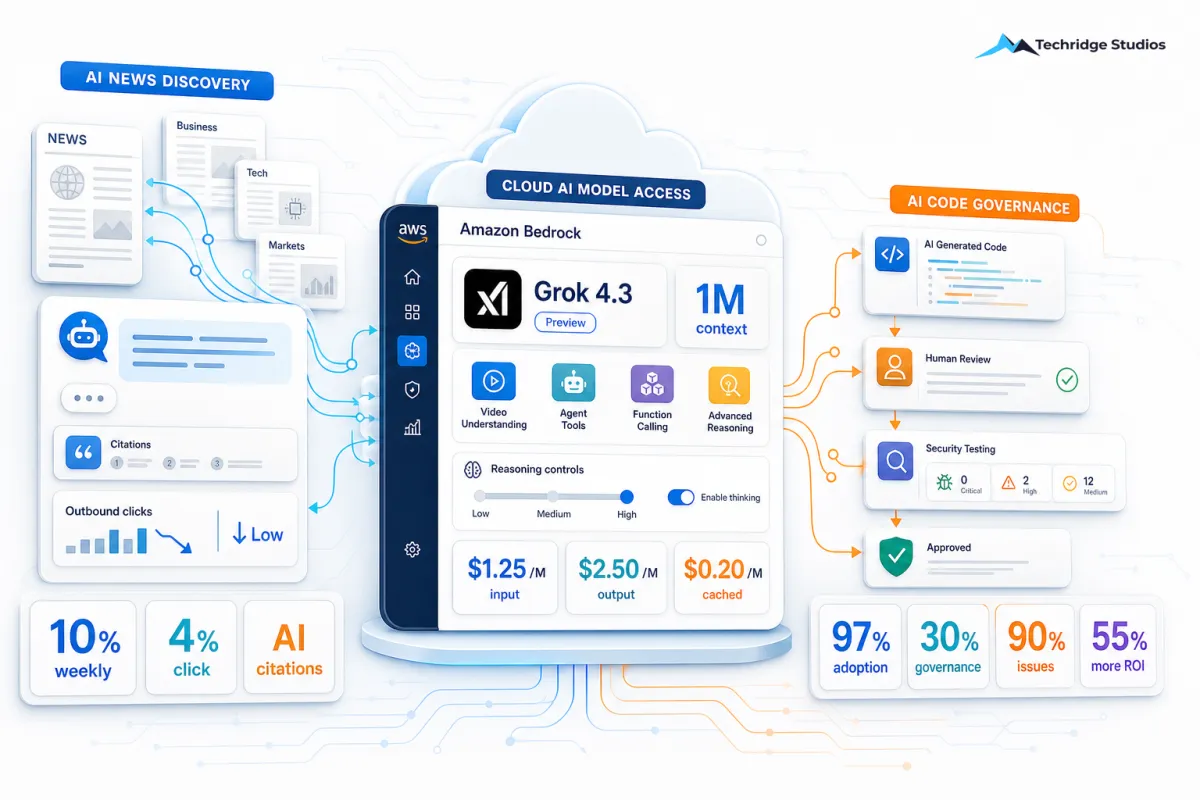
The Reuters Institute for the Study of Journalism released its 2026 Digital News Report, and one number stands out: 10 percent of adults worldwide now use AI chatbots to consume news every week. That is up from 7 percent a year ago. Among adults under 35, it rises to 16 percent.
The second number is the one that matters more for businesses: only 4 percent of those users click through to the original source. Meaning that for every hundred people who learn something from an AI chatbot, four end up on the website where the information actually lives.
For small businesses whose content strategy is built on search engine optimization and organic traffic, this is a structural shift. The classic playbook — write good content, rank on Google, get visitors — is not broken, but it is no longer the only path that matters. An increasingly large share of discovery is happening inside AI tools like ChatGPT, Claude, and Gemini. And those tools surface information by citing it, not by sending users somewhere else.
The practical implication: think about whether your business is the type of source AI tools cite. That means having clear, factual, structured content that answers specific questions. It means being present on platforms that AI tools draw from. And it means accepting that some of your audience will learn about your expertise without ever visiting your website — and treating that as a win, not a loss.
Grok 4.3 Is Now on Amazon Bedrock — No New Contracts Required
xAI's Grok 4.3 became generally available on Amazon Bedrock on June 15, 2026. For businesses that already use Amazon Web Services, this is the most friction-free way to test a new frontier AI model that has appeared in years.
The pricing is straightforward: $1.25 per million input tokens and $2.50 per million output tokens on the on-demand tier, with cached input available at $0.20 per million. The model has a 1-million-token context window, which means it can handle full contracts, large codebases, or long multi-turn conversations in a single pass. It also supports native video input and AI agent tool-calling.
xAI claims Grok 4.3 has the lowest hallucination rate among current frontier models. The model does trail Claude Opus 4.8 and GPT-5.5 on overall reasoning and instruction-following benchmarks, but at roughly one-quarter of the cost per token, it is a competitive option for specific use cases — particularly document analysis, content review, and customer-facing text generation where cost per query matters.
The practical implication for SMBs: if you already have an AWS account and you have been curious about alternatives to your current AI provider, Grok 4.3 is now available to test without a new vendor contract. Build a small pilot, compare outputs, and make a decision based on actual results rather than benchmark rankings.
The AI Code Governance Gap Is Bigger Than You Think
Black Duck Security surveyed more than 800 software engineers and DevOps professionals for its "State of AI-Powered Software Development" report. The headline number: 97 percent of developers now use AI coding assistants in their daily work. That is near-total adoption.
The second number is the problem: fewer than one in three organizations — 30 percent — have a full governance framework in place for AI-generated code. And 90 percent of teams encounter issues with that code, most commonly in manual review, security testing, and rework. The teams that have addressed this have a measurable advantage: those with full governance in place are 55 percent more likely to report major efficiency gains. The oversight does not slow the work down. It speeds it up.
For small businesses, the governance gap is easy to miss because most SMBs are not running large engineering teams. But AI-generated code now shows up in more places than ever — website maintenance, internal automations, customer-facing tools, and third-party app customizations. If any AI-generated code in your business touches customer data, handles payments, or sits in a login flow, it needs human review before it goes live. That is not an engineering-only problem. It is a business risk.
The good news is that a governance framework does not have to be complicated. Start with a single written policy that defines which types of AI-generated code require review, who is responsible for that review, and how the decision is documented. That alone puts you in the top 30 percent.
What This Means for Your Business
This weekend's three stories point to the same underlying reality: AI is no longer a thing your business might eventually adopt. It is already inside the tools, platforms, and workflows your customers and employees use every day. The question is whether you are shaping how it represents your business, which models you are using and why, and whether the AI-generated work your team produces is being checked before it causes a problem.
The single next action: pick one of these three areas and spend 30 minutes on it this week. Update one page of your website to be more citable by AI tools. Test one query through Grok 4.3 on Bedrock. Or write one sentence that defines your team's AI code review policy. One step in any of these directions is a concrete win.
Sources
Reuters Institute for the Study of Journalism — https://reutersinstitute.politics.ox.ac.uk/digital-news-report/2026/emerging-uses-ai-chatbots-news-and-what-it-means-journalism
Amazon Web Services — https://aws.amazon.com/about-aws/whats-new/2026/06/grok-amazon-bedrock/
Black Duck Security / PR Newswire — https://www.prnewswire.com/news-releases/ai-coding-hits-97-enterprise-adoption-new-black-duck-study-shows-governance-is-the-roi-multiplier-302794103.html