AI Just Got Cheaper to Run and Safer to Deploy
Three AI developments from September 3rd, 2026 arrived at the same time and point in the same direction: AI is moving deeper into business operations, the costs of running it are dropping, and the risks of deploying it without proper safeguards are becoming real enough to attract major investment. Here is what happened and what it means for your business.
Anthropic Releases Claude Fable 5.1 and Cuts Cache Pricing by 75 Percent
Anthropic released two new model versions today — Claude Fable 5.1 and Claude Mythos 5.1. Fable 5.1 is built for programming and complex knowledge work, while Mythos 5.1 is reserved for a restricted group of verified organizations working in high-risk domains including cybersecurity and biological research. Both represent updates to the existing Fable 5 and Mythos 5 families rather than entirely new-generation models.
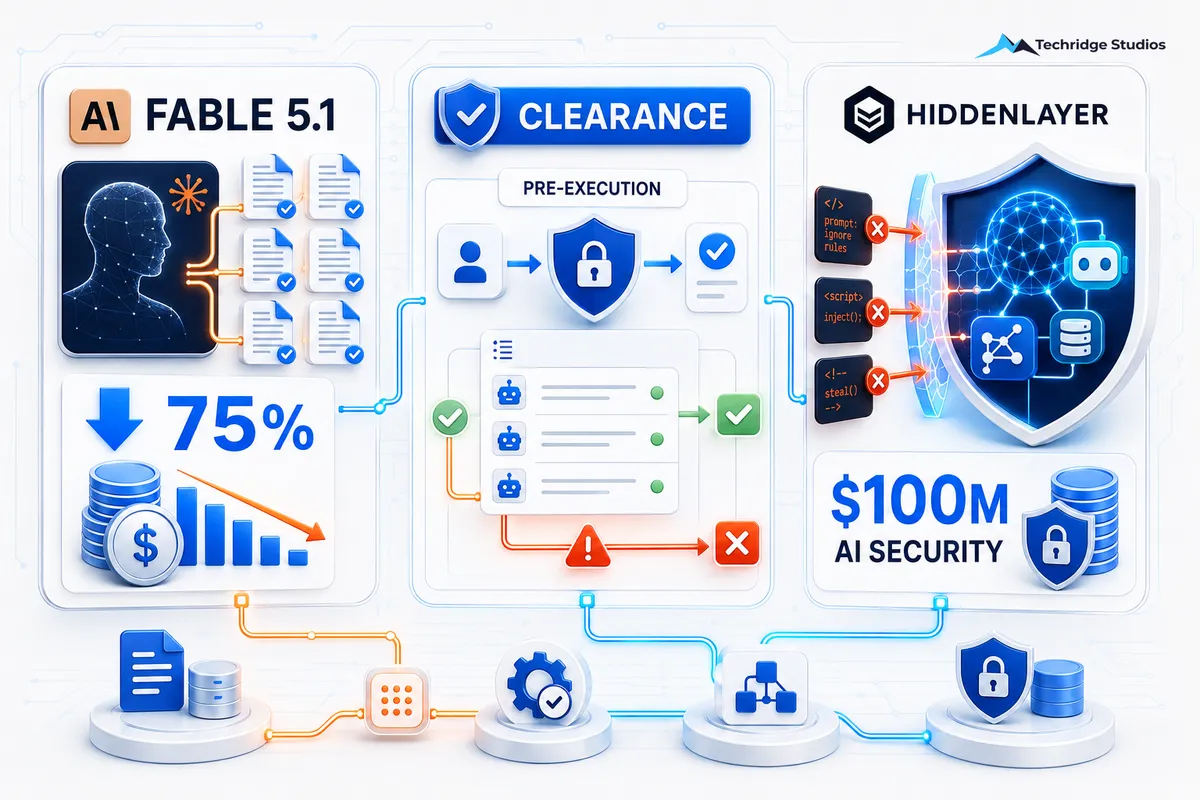
The bigger business story is the pricing move. Anthropic cut prompt cache-read pricing by 75 percent across its API. Prompt caching is the mechanism that lets Claude remember content it has already processed — documents, instructions, prior context — so it does not have to re-read them from scratch on every request. If your business runs any automated Claude workflow, you just got a significant cost reduction without changing a single line of code.
The savings scale with usage. A business running high-volume automated calls — customer support responses, document reviews, internal search — will see materially lower monthly costs starting immediately. If you have not configured prompt caching yet, this is the moment to do it. Setting it up correctly can reduce costs even further than the pricing cut alone.
The broader takeaway is that Anthropic is not treating price reductions as a one-time event. This follows a pattern across the AI industry: as infrastructure costs fall and competition intensifies, the cost of running AI-powered workflows for businesses continues to drop. If your business delayed adopting AI automation because the cost felt prohibitive, that calculation is worth revisiting.
JetStream Clearance Puts a Safety Layer Between Your AI Agents and Your Business Systems
JetStream Security launched Clearance, a reasoning engine that sits between an AI agent and the actions it wants to take. Before the agent does anything — sends a message, deletes a record, writes to a database, calls an external service — Clearance evaluates whether the action is authorized and aligned with the agent's approved design. If the sequence is flagged as dangerous, Clearance blocks it and requires human review before anything executes.
This matters because most businesses deploying AI agents today are relying on post-incident detection: they find out something went wrong by reviewing logs after the fact. An agent that sends an unintended email, overwrites a critical file, or begins exfiltrating data through an approved channel can cause real damage in the time between action and detection. Clearance moves the control point to before execution.
The product is positioned as a zero trust approach to agent governance, applying the same principle to AI agents that modern network security applies to users: trust nothing by default, verify everything before it runs. This is a meaningful shift in how businesses can manage agent behavior at scale, especially as agent fleets grow beyond what any single person can monitor in real time.
For small businesses running agents across tools like HubSpot, Salesforce, ClickUp, or Gmail, Clearance represents a new category of control worth tracking. You may not need it today if you are running one or two tightly scoped automations. But as your agent footprint grows, pre-execution authorization will become as standard as access controls and audit logs.
HiddenLayer Raises $100 Million — AI Security Becomes a Required Business Layer
HiddenLayer, a US security startup focused on protecting AI systems, closed a $100 million funding round. The company develops protections for AI models, agents, and automated workflows against a specific class of threat: adversarial manipulation, including model inversion attacks, prompt injection, and malicious code injection into AI pipelines.
For most small businesses, AI model security has felt like an enterprise concern. That is changing. As AI agents become standard parts of business operations — answering customer questions, processing orders, reading and writing documents, making scheduling decisions — they also become attack surfaces. A compromised AI agent in a customer-facing workflow can cause significant damage before anyone notices, and traditional security tools were not built to detect or prevent these kinds of attacks.
The $100 million raise signals that the market recognizes this risk. When significant capital flows into a security category, it typically means two things: the threat is validated at scale, and the tools to address it will become more accessible and more affordable over the next 12 to 18 months. HiddenLayer's growth trajectory suggests this will follow the same pattern as endpoint security and cloud security before it.
The practical step today is not to buy an enterprise AI security platform. It is to ask your AI tool vendors a direct question: what protections do they have in place against model manipulation and prompt injection? If they cannot give you a clear answer, that is a signal. And if you are building any custom AI integrations, this is the moment to review whether your inputs are sanitized and whether your agent has access to more of your systems than it actually needs.
What This Means for Your Business
Today's three stories point in one direction: AI is becoming cheaper, more powerful, and more consequential for business operations at the same time. That combination is good news if you have governance in place, and a growing liability if you do not.
The single most important action you can take today is to audit your AI tool stack. Know what workflows are running Claude (and take advantage of the new cache pricing). Know what permissions your AI agents hold and what actions they can take without a human review step. And ask the vendors you trust with AI access what their security posture actually looks like. The businesses getting the most value from AI in the next 12 months are the ones building those guardrails now, before they need them.
Sources
Anthropic Newsroom — https://www.anthropic.com/news
Yahoo Finance / JetStream — https://finance.yahoo.com/technology/ai/articles/jetstream-announces-clearance-ai-zero-170000815.html
TechCrunch / HiddenLayer — https://techcrunch.com/2026/09/02/hiddenlayer-nabs-100m-as-enterprises-rush-to-secure-their-ai-deployments/