AI Compliance, Cheaper Models, and a Spending Reality Check
Three stories landed today that, taken together, say the same thing: AI is no longer a future concern for small businesses. It's a current one — with cost curves shifting, regulations arriving, and spending gaps revealing who's moving and who's watching.
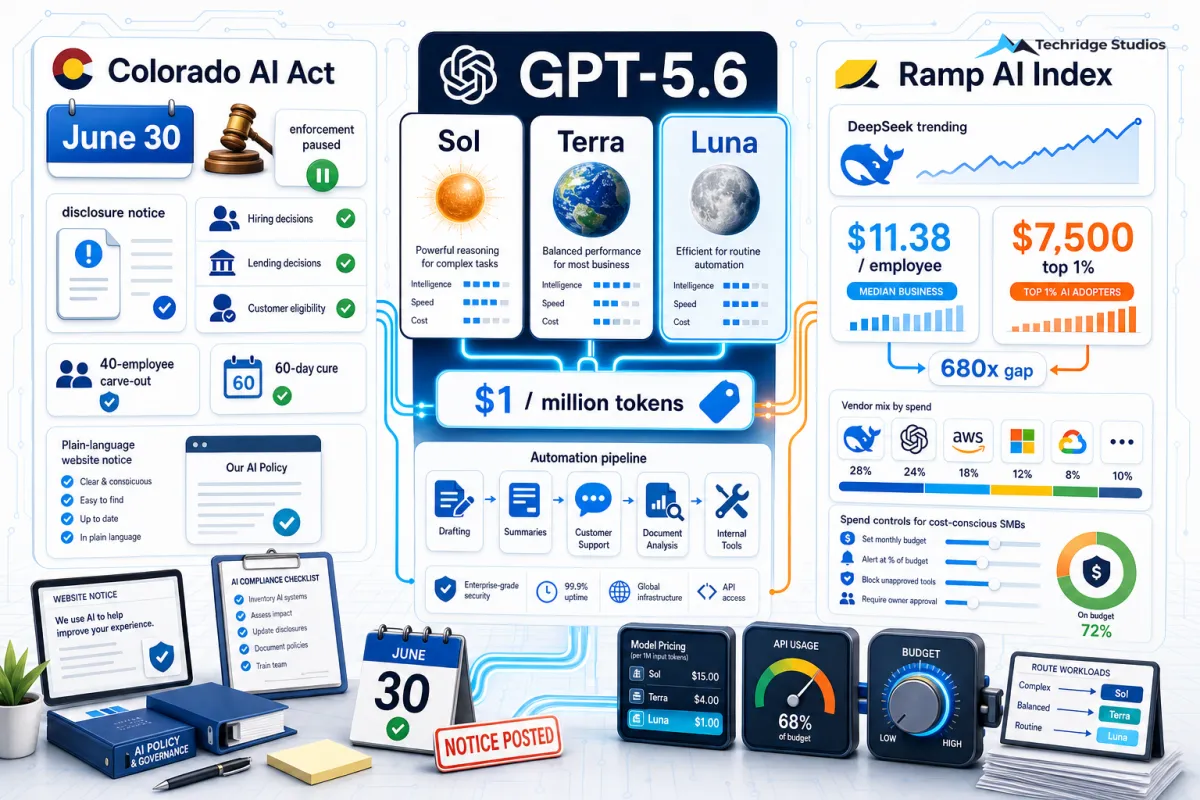
Colorado's AI Act Is on the Books Tomorrow — Here's What Small Businesses Should Do Today
Colorado's original Artificial Intelligence Act (Senate Bill 24-205) takes effect June 30, 2026. That's tomorrow. If your business uses automated decision-making technology to assist in consequential decisions — hiring, loan eligibility, customer pricing, healthcare intake, or residential real estate — you are potentially in scope of this law, and the deadline is real.
The enforcement picture is more complicated than the calendar suggests. In April 2026, the Colorado Attorney General agreed in a federal court filing not to enforce the act or investigate alleged violations while the ongoing legal challenge plays out. The lawsuit was filed by xAI, with the U.S. Department of Justice intervening in support. That agreement provides practical protection for now. But it does not eliminate the law — the original statute is on the books through December 31, 2026.
A replacement law changes the landscape starting January 1, 2027. Governor Polis signed Senate Bill 26-189 on May 14, 2026, in a bipartisan 34-1 Senate vote. The new framework repeals the old one and replaces it with five concrete duties: a plain-language pre-use notice wherever AI assists a decision; a 30-day adverse-outcome notice when AI contributes to a denial or unfavorable result; a meaningful human review process for those adverse outcomes; a way for consumers to access and correct the data the AI used; and three years of records documenting compliance. The old law's open-ended "reasonable care" standard is gone. Mandatory impact assessments are gone. A 40-employee carve-out reduces the burden on the smallest teams. A 60-day right to cure gives businesses a window to fix issues before formal enforcement begins.
The single most effective thing a Colorado small business can do today is post a plain-language disclosure notice on any website page where AI influences a decision about a person. A hiring application. A loan intake form. A customer eligibility tool. The notice does not need to be long. It needs to clearly say that AI is used in the decisions made on that page and how a person can ask for more information. That covers the disclosure duty under both the old and new laws, and it is the first thing a regulator will look for.
If you operate outside Colorado but serve Colorado residents through an online product or platform, you may still be in scope. Any business that uses AI to make or influence consequential decisions affecting people in Colorado should treat this compliance window as the floor, not the ceiling — more states are watching Colorado closely.
OpenAI Launches GPT-5.6 in Three Tiers, Cutting the Cost of Business Automation
OpenAI announced the GPT-5.6 model family on June 26, 2026, making three model tiers available in a limited preview to approximately 20 government-vetted partner organizations. The models — Sol, Terra, and Luna — are designed around distinct use cases and price points, with broader general availability expected within weeks.
Sol is the flagship tier, designed for the hardest problems: complex coding, security research, and long-horizon reasoning tasks. It is priced at $5 per million input tokens and $30 per million output tokens — expensive relative to prior tiers but targeted at tasks that demand that level of capability. Terra is the business-task tier: customer support automation, document analysis, internal tooling, and high-volume processing. Priced at $2.50 input and $15 output per million tokens, it is roughly price-competitive with GPT-5.5 while offering improved performance. Luna is the everyday automation tier: drafting, summarization, email response, form processing, and routine task automation. At $1 per million input tokens and $6 per million output tokens, Luna represents the most affordable OpenAI model in the company's history and a meaningful reduction versus the prior generation.
For small businesses, the relevant number is Luna's pricing. At $1 per million input tokens, a business processing several thousand customer emails or documents per month through an AI layer would spend less than a dollar in raw model costs. The practical floor for building a simple AI automation workflow — email triage, first-draft responses, intake form processing — just dropped. The broader rollout in the coming weeks means this is the right time to identify one workflow to automate before pricing locks in at current levels.
The context around the limited preview is worth understanding. OpenAI shared the GPT-5.6 family with the U.S. government before the public release as part of an ongoing coordination arrangement, and the initial 20-organization preview is a function of that process, not a production-readiness issue. The models are expected to behave broadly as described in the preview documentation. Small businesses should expect Terra and Luna to be the workhorses once available — Sol is a specialized tool most SMBs will not need or be able to cost-justify for typical workflows.
Ramp's June AI Index: DeepSeek Tops US Corporate Spending, and the Median Firm Is Barely in the Game
Ramp's June 2026 AI Index draws on real transaction data from more than 50,000 US businesses that use Ramp's expense platform. It is one of the most reliable signals available on what companies are actually spending — not what they say they plan to spend. Two findings from the June index are worth sitting with.
First: DeepSeek topped the trending vendor list. This is notable for two reasons. DeepSeek's open-source models have been available for months, and many developer teams have been self-hosting them to avoid sending data to the company's infrastructure. The June data shows something different — US businesses are now making direct payments to DeepSeek as a provider. That is a behavioral shift. It means DeepSeek is moving from a developer tool to a business procurement decision, which carries different implications for data governance and vendor review than self-hosting does. If your team is using DeepSeek via direct API access and your business handles sensitive customer data, this is the moment to confirm that your vendor review and data-handling policies cover this relationship.
Second: the spending gap. The median US business on Ramp's platform spends $11.38 per employee per month on AI tools. The top 1 percent of companies spend $7,500 per employee per month. That is a 680-fold gap between where most businesses are and where the most AI-aggressive companies operate. To be clear, the top 1 percent number reflects companies with large, specialized AI infrastructure and research functions — it is not a target for most small businesses. But the median of $11.38 is a useful floor benchmark. If your business is spending meaningfully less than that per person, you are likely underutilizing the tools available to you. If you are spending more, you should be able to articulate what you are getting for it.
Ramp's data also shows Anthropic at 41 percent adoption among US businesses with paid AI subscriptions — the highest of any provider. That figure reflects Claude's strong positioning in enterprise and mid-market workflows, and it aligns with the broader trend of businesses paying for AI tools rather than relying on free tiers.
What This Means for Your Business
Three distinct developments today — compliance, pricing, and spending data — all point to the same underlying shift: AI has moved from optional experimentation to baseline infrastructure for competitive businesses. The compliance question is no longer if AI will be regulated but how, and the Colorado model is the most concrete preview available. The pricing question is shifting from expensive to accessible, and the GPT-5.6 launch is the clearest signal yet of where the floor is heading. The spending question is about where your business stands relative to peers — and $11.38 per employee per month is now the median, not the leading edge.
The one action that covers all three today: open a document, list every AI tool your business pays for or uses for free, note which employee decisions or customer interactions each one touches, and confirm you have a disclosure in place where needed. That inventory is the foundation of a compliance posture, a cost review, and a spending audit all in one.
Sources
Available Law — https://availablelaw.com/blog/colorado-ai-act-rewrite-2026-smb-impact
The Decoder / Ramp — https://the-decoder.com/deepseek-topped-ramps-trending-software-vendors-in-june-2026-as-us-companies-chase-cheaper-ai/