AI Costs, a Weak Jobs Report, and Agents That Work Without You
Managing AI just shifted from figuring it out to budgeting and governing it. Two stories published this week show that AI is now affecting your payroll and your invoices. A third shows that the tools themselves are starting to run your operations without you.
Tesla's $200 Weekly Cap Signals the End of Unlimited AI Spending
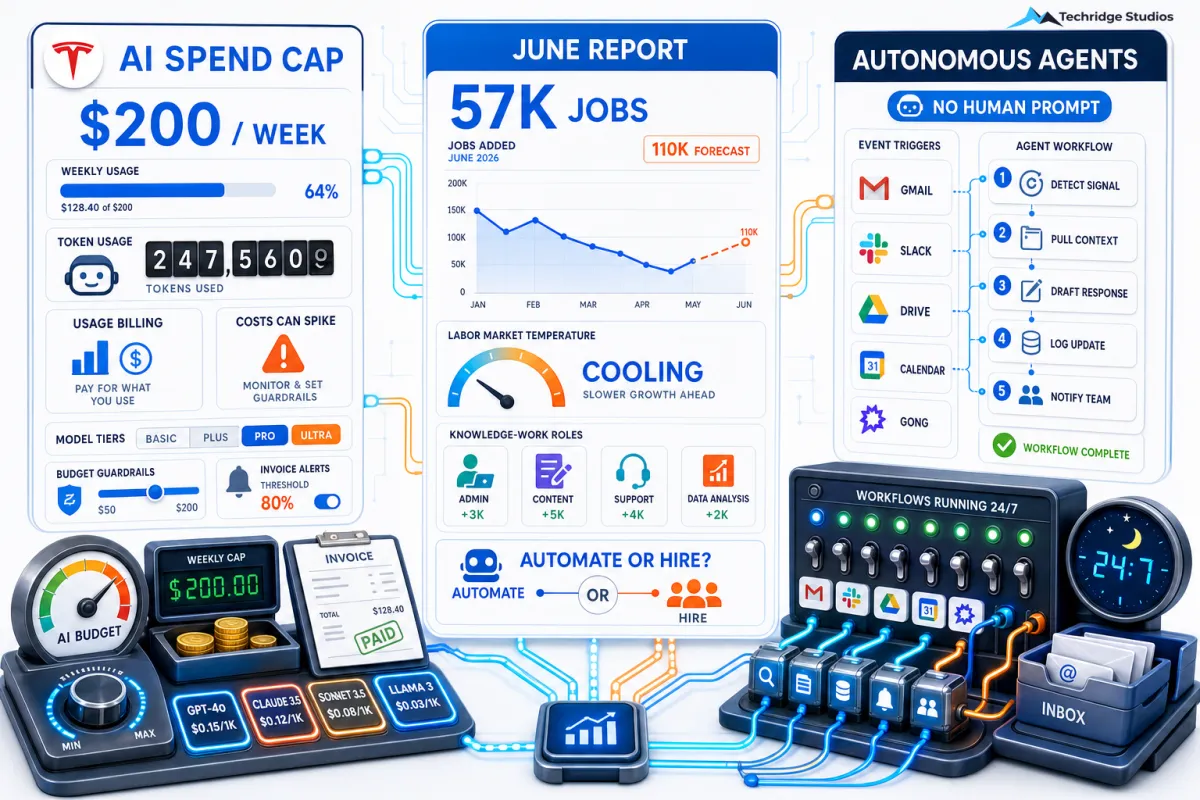
Tesla announced this week that it will cap employee AI tool spending at $ 200 per week, effective July 6, 2026. According to The Information, software engineers had been consuming thousands of dollars per week in token costs under usage-based pricing. Some internal teams even built dashboards ranking employees by token consumption to encourage adoption — until the bills arrived and management stepped in.
The carve-out in the policy is worth noting. Tesla's limit excludes beta versions of xAI products — the AI company founded by Elon Musk. That exemption tells employees which tools management wants them to use and tells the rest of the market how AI platform wars will increasingly play out: not through feature competition, but through billing policy.
Tesla is not alone in this situation. Uber burned through its entire 2026 AI budget by April, months ahead of schedule. Meta, Amazon, and Walmart have all implemented spending caps or pushed teams toward cheaper model tiers after token-based billing exposed them to costs that flat-rate subscriptions had previously hidden.
For small businesses, the lesson is straightforward: treat AI tool costs the way you treat cloud storage. Find out which tools on your team are billed by usage. Set a monthly cap per tool or per person. Check the bill weekly. Any tool consuming more than ten percent of your monthly software budget without a clear, measurable output deserves a second look.
June 2026 Jobs Report: 57,000 Jobs — What It Means for Your Hiring
The Bureau of Labor Statistics reported that US employers added just 57,000 jobs in June 2026 — well below forecasts ranging from 110,000 to 185,000 depending on the estimate. The unemployment rate edged down slightly to 4.2 percent, but the underlying picture is more concerning for knowledge workers.
The technology and finance sectors — which have the highest AI adoption rates among knowledge industries — are now losing an average of 28,000 jobs per month, according to government payroll data. Top executives at JPMorgan Chase, Citigroup, and Goldman Sachs have all publicly cited AI as a driver of workforce reduction. The displacement is concentrated in roles that AI handles most readily: administrative coordination, entry-level content production, customer correspondence, and routine data analysis.
For small businesses, this data is both a warning and an opportunity. If AI is eliminating these roles at large organizations, it will reach equivalent tasks at smaller businesses in the same cycle. The window to decide whether to automate a role or strengthen it with AI assistance is getting shorter.
The practical step today is simple: identify one repetitive, information-heavy task on your team — something that involves sorting, summarizing, drafting, or routing — and evaluate whether an AI tool handles it reliably. If the answer is yes, that evaluation should happen before you post a job to fill that role.
Writer Launches Autonomous AI Agents That Work Without Being Asked
Writer, the enterprise AI platform backed by Salesforce Ventures and Adobe Ventures, launched event-based triggers for its Writer Agent platform in July 2026. The new capability allows AI agents to detect business signals across Gmail, Gong, Google Calendar, Google Drive, Microsoft SharePoint, and Slack — and automatically execute complex, multi-step workflows without any human intervention.
This is a meaningful shift in how AI operates inside businesses. Most AI tools in use today are reactive: you prompt, they respond. What Writer is building — and what several enterprise AI platforms are now racing toward — is proactive automation. The agent watches your business data, identifies a signal, and executes the next action without anyone asking.
The governance additions included in this release matter too. Bring-your-own encryption keys and a Datadog observability plugin are not features most small businesses will use on day one — but they signal where this market is heading. Autonomous agents handling business data will require accountability trails. The companies building these products know that, and they are building compliance in from the start.
For small businesses, the immediate opportunity is simpler than the enterprise version. Identify one workflow that starts with a trigger event — a form submission, a new email from a customer, a meeting that just ended — and ask whether an AI agent could handle the first three steps without you. Tools like Zapier, Make, and now Writer are making this possible today without a developer on staff.
What This Means for Your Business
This week's three stories share a common throughline: AI is no longer a capability you adopt at your own pace. It is a cost you manage, a workforce shift you plan for, and a system that increasingly operates without you.
The single most useful thing you can do today: open your AI tool subscriptions and identify which ones bill by usage rather than a flat rate. That check takes fifteen minutes and could prevent a significant surprise on next month's credit card statement.
Sources
The Information / Electrek — https://electrek.co/2026/07/02/tesla-caps-employee-ai-spending-200-week/
Robert Half — https://www.roberthalf.com/us/en/insights/research/june-2026-jobs-report-employers-add-57000-jobs