The Week AI Costs Fell Off a Cliff
Three major releases landed this week, each cutting the cost of running AI in your business by a significant margin. Whether you pay for an AI agent platform, use AI in your code editor, or manage an agent workflow, something changed this week.
Writer Palmyra X6 Cuts Agent Costs in Half
Running AI agents in production has always had a dirty secret: the token costs add up fast. A single automated workflow can burn through thousands of tokens per run, and when you are running dozens or hundreds of them daily, the bill gets serious.
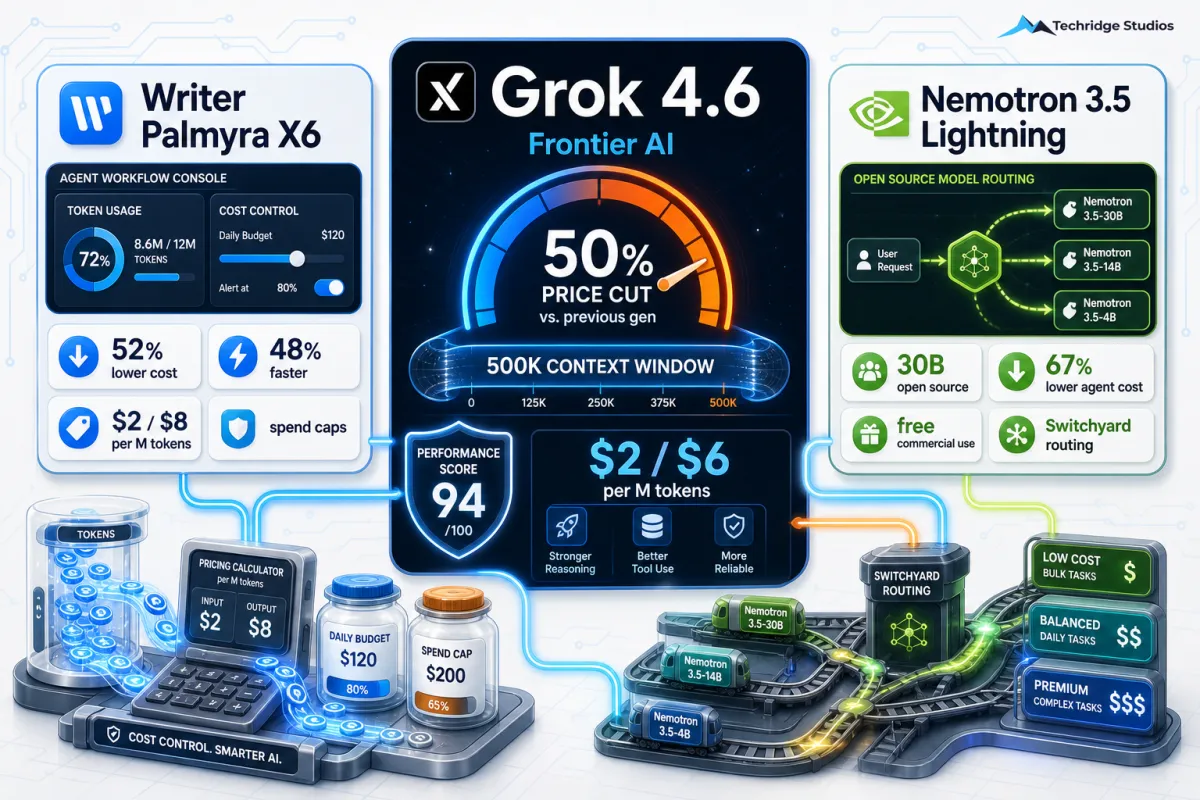
Writer addressed that directly on August 13th with the launch of Palmyra X6, the company's new flagship model, alongside major upgrades to its agent platform. The headline number is a 52 percent reduction in cost per workflow — but the speed improvement is just as notable. Tasks now run 48 percent faster, which means your AI agents are not just cheaper to run but more responsive.
At 2 dollars per million input tokens and 8 dollars per million output tokens, Palmyra X6 positions itself well below competitors like Claude Opus 4.8 and GPT-5.5. The platform now also includes governance tools that enable administrators to track usage and manage token spend across teams.
If you are running any kind of marketing automation, revenue workflow, or customer-facing AI agent, this pricing shift matters. The threshold where AI workflows become economically viable just moved. You can do more work per dollar than you could a week ago.
Grok 4.6 Lands at Frontier Performance for Half the Price
xAI released Grok 4.6 on August 12th, roughly five weeks after Grok 4.5. The model is not a new architecture — it is the same 1.5-trillion-parameter V9 foundation — but a significant improvement in training quality has pushed benchmark scores meaningfully higher. On the Artificial Analysis Intelligence Index, Grok 4.6 now scores 61, matching OpenAI's GPT-5.6 Sol and sitting just one point behind Anthropic's Claude Fable 5.
The pricing is where it gets interesting for small businesses. At 2 dollars per million input tokens and 6 dollars per million output tokens, Grok 4.6 is roughly half the cost of GPT-5.6 Sol and a fraction of Claude Fable 5 pricing. For businesses building applications or running agent workflows, this means frontier-grade intelligence is now accessible without a massive API budget.
The model is live now in Cursor, Grok Build, the xAI API, OpenRouter, Vercel, and Cloudflare. The context window is 500,000 tokens. If you are currently paying for a premium model but not using its full range of capabilities, Grok 4.6 is worth benchmarking against your specific use case.
Nvidia's Free Routing Model Drops Agent Costs to One-Third
On August 11th, Nvidia released two things at once: Nemotron 3.5 Lightning, a 30-billion-parameter open-source model free for commercial use, and NeMo Switchyard, an open-source routing library that automatically routes each step of an agent workflow to the most cost-efficient model available.
The results are striking. In Nvidia's internal benchmarks, Switchyard maintains frontier accuracy while reducing task cost to roughly one-third of what businesses pay when routing everything through a premium model like Opus 4.8. In real-world deployments, Ramp cut AI costs 58 percent and runtime 33 percent. Cognition cut mean cost 28 percent.
What makes this relevant for small businesses is that it is free. Nemotron 3.5 Lightning is available on Hugging Face, ModelScope, OpenRouter, and build.nvidia.com. NeMo Switchyard is open source on GitHub. Neither requires a paid subscription. If you or your developer is managing AI agent workflows, this is worth evaluating as a way to stretch your current AI budget further without sacrificing output quality.
What This Means for Your Business
This week's releases tell a clear story: the cost of running AI in your business is falling faster than most people expected. Writer, xAI, and Nvidia each came at it from a different angle — a better agent platform, a cheaper frontier model, and a free routing layer — but the direction is the same.
The immediate action is straightforward: if you are paying for any AI tool or API on a monthly basis, compare your current per-task cost against these new options. You may find that switching or layering in one of these tools cuts your AI spend meaningfully without changing your output.
Sources
TechCrunch — https://techcrunch.com/2026/08/13/writer-introduces-new-ai-model-and-upgraded-harness-to-contain-token-costs/