AI Is Cutting Jobs, Threatening Businesses, and Breaking Budgets
Three stories dropped this week that capture exactly where AI stands right now for small businesses: it is displacing workers at scale, enabling new classes of cyberattacks, and costing even the largest enterprises more than they planned. Each story includes a direct action item for every business owner watching AI develop.
Oracle Named AI in Its Regulatory Filing — and the Business World Is Taking Note
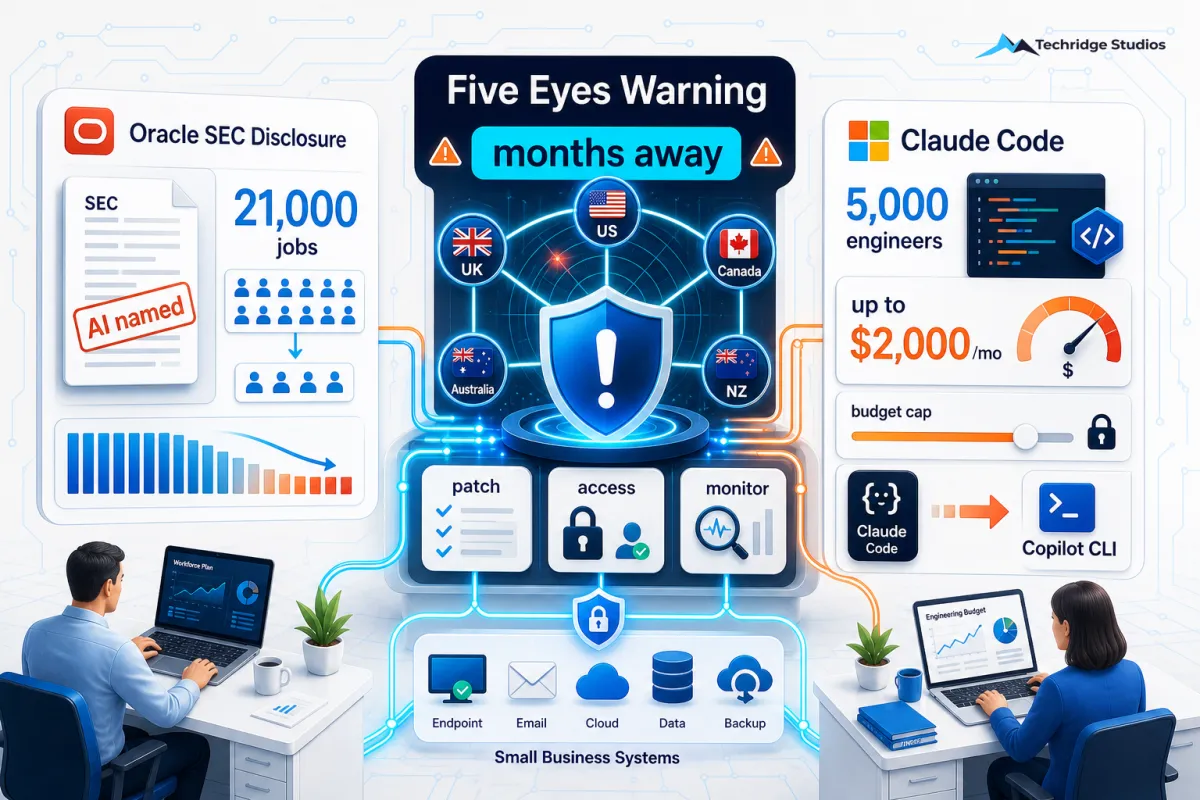
Oracle's global workforce fell by 21,000 people in fiscal 2026, dropping from approximately 162,000 to 141,000 full-time employees. That is a 13 percent reduction in one year. The number alone is significant — but what makes this story different is where Oracle disclosed the reason.
In its annual regulatory filing with the US Securities and Exchange Commission, Oracle stated that "the adoption and deployment of AI technologies across our operations have resulted, and may continue to result, in reductions to our workforce." That sentence, placed inside a document that carries legal weight with investors and regulators, is the first time a company of Oracle's scale has put this claim formally on the record. It is not a quote from an earnings call. It is not a press release. It is a disclosure filed with a federal agency.
The deepest cuts were in Oracle Health, the division built on Oracle's $ 28.3 billion acquisition of the electronic health records company Cerner. Between 8,000 and 10,000 employees lost jobs in that division alone. Oracle spent $ 1.84 billion on restructuring in fiscal 2026 — nearly five times as much as the year before — and has signaled that additional cuts may follow.
TechCrunch is now maintaining a running list of major employers who have formally cited AI as a factor in layoffs. The list already includes Block, Amazon, Salesforce, Cloudflare, and GitLab. Oracle's filing moves this from a trend companies talk about to a trend that is now entering the regulatory record. For small business owners, the question to answer is not whether AI will change the roles on your team — it is which roles, on what timeline, and what that means for how you hire and train today.
Five Eyes Intelligence Agencies Issue Urgent AI Cybersecurity Warning
On June 23rd, 2026, the Five Eyes intelligence alliance — the US, UK, Canada, Australia, and New Zealand — issued a rare joint warning directed at businesses and government leaders: AI-powered cyberattacks capable of overwhelming their defenses are not a future concern. They are months away.
The warning came from the highest levels of the intelligence community. The agencies described AI models that can independently identify vulnerabilities in business systems, generate working exploits, and deploy attacks faster than conventional security tools can detect or respond. The assessment is based on observed capabilities in classified threat environments, and the agencies say the commercial availability of frontier AI models is accelerating the timeline for adversaries to reach this capability.
Small and medium-sized businesses received specific attention in the warning. Intelligence officials described SMBs as "sitting ducks" if they have underinvested in security infrastructure — a characterization that applies to a large share of businesses with fewer than 200 employees that have not updated their security policies since deploying AI tools. The problem is compounded by the fact that many AI tools now have direct access to business data, customer records, and financial systems — creating a broader attack surface than most SMBs have planned for.
The recommended actions from the Five Eyes agencies are clear and actionable. Patch and update all software and operating systems now — do not defer routine updates. Limit who has access to critical systems, and review those permissions regularly. Monitor for unusual behavior in your accounts and tools. If you are using AI tools that connect to business data, audit what those tools can access and ensure connections are locked down with strong authentication. These steps will not make a business invulnerable, but they close the easiest doors that AI-assisted attackers exploit first.
Microsoft's Claude Code Cost Crisis — A Warning for Every Business Using AI Tools
Microsoft deployed Claude Code — an AI coding assistant — to 5,000 engineers across its Experiences and Devices division, the team responsible for Windows, Microsoft 365, Outlook, Teams, and Surface. The rollout appeared to be a success: usage climbed to between 84 and 95 percent among engineers by April 2026. The tools worked. Engineers used them constantly.
That was the problem. Monthly per-engineer API costs ranged from 500 to 2,000 dollars — costs that outpaced the value of fixed subscription arrangements and grew unpredictably as usage increased. Microsoft is now canceling the majority of those licenses by June 30th, 2026, directing engineers to migrate to GitHub Copilot CLI, a tool Microsoft controls directly. The official reason is toolchain consolidation. The underlying reason is cost.
Microsoft is not alone. Uber's chief technology officer disclosed that the company burned through its entire planned 2026 AI coding budget in four months after Claude Code usage jumped from 32 percent to 84 percent of its engineering team. The pattern is consistent: AI coding tools are good enough that engineers use them all the time. That level of use is what makes the unit economics fail at current token pricing.
For small businesses, this story is not about Microsoft's internal decisions. It is a cost signal. If a company with Microsoft's procurement power and engineering resources could not manage the costs of AI coding tools at scale without hitting a budget wall, any business deploying AI tools needs to plan for the same dynamic. The tools work. People will use them. Set hard monthly spending caps before you deploy — and build review checkpoints into your AI stack so you see cost trends before they become budget problems.
What This Means for Your Business
These three stories share a common thread: AI has moved past the pilot phase and into territory with real financial, legal, and security consequences. Oracle's regulatory disclosure means AI workforce changes are now part of the public record. The Five Eyes warning means AI-enabled threats to business systems are no longer theoretical. Microsoft's cost problem means even the best-resourced organizations are working through the economics of AI tool deployment in real time.
The single most useful action any small business owner can take this week is to sit down with these three questions: Which roles in my business are AI tools already affecting, and do I have a clear policy for that? Have I updated software, reviewed system access, and audited which AI tools connect to sensitive business data? And do I have monthly spending caps in place for every AI tool subscription or API I am running?
Those three questions cover the workforce, security, and cost angles that this week's stories represent. Answering them puts you ahead of most small-business owners who still treat AI as a future problem.
Sources
TechSpot — https://www.techspot.com/news/112864-oracle-cuts-21000-jobs-admits-ai-reducing-workforce.html
The Next Web — https://thenextweb.com/news/microsoft-claude-code-retreat-ai-cost