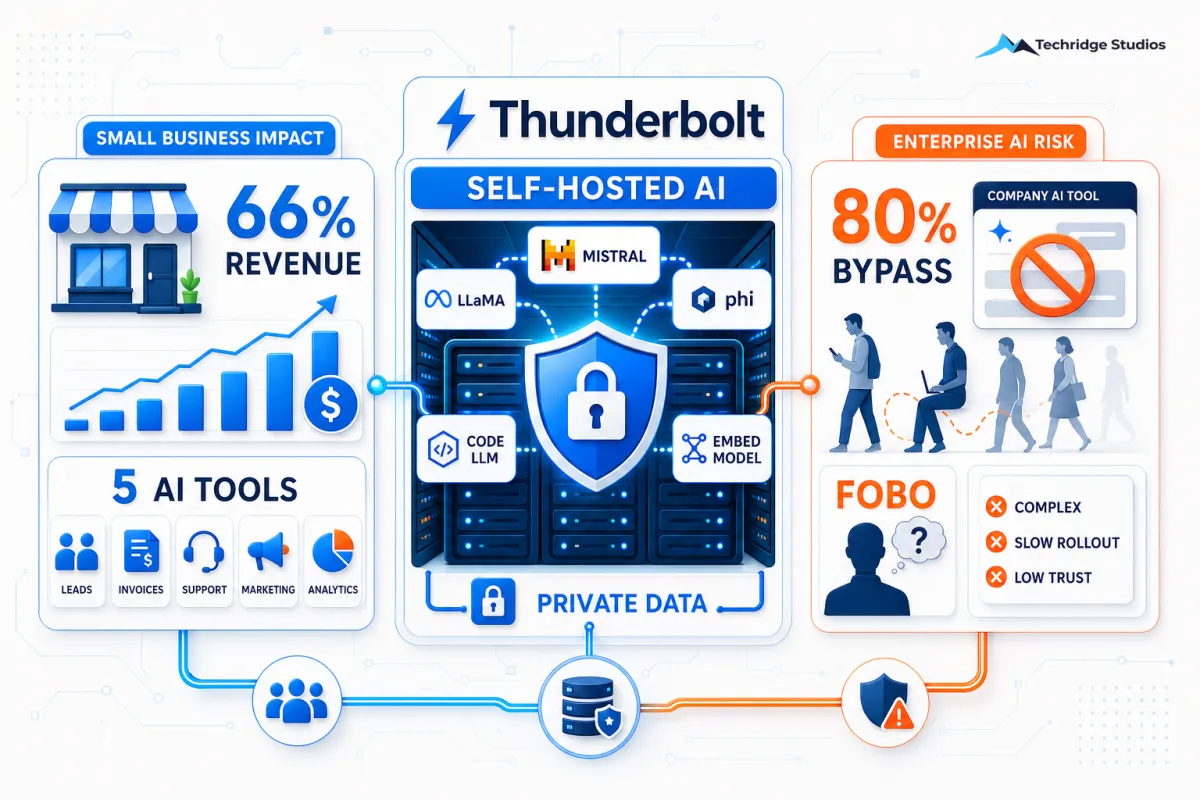
Data Control, Real Revenue Gains, and the Team Revolt
Three stories are shaping the AI landscape for small businesses today. They all point to the same truth: the businesses that will win with AI are not the ones with the biggest budgets. They're the ones who plan deliberately, act fast, and bring their teams along.
Mozilla Launches Thunderbolt — A Self-Hosted AI Option That Keeps Your Data Private
On April 16, Mozilla's for-profit arm, MZLA Technologies, released Thunderbolt. It's an open-source AI workspace that businesses can run on their own servers. The platform connects to multiple AI models — including commercial and open-source options — and integrates with company data through deepset's Haystack framework. It runs on Windows, macOS, Linux, iOS, and Android.
Most SMBs using AI today are running their data through platforms like Microsoft Copilot or ChatGPT Enterprise. That raises legitimate questions about data privacy, vendor lock-in, and long-term cost. Thunderbolt is a direct answer. It's open-source under the MPL 2.0 license, which means no proprietary lock-in. And because it runs on your own infrastructure, your business data never touches anyone else's servers.
If your business handles sensitive client data — legal, financial, health, or otherwise — Thunderbolt is worth evaluating now. Start by visiting Mozilla's GitHub to review the documentation. Compare it against your current AI tool's data processing agreement. If data privacy has been the main blocker, this may remove it.
New Data: Small Businesses Using AI Are Seeing Real Revenue Gains
The Small Business & Entrepreneurship Council published new findings on April 16. The numbers are concrete: 82% of small business employers have adopted at least one AI tool, and 66% of those businesses report AI-linked revenue increases. The typical small business is now running five different AI tools across their operations. Time savings are measurable too — a median of 5 hours per week for the owner and 11.5 hours per week across the team. 93% of small businesses plan to keep investing in AI, with 62% planning to increase that investment.
This matters because the discussion around AI has spent too much time on potential and not enough time on proof. The SBE Council data shows proof. Small businesses that committed to AI early are saving real time and generating real revenue. Those still in "wait and see" mode are not just missing out — they're falling behind businesses that are now running leaner and faster.
Pick one AI tool this week and track one concrete metric for 30 days. Time saved, leads generated, or support tickets resolved. Give it a number. That's how you move from "trying AI" to building a real advantage.
80% of Workers Are Bypassing Your AI Tools — And You Need to Know Why
Fortune reported on April 15 that 80% of enterprise workers are actively avoiding or bypassing company AI tools. The driver isn't confusion or lack of access — it's FOBO: the fear of becoming obsolete. Survey data found 44% of Gen Z workers have admitted to actively sabotaging their company's AI strategy. Among senior workers, the resistance comes from a different place: years of built expertise they're not willing to hand over to a machine.
If you're investing in AI tools and your team isn't using them, you're not getting any return. The resistance isn't coming from ignorance. It's coming from fear. That's a management challenge, not a technology one.
Before your next AI rollout, have a direct conversation with your team about what the tool will and won't change about their roles. Show specific examples of how AI makes their job easier — not how it replaces them. People adopt tools they see as allies. Build that trust before you deploy.
What This Means for Your Business
Today's three stories share a common thread: AI adoption is a human problem as much as a technology one. Mozilla's Thunderbolt addresses the teams whose privacy concerns have stalled adoption. The SBE Council data shows the revenue gap between early adopters and everyone else is real and widening. The worker resistance problem is rooted in fear that leadership hasn't directly confronted.
The businesses that close these gaps fastest will own the next two to three years.
Sources
The Register — https://www.theregister.com/2026/04/16/mozilla_thunderbolt_enterprise_ai_client/
Small Business & Entrepreneurship Council — https://sbecouncil.org/2026/04/16/ai-and-entrepreneurship-opportunities-and-solutions/
Fortune — https://fortune.com/2026/04/15/ben-horowitz-a16z-ai-anxiety-founders-workers-different-fears/