Free Tools, Affordable Video, and New Chatbot Laws You Need to Know
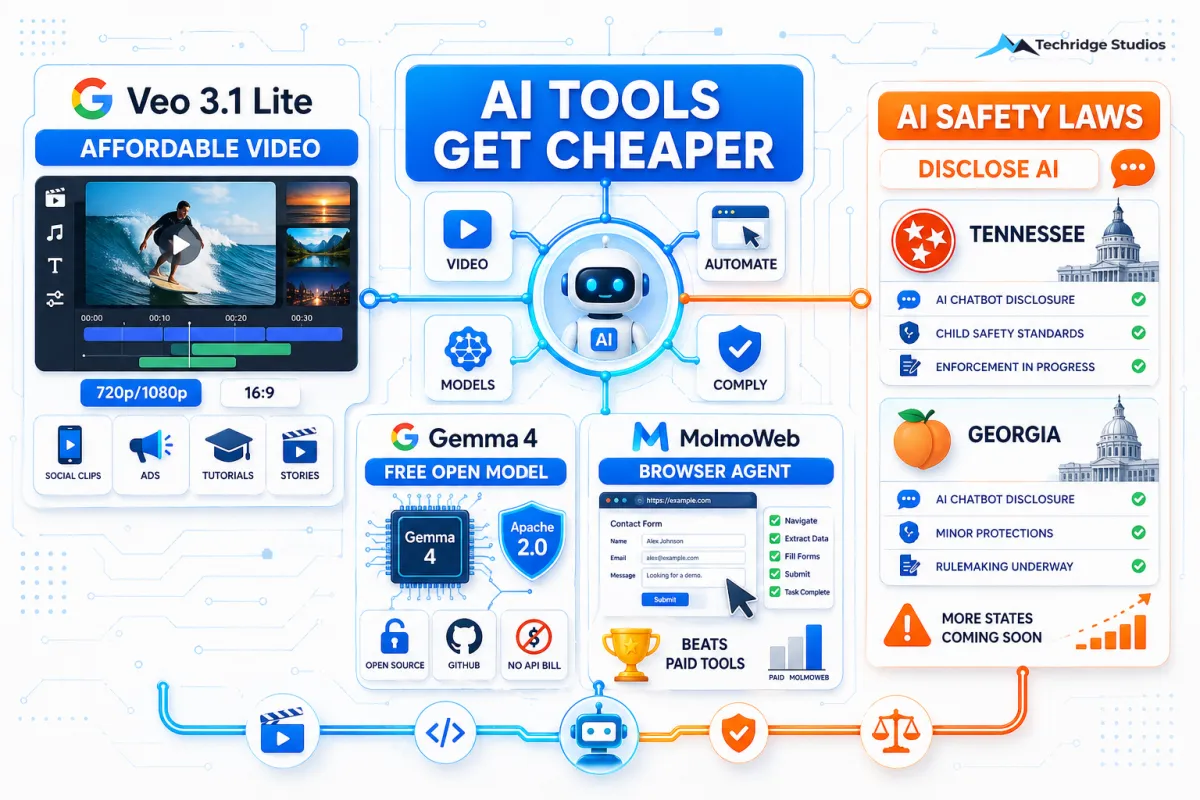
April 3, 2026 delivered four AI stories that matter to small business owners. Google released two new tools — one affordable, one completely free. The Allen Institute dropped a browser automation agent that beats every paid competitor. And state-level AI laws moved fast, with real compliance deadlines now in view.
Google Veo 3.1 Lite Brings Professional Video Within Reach
Google launched Veo 3.1 Lite, a video generation tool built specifically for high-volume, cost-effective production. It outputs at 720p and 1080p resolution, making it viable for real marketing use — not just demos.
For small businesses, the significance is straightforward. Professional video has always required a production budget, a crew, or a lot of your own time. Veo 3.1 Lite shifts that equation. You can now generate clean, usable video content at a fraction of the traditional cost.
This is not a replacement for high-end brand production. But for social content, product explainers, or regular video marketing? It is a serious option worth testing now.
If you have been waiting for AI video to be good enough and cheap enough at the same time, that moment may have arrived.
Google Gemma 4 Is Free and More Capable Than It Has Any Right to Be
Google released Gemma 4 under an Apache 2.0 open-source license, which means anyone can download, run, and build with it at no cost. Google describes it as offering "unprecedented intelligence per parameter" — and given that previous Gemma versions crossed 400 million developer downloads, this release carries real weight.
The practical upside for small businesses is access. You no longer need to pay for an enterprise AI API to get enterprise-level AI performance. Gemma 4 is available through open APIs and GitHub, which means a developer — or an AI-savvy operator — can integrate it into your workflow without ongoing subscription costs.
This matters most for businesses that have been priced out of AI tools or are looking to reduce dependency on per-call API billing. Gemma 4 gives you a capable, vetted model with no ongoing licensing fees.
It is also worth noting the track record. Gemma is not an unknown quantity. Four hundred million downloads across prior versions means there is a strong developer ecosystem around it already.
MolmoWeb Gives Small Businesses Free Browser Automation That Actually Works
The Allen Institute released MolmoWeb, an open-source AI agent that can navigate web browsers and complete tasks on its own. It does not just simulate clicks — it understands what it is looking at and acts accordingly.
The benchmark results are the headline. MolmoWeb outperformed paid, proprietary browser automation tools across every major test. That is a significant claim, and it holds up in the published data.
For small businesses, this means hands-free web automation is no longer something you pay for. Tasks like filling out forms, pulling information from websites, monitoring competitor pricing, or managing repetitive browser-based workflows can now be handled by a free, open tool.
The barrier to entry is still technical — you will need someone comfortable setting it up. But for businesses already exploring automation, MolmoWeb deserves a serious look before you renew any paid tool doing the same job.
State AI Chatbot Laws Are Moving Fast — and the Deadlines Are Real
Tennessee Governor Bill Lee signed SB 1580 into law, making it illegal for AI systems to pose as qualified mental health professionals. This is a targeted but clear signal: states are no longer waiting for federal guidance.
Georgia is right behind. Three AI bills are currently sitting on the governor's desk, covering chatbot disclosure requirements and child safety, with an April 6 legislative deadline. That is not a hypothetical future date — it is this week.
For any business using an AI chatbot to handle customer interactions, this matters now. The core requirement being pushed across multiple states is disclosure: customers must know when they are interacting with AI, not a human.
Getting compliant does not need to be complicated. Review how your AI tools are positioned to customers. Add a clear disclosure if one is not already in place. Check whether your chatbot vendor has built-in compliance settings.
Watch this space closely. A dozen AI-related bills are active across the country this month alone, and the pace is not slowing down.
What This Means for Your Business
Today's stories point in two directions at once. On one side, AI tools are getting more capable and more affordable — in some cases, completely free. On the other side, using those tools with customers comes with growing legal responsibility.
The businesses that come out ahead will do both: use the new tools aggressively to cut costs and improve output, and stay current on compliance so they do not get caught off guard by a state law they did not know was coming.
Start with one action today. Pick the tool most relevant to your current workflow — Veo 3.1 Lite, Gemma 4, or MolmoWeb — and run a test. Then spend 15 minutes reviewing how your AI chatbot introduces itself to customers.
Sources
FutureTech AI Marketing — https://blog.tahababa.com/2026/04/april-3-2026-ai-news-roundup-market.html
Radical Data Science (April 2026 Bulletin) — https://radicaldatascience.wordpress.com/2026/04/02/ai-news-briefs-bulletin-board-for-april-2026/
Transparency Coalition — https://www.transparencycoalition.ai/news/ai-legislative-update-april3-2026