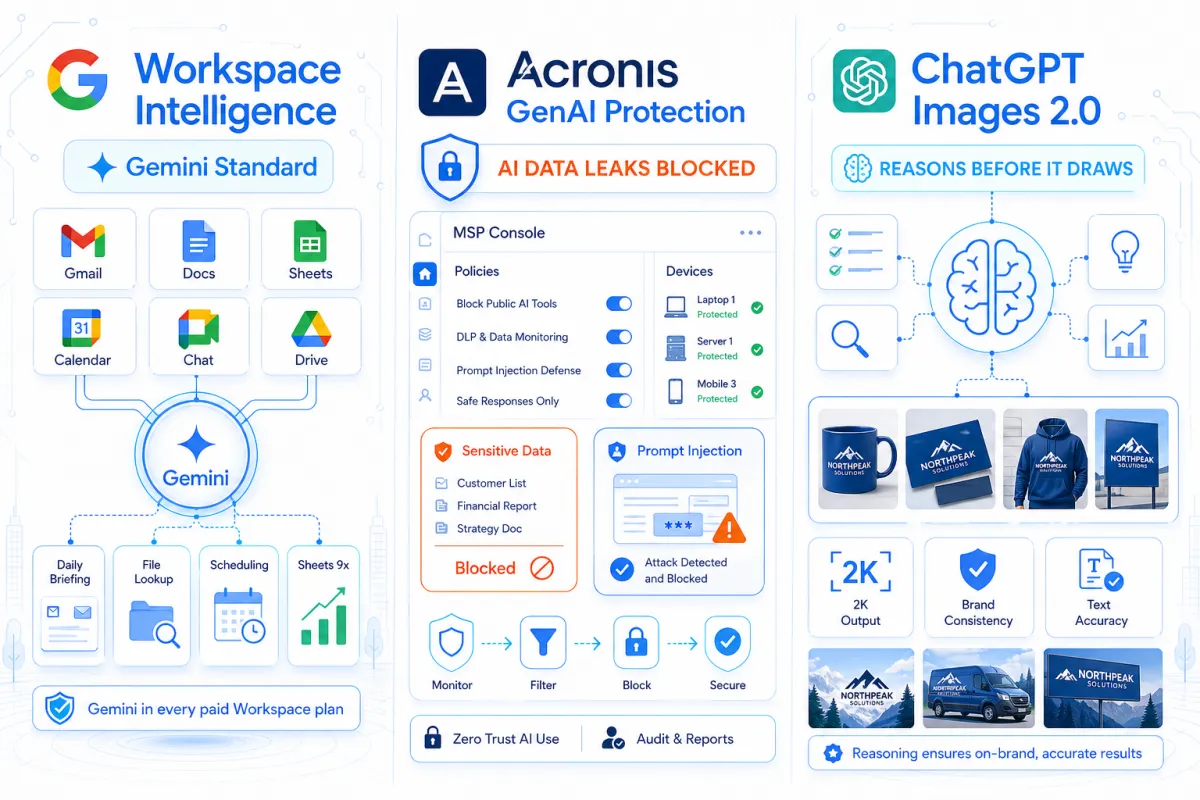
Google Makes AI Standard, Acronis Locks Down AI Data Leaks, OpenAI Teaches AI to Think Before It Draws
Three significant AI moves landed in the last 24 hours — and all three have direct, practical implications for small businesses. Google stopped treating AI as an upgrade and started treating it as a standard tool. Acronis gave small business IT providers a way to govern how employees use AI without disrupting operations. And OpenAI changed how AI generates images by making the model reason before it creates. Here's what each move means for your business.
Google Workspace Intelligence: AI Is Now a Standard Feature, Not an Add-On
For years, getting AI inside Google Workspace meant paying extra. That changed this week. At Google Cloud Next 2026 in Las Vegas, Google announced Workspace Intelligence — a system-wide integration of Gemini that is now included in every paid Workspace Business plan: Starter, Standard, and Plus.
The feature set is significant. Gemini now reads across your entire Workspace environment by default — emails, documents, calendar events, and files. It uses that context to power practical functions: daily work briefings, scheduling requests handled through Google Chat, files located by description rather than file name, and data pulled from connected tools like Asana, Jira, and Salesforce.
Sheets gets a particularly useful upgrade. Prompt-based spreadsheet population is described as nine times faster than manual entry. Docs and Slides can generate complete drafts from a single prompt, pulling templates and company context automatically. For small teams, this is the equivalent of adding a capable assistant who already knows your entire business history.
If your business is already on a paid Workspace Business plan, your admin console should reflect access to these features. Check your Google Admin dashboard and ensure Workspace Intelligence is enabled. If you've been weighing whether to upgrade from a free Google account, this update makes the paid tier a direct operational tool — not just a storage upgrade.
Acronis GenAI Protection: Your IT Provider Can Now Govern How Your Team Uses AI
Most small businesses don't have an internal IT department. They have a managed service provider — an IT firm they pay monthly to keep their systems running. Acronis, which supplies security tools to thousands of those IT firms, launched a product this week that lets those providers extend their oversight into how your employees use AI.
Acronis GenAI Protection, released April 22, monitors which AI tools employees are using across company devices. It inspects prompts in real time for sensitive data — personally identifiable information, protected health information, financial records — and blocks that data from being sent to public AI tools like ChatGPT, Gemini, or Copilot. It also detects prompt injection attacks: situations where bad actors try to manipulate an AI system into bypassing its own rules or leaking information.
The delivery model is important for small businesses. This isn't software you install separately. It runs through the Acronis console your IT partner already uses. That means your provider can activate it across all your client devices, set policies, and get reports — without touching your daily operations. For most small businesses, this protection would simply show up as a new capability from your IT provider.
The practical action: call your IT partner this week and ask if they're an Acronis partner. If they are, ask about GenAI Protection. If they're not, this is a useful benchmark when evaluating any IT or cybersecurity contract. Shadow AI — employees using unsanctioned tools with company data — is one of the highest-probability data risk factors for small businesses in 2026.
ChatGPT Images 2.0: AI Stops and Thinks Before It Generates
OpenAI launched ChatGPT Images 2.0 on April 21, powered by a new model called gpt-image-2. The key difference from prior image generation: the model uses the same reasoning process behind OpenAI's o-series to think through the prompt before it generates anything.
In practical terms, this matters for complex requests. If you give a prior model a detailed brand brief — specific logo placement, multiple text elements, consistent character across five images — it tends to drift or misinterpret. The gpt-image-2 model works through the constraints before producing output, resulting in more accurate images on the first attempt.
The technical specs are also notable. Output resolution is 2K. Multi-image consistency is built in, meaning a character, product, or scene can remain visually consistent across a set of images — useful for any business producing visual content at volume. Text rendering inside images is significantly improved, with support for multiple languages.
For small businesses, this removes one of the most common objections to AI image generation: "It gets close but never exactly right." A business producing social media graphics, product images, or presentation visuals can now describe a complex spec in plain English and get a usable first output. Full reasoning features require a ChatGPT Plus, Pro, or Business subscription.
If your team produces visual content regularly, test it this week. The most practical starting point: give it your brand guide as context and request a set of social media images for an upcoming campaign. Note where it succeeds and where it still needs direction — that will tell you where it can replace your current workflow and where it still needs a human hand.
What This Means for Your Business
This is a pattern worth tracking. Google, OpenAI, and Acronis each made a move this week that pulls AI further into the operational layer of a small business — not as a special project, but as a baseline expectation. Google now treats AI as a standard Workspace feature. OpenAI is raising the floor on what AI-generated content looks like. And Acronis is building governance into the same systems small businesses already use.
The single next action: check your Google Workspace plan tier, ask your IT partner about AI governance tools, and run one test prompt in ChatGPT Images 2.0 with your brand context included. Each of those takes under 15 minutes. Together, they tell you exactly where your business stands on each of the three moves that happened today.
Sources
Technology.org / Google Workspace Blog — https://www.technology.org/2026/04/23/google-gemini-workspace-intelligence/
GlobeNewswire (Acronis GenAI Protection) — https://www.globenewswire.com/news-release/2026/04/22/3278877/0/en/acronis-launches-genai-protection-enabling-msps-to-secure-and-govern-ai-usage.html
OpenAI Newsroom (ChatGPT Images 2.0) — https://openai.com/index/introducing-chatgpt-images-2-0/