Happier Owners, Smarter Agents, and a Warning About Both
Three stories are moving today that tell a surprisingly coherent message: small business owners are happier when they use AI, vertical AI built for specific industries is proving out at scale, and the agents powering all of this still carry a reliability risk too many businesses are ignoring.
VistaPrint Survey: AI Is Making Business Owners Happier
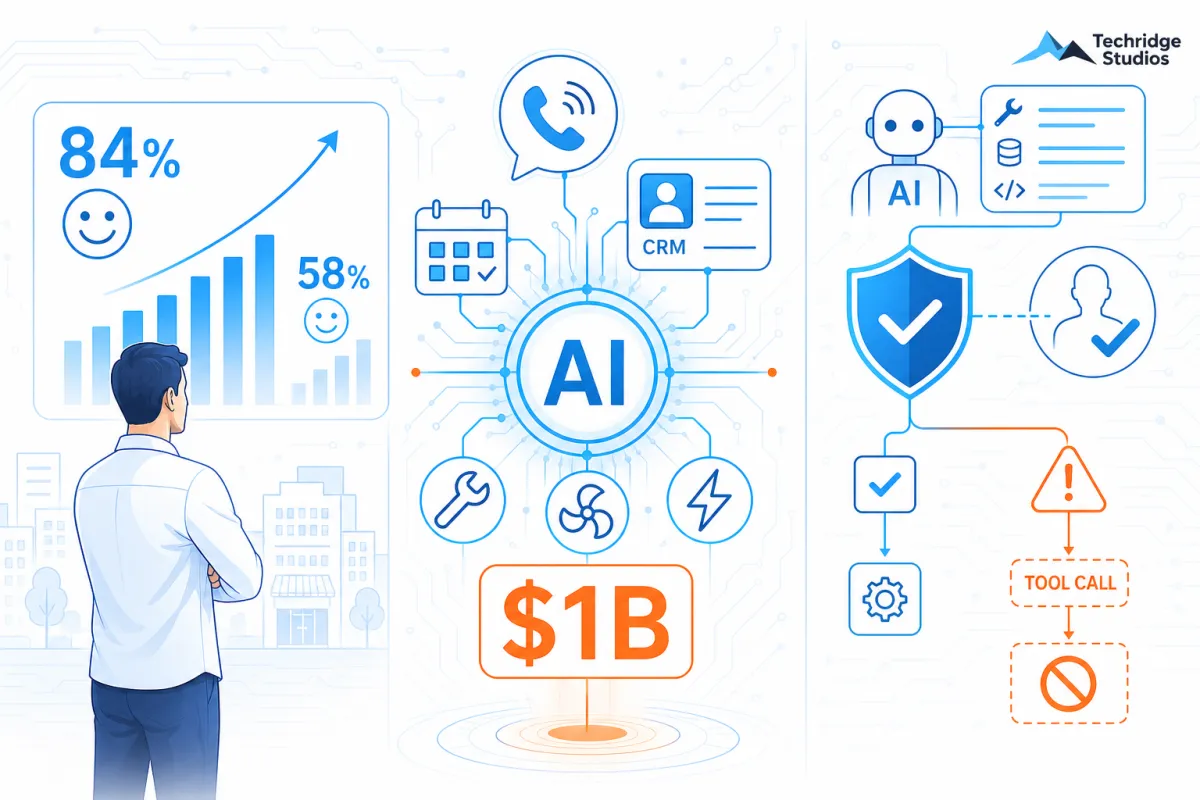
A new study from VistaPrint, conducted with YouGov and surveying 610 U.S. small business owners, found that 84% say they are currently happy in their role — and 83% say they are happier than when they worked for someone else.
The more important data point for business owners thinking about AI is this: 58% of small business owners who use AI regularly say they are happier now than before they started. That is not a marginal improvement. It is a meaningful shift in how people feel about running their business.
Seventy-four percent of respondents use AI tools at least once a month. Among active AI users, marketing is the top use case at 47%, followed by writing and documentation at 56%, analysis and problem solving at 47%, and communication at 45%.
What does this mean for your business? Start with one task. If you are spending time every week writing marketing copy, drafting emails, or summarizing data, these are the places where AI is delivering the most satisfaction. The goal is not full automation. It is finding the friction points in your week and removing them one at a time.
Avoca AI Hits $1 Billion — AI Agents Built for Trade and Service Businesses
Avoca AI announced it has raised more than $125 million at a $1 billion valuation to scale its AI voice agent platform for service businesses — plumbing, HVAC, electrical, and adjacent trades.
The platform does three things: it answers every inbound call within seconds, it books jobs directly into the business's CRM, and it follows up on outstanding estimates automatically. Avoca says it is on track to book $1 billion in jobs this year across its customer base.
What makes this story significant for small business owners is the model it represents. Avoca is not a general-purpose AI tool. It is an agent trained on the workflows of one specific industry and sold to small operators who have not traditionally considered themselves AI buyers.
This is the wave of vertical AI — tools designed not for enterprise software teams but for small operators in specific trades. If you run a service company, the question is no longer whether AI can work in your industry. It is which platform built specifically for your industry is worth testing.
The near-term action: search for AI tools designed specifically for your trade or service category. The products built for the general market may not fit your dispatch workflow, your estimate process, or your CRM. Vertical AI does.
The AI Agent Hallucination Trap — What to Know Before You Deploy
Research presented at ICLR 2026 confirms a troubling pattern: training AI models to reason more deeply — which generally improves their performance on complex tasks — also increases the rate at which they hallucinate tool calls. That means the model invents an action, an API call, or a data input that does not exist, then tries to execute it.
This is different from a chatbot giving a wrong answer. When an agent hallucinates a tool call, it triggers an action. That action can touch your data, send a message, modify a record, or make a request to an external system.
The research frames this as a fundamental reliability-capability trade-off in current reasoning models. Stronger reasoning and tool reliability are not currently optimized together. The cost of ignoring this is real — AI hallucinations cost companies an estimated $67.4 billion globally last year.
For small businesses deploying AI agents in workflows, the practical message is this: every agent you put in production needs a human review checkpoint somewhere in the loop. Not because AI is untrustworthy in general, but because the failure mode of a confident wrong action is harder to catch than a confident wrong sentence.
Start by auditing which AI agents you run today that take actions without review. Identify at least one point in each workflow where a person confirms before something executes. That step is not friction. It is risk management.
What This Means for Your Business
Today's three stories add up to a clear message: AI is delivering real benefits to small business owners — in satisfaction, in efficiency, and in the ability to compete in specialized markets. But the same tools boosting happiness and booking jobs are also capable of quiet, costly mistakes if left unchecked.
The owners reporting the highest satisfaction are not the ones who handed everything to AI. They are the ones who found specific use cases, tested them, and kept a hand on the wheel.
One action this week: list every place AI takes an action in your business. Ask whether there is a human confirmation step before anything consequential happens. If there is not, add one.
Sources
CPA Practice Advisor / VistaPrint — https://www.cpapracticeadvisor.com/2026/04/28/84-of-smb-owners-are-happy-and-advancing-with-ai-resilience-and-autonomy/182363/
Morningstar / PR Newswire (Avoca AI) — https://www.morningstar.com/news/pr-newswire/20260427ny43862/avoca-raises-125m-at-1b-valuation-to-power-americas-services-economy-with-ai
Asanify / ICLR 2026 — https://asanify.com/blog/news/ai-agent-hallucination-april-29-2026/