Snap's Cuts, Canva's Leap, and the Productivity Data That Should Wake You Up
Three AI stories broke this week with a shared message: the gap between businesses acting on AI and those still waiting is no longer a future risk — it is a current one. Job cuts, a major product launch, and hard productivity data all point in the same direction. Here's what it means for your business.
Snap Cuts 1,000 Jobs as AI Takes Over the Workload
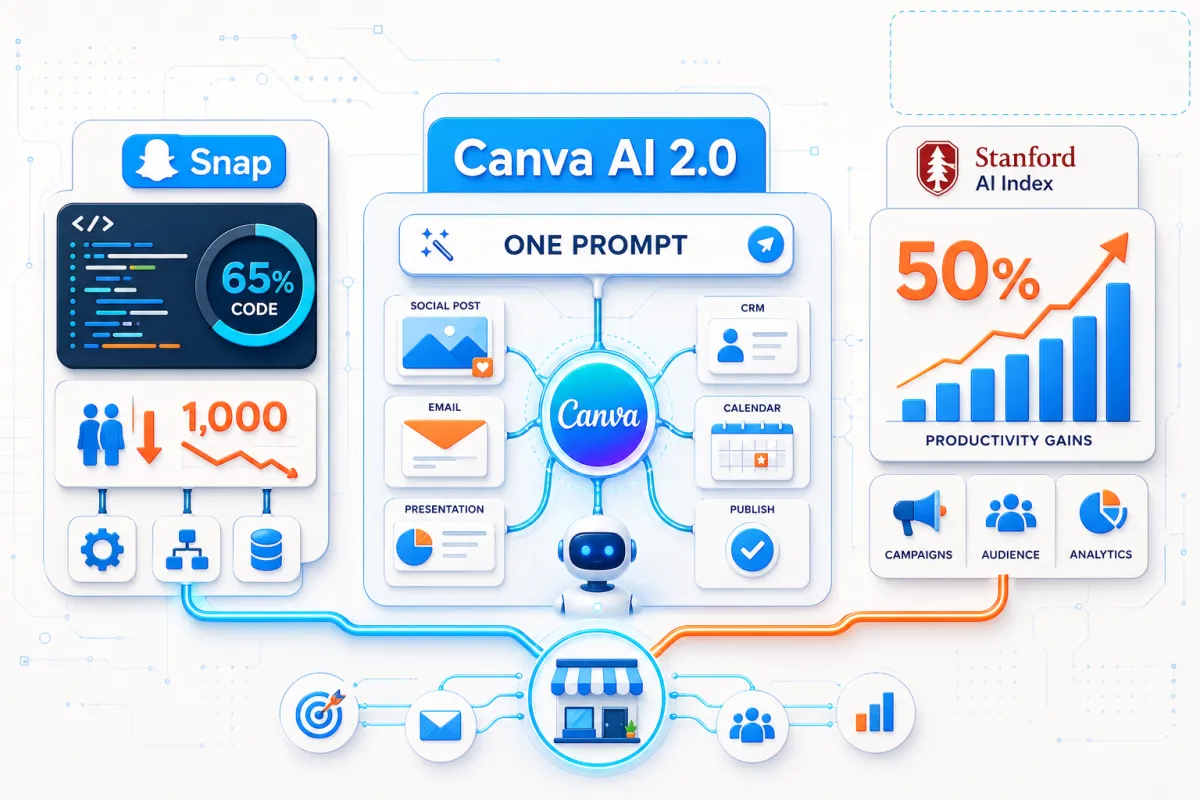
On April 15, Snap announced it would cut 1,000 employees — roughly 16% of its workforce. The reason wasn't budget pressure or a slow market. It was AI. Specifically, the company reported that AI now generates more than 65% of all new code written at Snap.
This matters because Snap isn't running an experiment. It is a mature technology company at scale, and it has reached the point where AI handles the majority of its core technical output. The human headcount requirement has dropped — not because people were bad at their jobs, but because AI is now genuinely capable of doing the work.
For small business owners, the implication is direct. You don't need to hire your way to scale. Whether that's customer service, content creation, software development, or administrative workflows, the barrier to doing more with less has dropped significantly. If you are still waiting until your business is "ready" for AI, this is your signal that the window is narrowing.
Canva AI 2.0 Just Changed What a Small Team Can Do
On April 16, Canva launched AI 2.0 at its annual Create event in Los Angeles. This is not a feature update. It is a platform transformation.
Canva AI 2.0 turns the tool into a conversational, agentic system. You type a brief — "build a multi-channel campaign for a summer launch" — and Canva generates a complete set of assets: social posts, email headers, presentations, and more. The platform connects to your CRM and project management tools, maintains persistent memory of your brand identity, and can schedule and publish directly from within the platform.
For small businesses, this is a significant moment. Canva already serves hundreds of millions of users, and a large portion of them are SMBs relying on it for day-to-day marketing. AI 2.0 means that a one-person marketing operation or a small team can now produce campaign-level output that previously required an agency or a much larger in-house team.
The initial rollout is a research preview, with broader access coming in the weeks ahead. If you use Canva, watch for access to drop into your account — and when it does, test it immediately.
Stanford's AI Index Confirms: Integrated AI Delivers 50% Productivity Gains in Marketing
Stanford's 2026 AI Index Report provides some of the clearest data yet on what happens when businesses fully integrate AI into their workflows — not just test it occasionally.
In marketing specifically, organizations that have embedded AI into their creative and campaign workflows are seeing productivity gains of up to 50%. The same team is producing twice the output in the same time. The report also found that 88% of organizations now report using AI in some form. The question is no longer whether your competitors are using AI — it is whether they are using it more effectively than you are.
For SMBs, this is a concrete benchmark. If your marketing team is not using AI to assist with content creation, campaign planning, or email, you are operating at roughly half the output potential of a competitor who is. That is not a projection. It is current data.
What This Means for Your Business
Snap's cuts show that AI is handling the majority of technical output at a large company. Canva's launch shows that the same capability is now arriving in tools your business already uses, at price points you already pay. Stanford's data shows what the productivity gap looks like for teams that commit versus those that don't.
The businesses pulling ahead in 2026 are the ones that moved from experimentation to deployment. The ones falling behind are the ones still waiting for a better moment to commit.
Pick one workflow. Put AI in it. Measure the output. Then do it again.
Sources
TechCrunch — https://techcrunch.com/2026/04/15/snap-is-cutting-1000-jobs-16-of-its-workforce/
Fortune — https://fortune.com/2026/04/16/canva-ai-agentic-design-suite-coo-cliff-obrecht/
Stanford HAI — https://hai.stanford.edu/ai-index/2026-ai-index-report