Your CRM Is Getting an AI Upgrade — Here's What That Means for Your Business
Three AI stories landed today with direct implications for small businesses. A new report shows AI is fundamentally changing how CRM platforms operate. OpenAI is moving into financial planning. And generative AI adoption among small businesses just hit a new high. Together, they point to the same conclusion: AI is no longer a future investment — it is actively reshaping the tools your business runs on today.
Your CRM Is Becoming an Active Revenue Engine
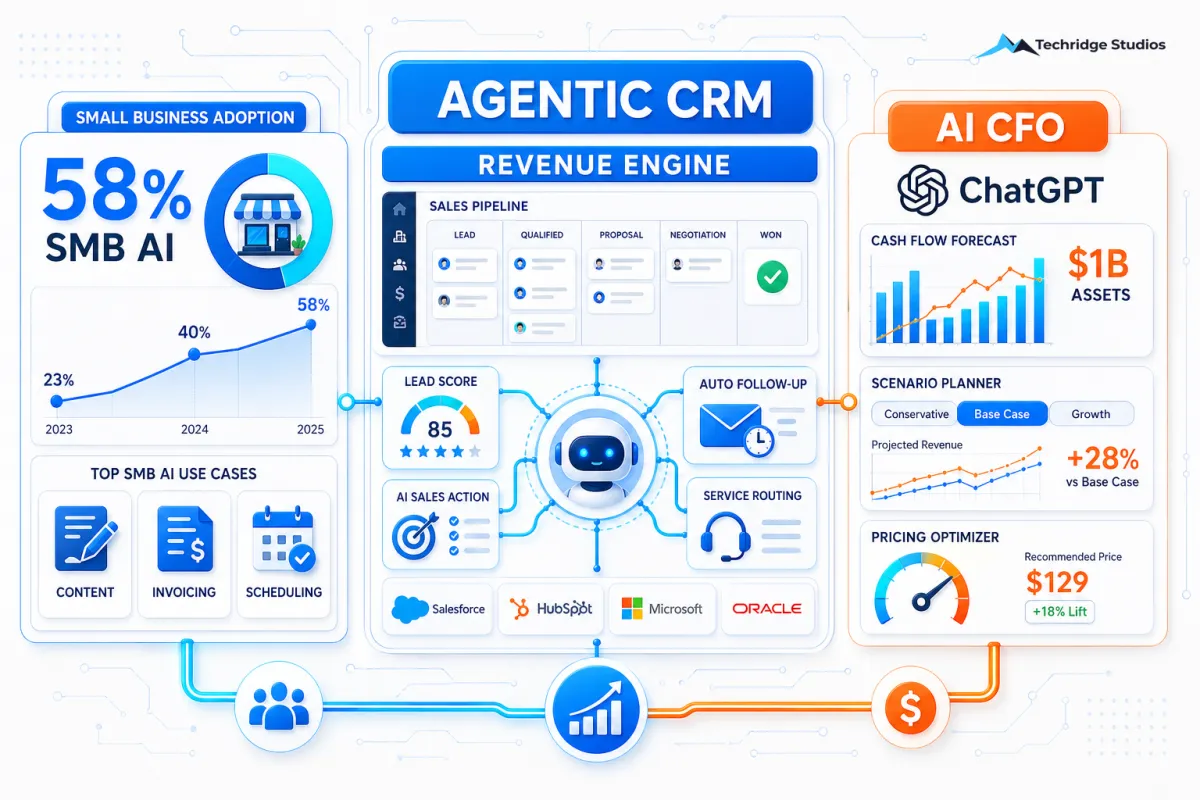
ISG published its 2026 CRM Buyers Guide on April 13, evaluating 52 software providers including Salesforce, HubSpot, Oracle, and Microsoft. The headline finding: AI has already enhanced CRM platforms through predictive lead scoring, segmentation, and automated service routing. But a newer category — agentic AI — is now taking this further. Agentic CRM systems can plan and execute sales actions within defined parameters, not just surface insights for humans to act on.
This is a meaningful shift for small businesses. Most SMBs use CRM tools primarily as databases — a place to log contacts, track deals, and record notes after the fact. Agentic AI changes that model entirely. Instead of waiting for a rep to send a follow-up or schedule a call, the system does it automatically, based on where a prospect is in the pipeline.
ISG found HubSpot ranked as a top-three overall leader across multiple CRM categories. That means the tools many SMBs already pay for may soon have these capabilities built in. Watch for platform updates in the next 60–90 days. If you are not paying attention to your CRM's AI roadmap, now is the time to start.
OpenAI Just Bought a Personal CFO
On Monday, TechCrunch reported that OpenAI acquired Hiro Finance, a startup founded with the goal of building an AI personal CFO. The founding team is joining OpenAI to build those capabilities directly into ChatGPT. Hiro was backed by major fintech investors including Ribbit and General Catalyst, and had helped users manage over $1 billion in assets before the acquisition.
The Hiro product shuts down April 20, and existing users can export data until May 13. But the bigger story is what comes next. OpenAI has signaled that enterprise and business use cases now make up more than 40 percent of its revenue — and financial planning is clearly the next frontier.
For small business owners who manage cash flow, pricing, and financial scenarios without a full-time CFO, this is worth watching closely. If OpenAI successfully builds financial planning features into ChatGPT, the tool millions of businesses already use could become a real-time financial advisor.
58 Percent of Small Businesses Are Already Using AI
The U.S. Chamber of Commerce reports that generative AI adoption among small businesses has reached 58 percent — up from 40 percent in 2024 and just 23 percent in 2023. The most common uses are content creation, invoicing, and automated scheduling. Many small business owners say they still value human-created content but are using AI to handle the volume and speed that human teams cannot match alone.
The direction is clear. If you are part of the 42 percent not yet using generative AI in your business, the majority of your competitors have already moved. The question is no longer whether AI belongs in your business — it is where to deploy it for the fastest return.
What This Means for Your Business
Today's three stories share a theme: the software and tools your business already uses are getting smarter fast. CRM platforms are moving from record-keeping to revenue generation. ChatGPT is moving toward financial planning. And adoption among small businesses is accelerating whether you are ready or not.
The most direct action you can take today: check your CRM provider's AI roadmap, and identify one financial decision that currently takes your time every week. Both are about to change significantly.
Sources
ISG 2026 Buyers Guide — https://research.isg-one.com/buyers-guide/business-and-technologies/office-of-revenue/2026-buyers-guides-for-crm
SiliconANGLE — https://siliconangle.com/2026/04/09/anthropic-openai-target-big-businesses-enterprise-grade-controls-lower-pricing/
Automation Atlas — https://automationatlas.io/guides/ai-agents-in-automation-2026/