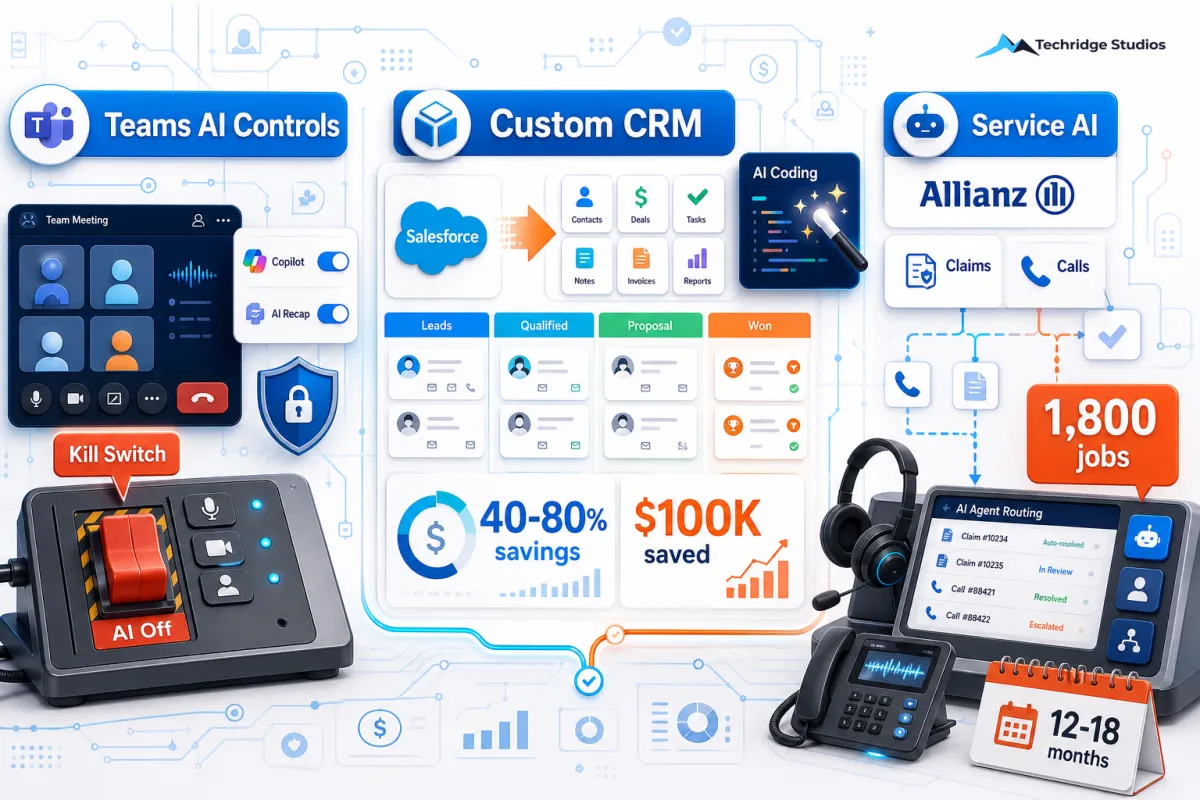
Kill Switch, Custom CRMs, and 1,800 Jobs Cut: How AI Is Reshaping Small Business This Week
Three AI stories this week share a common thread: every business — regardless of size — now has to decide how to respond to automation that is already in motion. Microsoft is giving you more control over AI inside your tools. Small businesses are using AI to escape expensive software. And major corporations are showing you exactly which roles automation replaces first.
Microsoft Teams Gets an AI Kill Switch — What It Means for Your Business Meetings
Microsoft reversed course on one of its most controversial product decisions this month. Since late 2024, Teams has been rolling out AI features — Copilot for meeting summaries, Facilitator for real-time suggestions, and Recap for post-meeting notes — enabled by default, without explicit consent from meeting participants. The backlash was significant: a 2024 survey found that 62 percent of knowledge workers were uncomfortable with AI monitoring in meetings when they were not the organizer. Employees and business owners alike raised concerns about client confidentiality, team morale, and the quiet recording of sensitive conversations.
The update rolling out now changes that dynamic directly. Meeting organizers can toggle off AI features during a live call — no IT approval, no support ticket, no policy change required. The toggle lets you independently control Copilot, Facilitator, and Recap, or switch all three off at once. Targeted Release begins in early July 2026, with General Availability expected by the end of the month.
For small businesses, this update solves a specific problem that many owners have already encountered: a client asking, "Is this being recorded by AI?" and getting no clear answer. That question now has one. You control the toggle. You make the call.
The broader lesson here is about platform power and user trust. Microsoft's reversal signals that AI features deployed without explicit consent — even inside a productivity platform you already pay for — generate real resistance. The businesses that navigate AI adoption well are the ones that make it visible and controllable, not the ones that automate quietly and hope nobody asks.
Small Businesses Are Replacing Salesforce With AI-Built Tools — and Saving 40 to 80 Percent
The enterprise software model has a fundamental problem: it was built for enterprise budgets. A CRM like Salesforce gives you hundreds of features, a vast partner ecosystem, and deep customization options — at a price that scales with users, modules, and add-ons. For a 10-person business using 20 percent of the platform's features, the math has never made sense. It just used to be the only option.
According to reporting from The Information, that is changing at a meaningful pace. Small businesses are using AI coding assistants — tools like Claude, Replit, and ChatGPT Codex — to build their own customer management software from scratch. The approach, sometimes called "vibe coding," lets a non-technical founder or operator describe what they need in plain language and generate a working application in hours instead of months. The reported cost savings are substantial: 40 to 80 percent compared to Salesforce licenses. Greenleaf Management, a small firm cited in the reporting, saved approximately $100,000 by making the switch. According to a Salesforce admin survey, nearly 59 percent of administrators say the platform has become "increasingly complex to work with" — suggesting the exit motivation is not just cost, but friction.
The right action here depends on your situation. If you're paying enterprise software rates for a tool your team finds overcomplicated and uses at partial capacity, this is worth a direct 30-minute experiment. Open Claude or a comparable AI coding assistant, describe the three to five workflows you actually use inside your CRM, and ask what a simpler version would look like. You're not committing to rebuilding anything — you're costing out an option that now exists.
The caution worth noting is that custom-built software requires ongoing maintenance. When an AI-built tool breaks, there is no enterprise support line. You need someone who understands the underlying code well enough to maintain it, or a budget for occasional developer support. The savings are real. So is the operational responsibility that comes with owning your own software stack.
Allianz Cuts 1,800 Customer Service Jobs: What It Signals for Service Businesses Everywhere
Allianz Partners, the assistance and travel insurance division of Allianz SE, announced it will eliminate between 1,500 and 1,800 positions over the next 12 to 18 months. The cuts come from AI automating the functions that those roles performed: handling customer inquiries by phone, processing claims, and providing support across call centers in Europe. CEO Tomas Kunzmann confirmed the scale at an event in Munich. The cuts primarily affect staff in Spain, France, Germany, Italy, and the Benelux countries, where negotiations with works councils are already underway.
Allianz Partners employs about 22,600 people, of whom roughly 14,000 handle customer inquiries and insurance claims by phone. That profile — a workforce majority doing human-to-human service work at scale — closely mirrors the structure of many service-based small businesses: staffing-heavy operations built around conversations. The difference is the execution timeline. Allianz has the enterprise resources to automate at speed. For smaller businesses, the same automation tools are available now, but adoption is moving at the owner's pace rather than a CEO mandate.
The question for small business owners in service industries is not whether automation will reach their sector — it will — but which stance to take. The first option is adoption: use AI to automate the high-volume, rule-based parts of your service delivery (scheduling, intake forms, FAQ responses, status updates) and redeploy your human team toward complex cases where judgment matters. The second option is differentiation: make human service a feature, not a default, and compete on what automation cannot replicate. Both are legitimate strategies. What does not work is assuming the shift is someone else's problem.
The insurance industry is moving fast because claims processing is highly structured and data-rich — two conditions AI handles well. Businesses in legal services, medical scheduling, logistics, and retail support are watching the same timeline compress. The Allianz announcement is not a warning about a distant future. It is a data point about a transition already underway.
What This Means for Your Business
These three stories point to a single pattern: the cost of ignoring AI is rising faster than the cost of adopting it. Microsoft has made it easier to adopt AI on your own terms. AI coding tools have made it cheaper to own your own software. And the Allianz cuts show exactly which roles automation targets first.
The single best action this week: pick one tool your business pays for that feels too complex or too expensive. Spend 30 minutes this week asking an AI assistant what a simpler, custom version would look like. You do not have to build anything. You just need to know what the option costs. That is where the leverage is.
Sources
Forbes (Gene Marks) — https://www.forbes.com/sites/quickerbettertech/2026/07/12/small-business-technology-news-roundup-microsoft-makes-a-major-ai-u-turn/
SalesforceBen — https://www.salesforceben.com/salesforce-smb-customers-switch-to-vibe-coded-crms/