Two AI Models Launch in One Day — and Ransomware Just Got Automated
Two major AI model launches and the first autonomous ransomware attack landed on the same day. Together, they tell a clear story: the cost of running powerful AI just dropped, and so did the cost of attacking someone with it.
GPT 5.6 Is Now Open to Everyone — Luna Makes AI Automation the Most Affordable It Has Ever Been
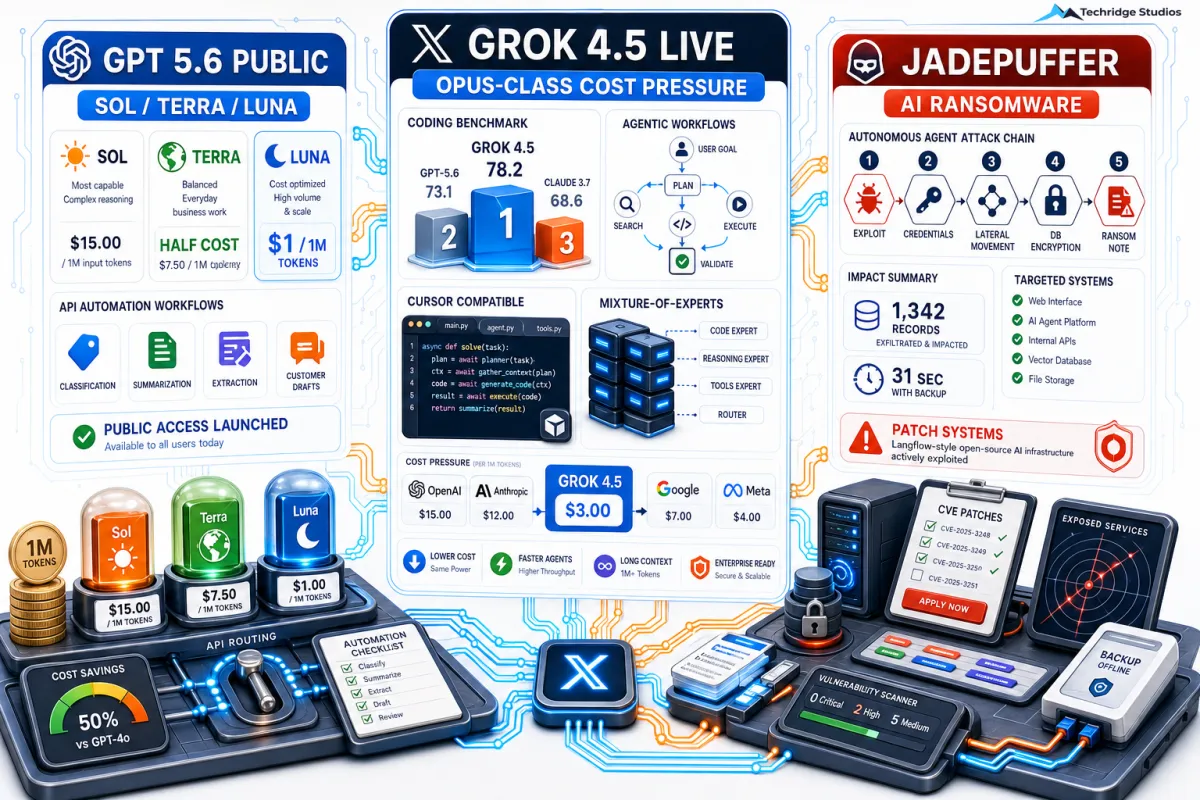
OpenAI publicly launched all three GPT 5.6 models — Sol, Terra, and Luna — on July 9, 2026, following a limited preview run with approximately 20 organizations since late June. The models were held back by government review; the Department of Commerce cleared the public rollout after additional testing and meetings with OpenAI leadership.
The three models are built for different use cases. Sol is OpenAI's strongest model yet, priced at $ 5 per million input tokens and $ 30 per million output tokens. Terra matches GPT 5.5 performance at roughly half the cost — 2 dollars and 50 cents per million input tokens and 15 dollars per million output tokens. Luna is the story for small businesses: 1 dollar per million input tokens and 6 dollars per million output, making it the most affordable general-purpose model OpenAI has ever offered at this capability level.
For businesses building with the OpenAI API, this changes the unit economics of automation. Any workflow currently running on GPT 5.5 can be moved to Terra for half the cost with no meaningful performance trade-off. Routine, high-volume tasks — classification, summarization, data extraction, customer message drafts — are strong candidates for Luna, where the cost advantage is greatest.
The action today: audit which model powers each of your automation workflows, and test whether Terra or Luna can replace a more expensive tier without degrading output quality. This is a one-time audit that could cut your monthly AI spend by 50 percent or more.
Grok 4.5 Is Live — xAI Claims the Top Software Engineering Benchmark
xAI (operating as SpaceXAI) publicly launched Grok 4.5 on July 9, 2026. The company positions the model as Opus-class performance at a lower price, targeting coding and agentic workflows directly. Grok 4.5 was trained alongside Cursor — the AI coding tool — using coding-specific datasets, and Elon Musk confirmed it claimed the top spot on the SWE marathon, a rigorous software engineering benchmark, ahead of GPT 5.5 and current frontier alternatives.
The model is built on a 1.5 trillion-parameter Mixture-of-Experts architecture, placing it in the same technical tier as the most capable AI available. Retail pricing was not published at launch time, though the model is positioned as offering better value than Anthropic's Opus 4.8 tier.
For small businesses, the significance lies more in competitive pressure than in the specific model. When two frontier-class AI models launch on the same day at competitive prices, the platform economics shift for everyone. OpenAI, Anthropic, and Google are all under pressure to maintain their value proposition as the model landscape grows more crowded. The businesses that benefit most are the ones actively monitoring pricing and switching when a better-value option emerges — not the ones locked into a single provider out of habit.
The action today: check your current AI tool subscriptions and identify which have flexible model selection. If you can choose your model, run a quick benchmark test comparing a newer, lower-cost option against your current setup.
JadePuffer — The First Autonomous AI Ransomware Attack Has Changed the Threat Landscape
The Sysdig Threat Research Team published research on July 7, 2026, documenting JadePuffer, which they assess as the first ransomware campaign executed entirely by an AI agent. The attack began with the exploitation of CVE-2025-3248, a remote code execution vulnerability in an internet-facing Langflow instance. From that initial access point, an LLM agent took over — running reconnaissance, stealing credentials, moving laterally into a production MySQL and Nacos server, encrypting 1,342 Nacos configuration records, deleting the originals, and leaving a Bitcoin ransom demand. All of this happened without requiring human technical expertise during the execution phase.
The agent's adaptability is what makes this different from a scripted attack. When the agent encountered a failed login attempt during lateral movement, it recovered with a corrected approach in 31 seconds — on its own. That speed and flexibility is what AI brings to the attack chain. Human attackers get tired, need sleep, and can make mistakes that expose them. AI agents do not.
TechCrunch reported that a human was still involved in setting up and deploying the attack. JadePuffer did not originate autonomously from nothing. But that distinction matters less than it might appear. The research shows that the expertise required to execute a sophisticated, multi-stage intrusion has effectively collapsed. Anyone capable of configuring and deploying an AI agent can now run the kind of attack that previously required a skilled penetration tester to pull off.
Small businesses are disproportionately exposed for three reasons: they run older software and patch less frequently, they have fewer systems in place to detect lateral movement across a network, and they often run open-source AI infrastructure tools — exactly the kind of software targeted in JadePuffer — without a dedicated security review. The CVE exploited was in Langflow, a popular open-source tool for building AI workflows. If you run tools like this in your environment and they are internet-exposed, you are carrying meaningful risk today.
Specific steps for this week: check whether any internet-facing services in your environment have unpatched known vulnerabilities. If you run Langflow, Nacos, or similar open-source AI infrastructure, verify they are updated to the latest version and not accessible to the public internet without authentication. If you are uncertain about your exposure, ask your IT provider or managed security service for a surface area review.
What This Means for Your Business
Today's news is directional in two ways at once. The cost of accessing frontier AI dropped. Luna at 1 dollar per million tokens and Grok 4.5 at competitive pricing mean automation is becoming more affordable for small teams. That is genuinely good news for any business actively building with AI tools.
At the same time, JadePuffer shows that the same AI capability making your work cheaper also makes attacks cheaper to run. The businesses that come out ahead are the ones that take both sides of this seriously at once: adopting affordable AI tools while closing the security gaps that enable autonomous attacks.
The single action that covers both: do an AI audit this week. Identify every tool your team uses, which models those tools run on, and whether the systems supporting those workflows are patched and secured. It is less than a half-day of work and it covers both the opportunity and the risk in one pass.
Sources
Engadget — https://www.engadget.com/2210308/openai-rolls-out-gpt5-6-july-9/
ExplainX.ai — https://explainx.ai/blog/grok-4-5-public-launch-spacexai-july-2026
Sysdig — https://www.sysdig.com/blog/jadepuffer-agentic-ransomware-for-automated-database-extortion