The AI Model Is Gone, the Pilot Is Stuck, and the Chips Are Still Winning
Three stories landed today that connect directly to your business: a forced model migration for ChatGPT users, fresh data on why AI projects stall before producing results, and a market signal from the company powering the entire AI ecosystem. Taken together, they point to the same reality — the tools are advancing faster than most businesses are deploying them.
OpenAI Pulls the Plug on o3 — What You Need to Know Today
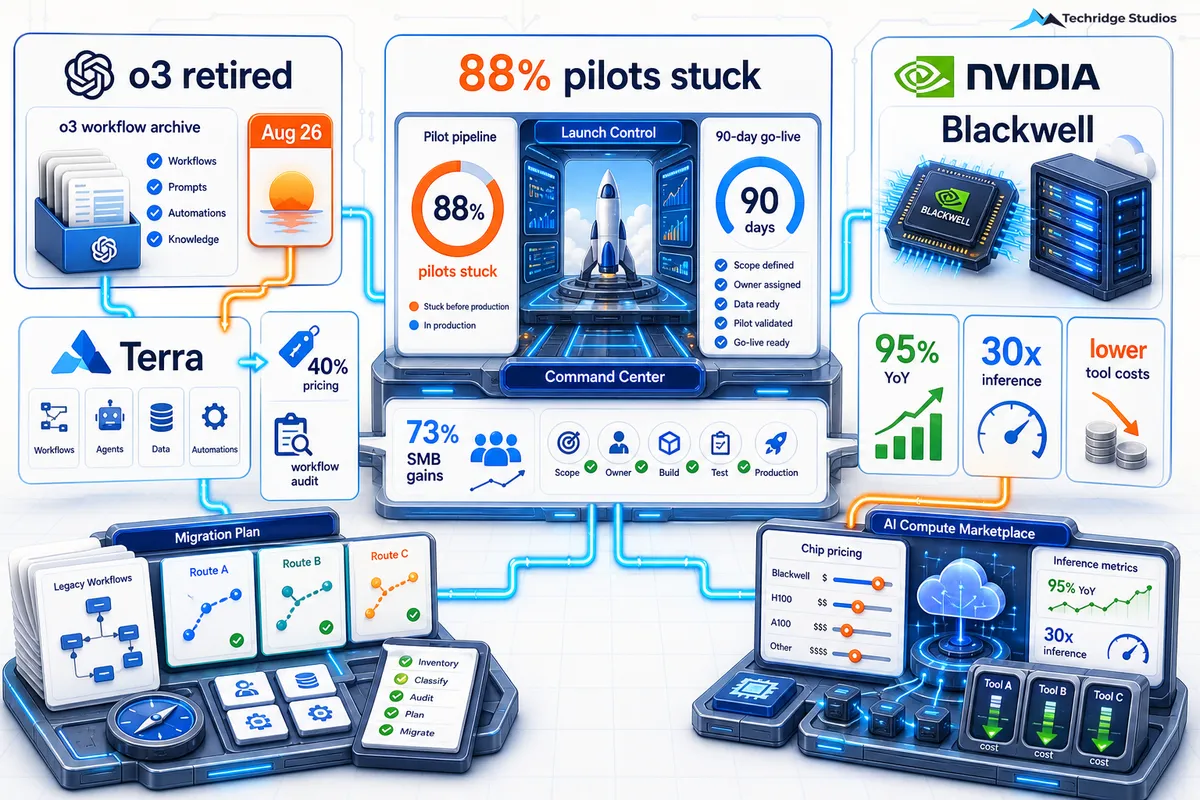
OpenAI officially retired its o3 reasoning model from ChatGPT on August 26th, 2026, ending the 90-day sunset window announced in May. The o3 model was widely used by business teams for complex reasoning tasks: summarization, analysis, structured data work, and multi-step logic. Its retirement is not just a product update — it forces every business with o3-dependent workflows to make a real decision today.
The primary replacement is GPT-5.6 Sol, OpenAI's current flagship. But Sol is also the most expensive option in the lineup. For most small business use cases — summarization, email drafting, document review, structured research — Terra is the smarter economic move. Terra handles the majority of what teams were using o3 for at approximately 40 percent of Sol's pricing. Developer API users have more time; the API versions of o3 snapshots remain active until December 11th, 2026.
The practical step for any business today: audit what your team is using in ChatGPT. If you relied on o3 for any automated or recurring task, test the same workflow in Terra. If Terra handles it, stay there. If it does not, move to Sol — but do not overpay out of habit.
One important note: o3-pro remains available for Pro, Team, Enterprise, and Edu subscribers. If you are on those tiers, you still have access to the extended-compute version — only the standard o3 is gone.
88 Percent of AI Pilots Never Reach Production — and That Is Your Opportunity
New research published today on the AI pilot-to-production gap confirms what many business owners have suspected: starting an AI project and finishing one are very different things. Across the study data, 88 percent of AI pilots never make it to full production deployment. The reason is almost never the AI itself. The failures trace to governance problems, scoping failures, and unclear ownership of the deployment process.
Here is the opportunity in that number: small businesses are structurally positioned to win this race. Enterprises fail at the pilot-to-production transition partly because of the complexity of integrating AI into legacy systems, organizational politics, and entrenched workflows. Small businesses do not have those constraints. The data reflects this directly — SMBs are achieving 90-day pilot-to-production timelines, and 73 percent of small businesses with deployed AI agents report measurable productivity gains.
The practical implication is straightforward. If you are running an AI pilot right now — a test of a chatbot, an AI assistant, a workflow automation — the single biggest risk is letting it stay in pilot status indefinitely. Define a go-live date. Assign someone to own the production deployment. Set one measurable benchmark for success. Those three actions separate the 12 percent that reach production from the 88 percent that do not.
BCG's supporting research makes the financial case clearly: companies that committed to production-grade AI deployment see 1.7 times higher revenue growth and 3.6 times greater shareholder return than peers that stayed in pilot mode.
Nvidia's Q2 Earnings Signal the AI Infrastructure Race Is Still Accelerating
Nvidia reported second-quarter fiscal 2027 earnings after market close on August 26th, 2026, with Wall Street projecting approximately 91 to 95 billion dollars in revenue — a 95 to 96 percent increase year over year. These numbers reflect demand for Nvidia's Blackwell chip architecture, which delivers 30 times faster AI inference than its predecessor and has been adopted across every major cloud platform.
For small businesses, the earnings story matters for one reason: it confirms that AI infrastructure spending is not slowing down. When hardware demand grows at this pace, competition intensifies — and competition drives down the cost of running AI tools at every tier. AMD, Qualcomm, Intel, and others are all building competing chip platforms. More chips in the market means lower inference costs for cloud providers, and lower inference costs mean cheaper AI tools for business customers.
The specific mechanism: tools built on APIs from OpenAI, Anthropic, Google, and others are priced on compute cost. As compute costs fall — driven by better chips and more competition — AI tool pricing falls alongside. The OpenAI price cuts of recent months, the Gemini Flash pricing, and the DeepSeek cost pressure are all downstream of this hardware race.
Nvidia's results also carry a risk signal. If the company misses, expect a volatility moment across the AI industry. But if they beat — which analysts are projecting — expect the AI infrastructure buildout to continue through the end of the year and into 2027.
What This Means for Your Business
Three different stories, one clear direction: the AI tools your business is using are moving fast, the infrastructure behind them is accelerating, and the businesses that act — not just test — are pulling ahead.
Today's single next action: open ChatGPT, confirm your default model, and migrate any o3-based workflows to Terra. Then pick one AI pilot your team has been running for more than 60 days and set a go-live date. Both of those actions take less than an hour and put you ahead of 88 percent of businesses still stuck in test mode.
Sources
Forkast News — https://forkast.news/openai-retired-o3-from-chatgpt-today-the-real-cost-is-the-churn-it-forces-on-everyone-else/
Science Technology News Articles — https://science-technology.news-articles.net/content/2026/08/26/bridging-the-ai-implementation-gap-and-pilot-purgatory.html
Kiplinger — https://www.kiplinger.com/investing/live/nvidia-earnings-live-updates-and-commentary-august-2026