Google Ended Blue Links, Alteryx Skipped the Developers, and OpenAI Cut Its Prices
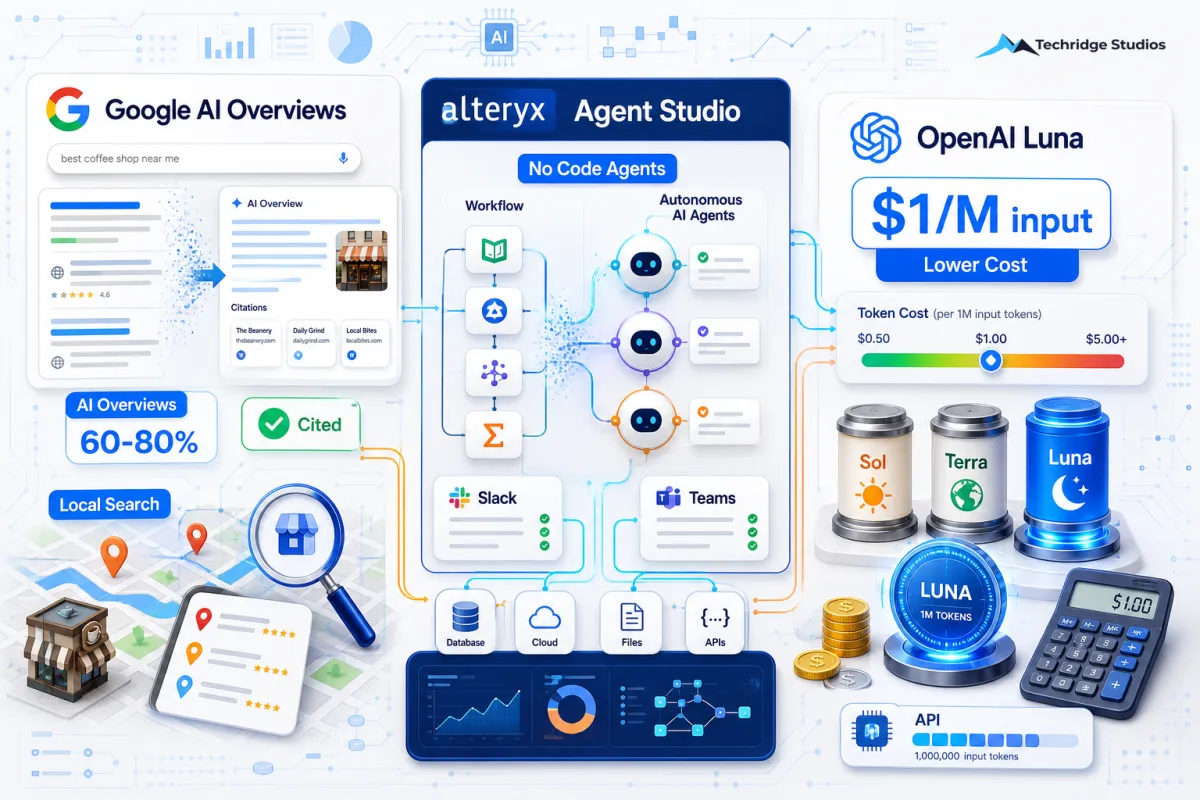
Three AI shifts landed this week that small business owners cannot afford to ignore. Google has officially replaced traditional search results with AI-generated summaries. Alteryx gave business analysts the tools to build AI agents without writing code. And OpenAI released its lowest-priced capable models yet. Here's what happened and what your business should do about it.
Google Has Replaced Blue Links With AI Summaries
As of July 10, 2026, Google Search no longer shows the traditional ranked list of ten websites for most queries. Gemini-powered AI Overviews — AI-generated summaries that answer questions directly on the search page — are now the default result format globally. The transition began in 2024 with limited tests and has now completed its full rollout.
The numbers are stark. Studies tracking the rollout show that 60 to 83 percent of searches that trigger an AI Overview end without the user clicking any external link at all. Research from Seer Interactive found that brands cited inside an AI Overview earn approximately 120 percent more organic clicks per impression than uncited brands on the same query. Getting cited is no longer a bonus — it is the game.
For small businesses, this marks the end of the SEO playbook that worked for the last decade. Ranking on page one does not guarantee traffic anymore. The new goal is to be cited as a source in the AI-generated answer. Google selects citations based on content authority, factual clarity, structured formatting, and specificity — not keyword density or backlink counts alone.
The practical action for small business owners is clear. Review your highest-traffic pages and ask: Does this content answer a specific question with enough precision that Google would trust it as a source? If not, it needs to be rewritten. Businesses that make this shift now — while most competitors are still optimizing for ranked links — will have a structural advantage in local and industry search for the next two to three years.
Alteryx Launched Agent Studio: AI Agents From Workflows You Already Have
Alteryx announced Agent Studio at its Inspire 2026 conference this month, and the implications for mid-market and small business analytics teams are significant. The platform does one thing: it takes your existing Alteryx workflows — the data pulls, reports, and decision logic your analysts already built — and converts them into autonomous AI agents that run without human supervision at each step.
The key distinction from other AI agent platforms is the starting point. Most tools ask you to build AI agents from scratch. Agent Studio starts from what your team has already built. A workflow that previously ran on a schedule and produced a report can now interpret that report, decide what to do next, and take action — connecting into Slack, Microsoft Teams, Claude, or OpenAI via Alteryx's new MCP Server.
For business analysts without coding expertise, this is a meaningful shift. Building AI agents has generally required developer involvement or prompt engineering skill sets that most analytics teams lack. Agent Studio removes that requirement by treating your existing business logic as the foundation of the agent, not an afterthought.
Agent Studio entered preview in June 2026 and is now available to Alteryx One customers. For teams already invested in the Alteryx ecosystem, the upgrade path is straightforward. For teams not currently using Alteryx, this is a strong signal about the direction of the analytics-to-automation market — and worth watching regardless of which platform you use.
OpenAI's GPT-5.6 Makes AI Automation Affordable for Small Teams
OpenAI launched the GPT-5.6 model family on July 9, 2026, and its pricing structure is the most important aspect for small businesses. Three tiers: Sol at 5 dollars per million input tokens for the most demanding tasks, Terra at 2.50 dollars per million input tokens for balanced everyday work, and Luna at 1 dollar per million input tokens for speed and affordability.
Luna is the headline for small businesses. One dollar per million input tokens is OpenAI's lowest-cost capable model to date. For context: Terra delivers performance comparable to GPT-5.5 at roughly half the per-task cost. Luna brings capable AI performance at prices that make even modest automation projects financially viable for small teams on tight budgets.
All three models are available now in ChatGPT, Codex, and via the OpenAI developer platform. GitHub Copilot also added access to all three as of July 9th. For teams already inside those environments, the new tiers are live and available without any additional setup.
The practical action here is straightforward. If your business has any recurring tasks powered by an OpenAI model — customer service drafts, document summaries, content workflows, data extraction — run a cost comparison against the new Luna and Terra tiers this week. Many workflows that defaulted to a premium model out of familiarity can likely run equally well on a cheaper tier at a materially lower monthly cost.
What This Means for Your Business
This week's three stories are connected by a single underlying theme: the barriers to AI — in search, in automation, and in cost — are dropping fast. Google is forcing an SEO reckoning that no small business owner can postpone. Alteryx is showing that AI agents are no longer just an enterprise capability. And OpenAI is proving that the cost of capable AI is heading toward commodity pricing.
The single next action: pick the story most relevant to your business right now and act on it this week. If you have a website that drives leads, audit your content for AI Overview citation readiness. If your team runs recurring data workflows, look at whether Agent Studio fits your stack. If you pay for AI model calls every month, run the new GPT-5.6 pricing against your current usage. One of those three things is overdue.
Sources
Digital Information World — https://www.digitalinformationworld.com/2026/06/how-google-ai-overviews-are-changing-local-search.html
TechCrunch — https://techcrunch.com/2026/07/09/openai-launches-its-new-family-of-models-with-gpt-5-6/