AI Pricing Is at War With Itself: What Google's Cut and DeepSeek's Hike Mean for Your Business
Three stories this week expose a tension every SMB owner needs to understand: the forces pushing AI costs down and the forces pushing them up are now running simultaneously.
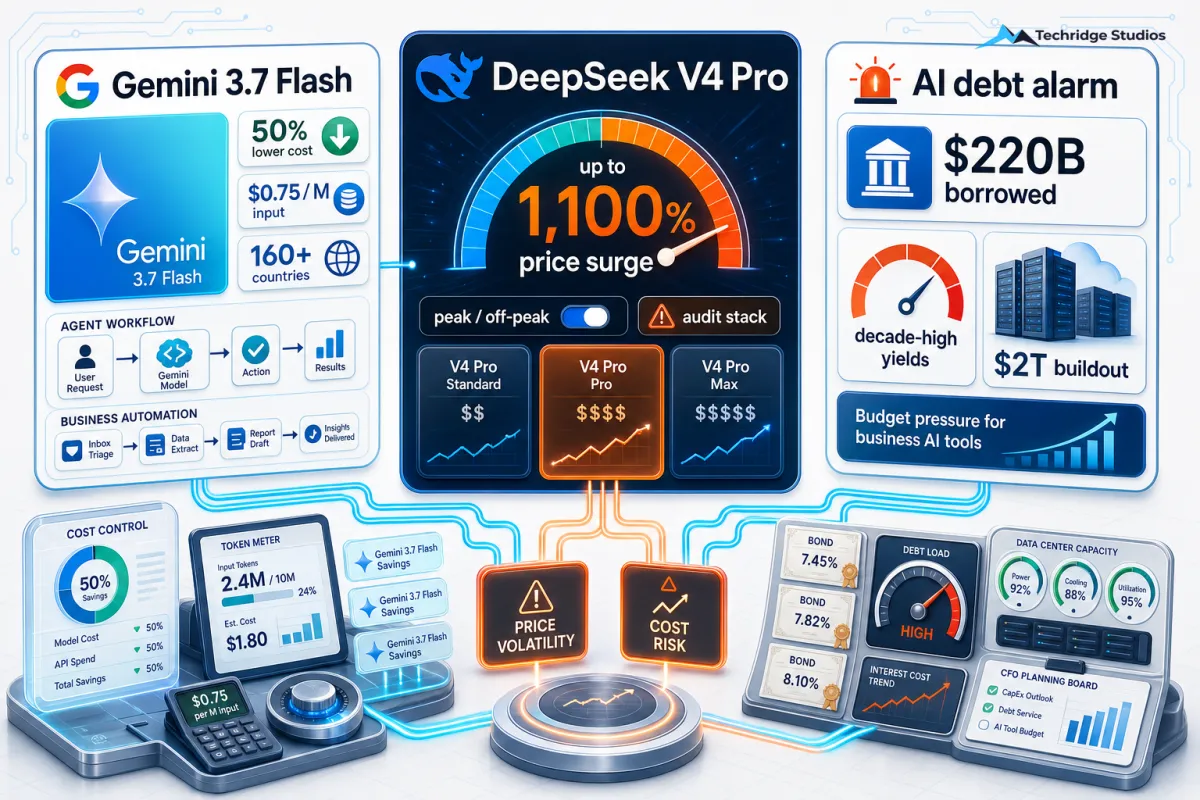
Google Drops Gemini 3.7 Flash at Half the Price — and It Is Built for Your Business
Google launched Gemini 3.7 Flash on August 13, 2026, and it arrived with an unusual headline: it costs half as much as its predecessor.
Priced at 75 cents per million input tokens, Gemini 3.7 Flash sits at the lower-cost tier of frontier AI models. But price alone does not move the needle for business owners. The more important headline is what the model actually does.
Google built Gemini 3.7 Flash specifically for agent workflows — AI that plans tasks, uses software tools, and completes multi-step work without constant human direction. The company reported strong gains over Gemini 3.6 Flash in software engineering, debugging, and production-ready code generation. On the DeepSWE benchmark, a test of real-world software engineering tasks, the model jumped from 49 percent to 65.3 percent.
For small businesses, that translates directly into automating proposals, email drafts, customer intake, data summaries, and similar tasks — at materially lower cost than the previous generation. Gemini 3.7 Flash is available now in Gemini Spark across more than 160 countries.
The action to take today: log into your Google account or Gemini Spark dashboard and test Gemini 3.7 Flash on one of your current workflows. The model is live. The savings are real.
UPDATE: DeepSeek Raises V4 Pro Prices Up to 1,100 Percent Starting Today
Three weeks ago, this brief flagged a DeepSeek price hike warning. Today, those increases are taking effect.
DeepSeek launched the general availability version of its flagship model, DeepSeek V4 Pro, on August 13. The model scores 53 points on the Artificial Analysis Intelligence Index — significantly ahead of the V4 Flash variant — and brings improved performance for agent tasks. The new pricing structure introduces peak and off-peak billing, with off-peak rates at half the peak cost.
But the headline is not the new model tier. It is the price increase. Depending on the model and usage pattern, DeepSeek is raising prices between 50 percent and 1,100 percent. This is a significant reversal for a platform that built its reputation as the low-cost alternative in the frontier AI market.
The direct SMB risk: many business tools that offer AI features do not use OpenAI or Anthropic under the hood — they use DeepSeek due to its cost advantage. As of today, that advantage is narrowing or, in some cases, disappearing entirely.
What to do now: contact your AI tool providers and ask which underlying models power their AI features. If DeepSeek is in the stack, your costs are going up. Knowing this before your next billing cycle gives you time to negotiate, switch, or budget accordingly.
AI Debt Alarm: Big Tech Borrowed 220 Billion Dollars in 2026 — and the Bill Is Coming Due
A Forbes report published August 14 draws a line that SMB owners should pay attention to: Alphabet, Amazon, and Meta have collectively borrowed nearly 220 billion dollars in bonds during 2026 alone — more than double their combined 2025 pace.
The result is real. Bond yields have climbed to their highest level in over a decade. Investment-grade credit markets are showing signs of saturation. Amazon recently had to sweeten a 25 billion bond sale by offering higher yields because demand came in weaker than expected. Apollo estimates the full AI infrastructure buildout could require two trillion dollars in debt — far more than public markets may be able to absorb at current rates.
For SMBs, this is not a story about bond markets. It is a story about pricing expectations. The assumption that AI tool costs would continue to drop sharply — driven by gains in model efficiency — was partly valid. But those models still require massive physical infrastructure to run: data centers, chips, and power. That infrastructure is now being financed with expensive debt.
The practical implication: do not plan your AI budget around the expectation of significant price decreases in 2027. Build AI spending into your stable operational costs, evaluate tools based on actual return on investment rather than discounted introductory pricing, and diversify your model exposure so that no single price increase — like DeepSeek's today — can destabilize your workflow economics.
What This Means for Your Business
This week's stories are a useful reminder that AI is now a cost category, not just a capability. Costs move in both directions, driven by different forces, on different schedules.
The one action to take today: audit what AI tools your business actually uses, what models power them, and what you are paying per user or per task. That audit will tell you whether Google's half-price Gemini model is a meaningful upgrade opportunity, whether DeepSeek's price hike is affecting you directly, and whether your current AI stack is defensible as infrastructure costs rise industry-wide.
Sources
9to5Google — https://9to5google.com/2026/08/13/gemini-3-7-flash-launch/
Reuters — https://www.reuters.com/world/china/deepseek-raises-api-pricing-its-v4-models-2026-08-13/