90 Percent of Executives Say AI Isn't Working — Two Stories Show Why Workflow Is Everything
A major new study just confirmed what a lot of business owners already suspect: having AI tools is not the same as getting results from them. At the same time, two announcements this week reveal what happens when AI is applied to a specific, bounded problem — and what happens when an entire industry decides that AI-only creation crosses a line.
The AI Productivity Gap Is Bigger Than Anyone Is Admitting
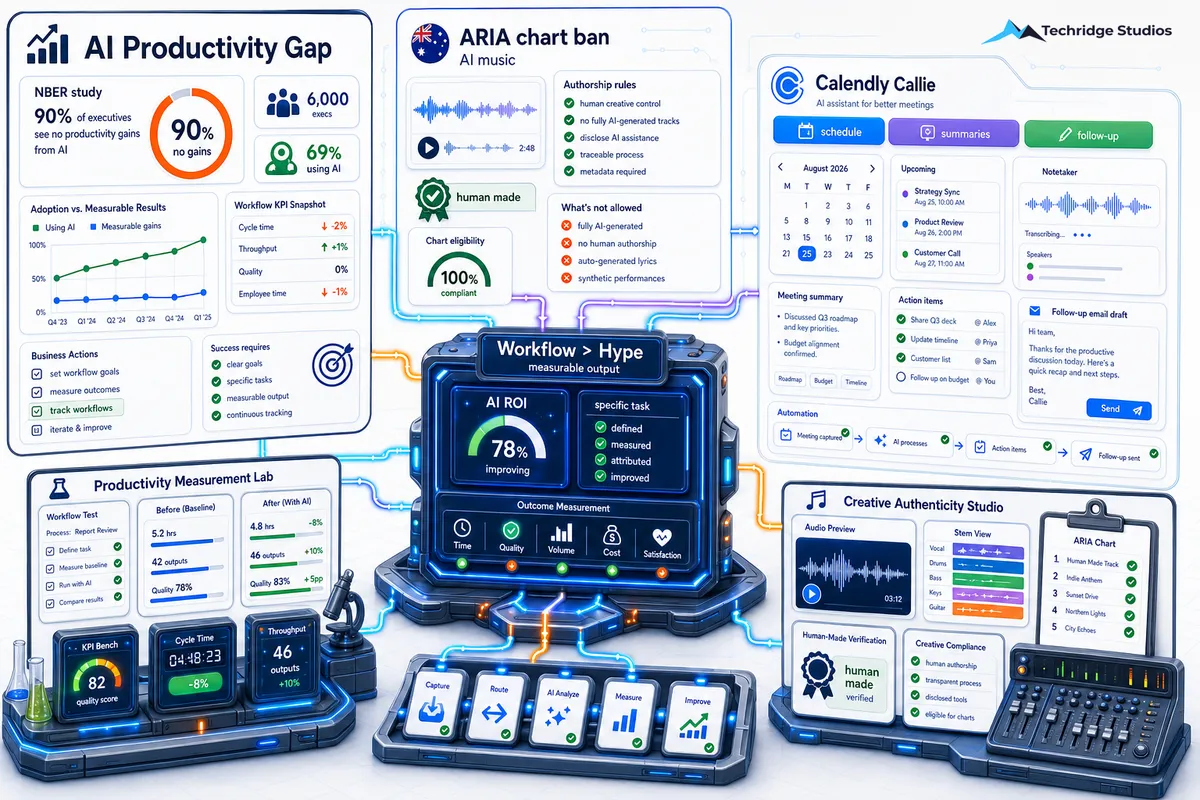
The National Bureau of Economic Research published findings from a survey of nearly 6,000 senior executives across the United States, United Kingdom, Germany, and Australia. The headline finding is stark: about 90 percent of executives said AI has not improved productivity at their companies over the past three years. These are not small companies struggling to afford the tools. These are senior leaders at organizations that have made real AI investments.
What makes this finding particularly important for small business owners is the second number: 69 percent of those same businesses are already using at least one AI tool. Adoption is not the problem. The application of that technology to work that produces a measurable outcome — that is the problem.
The study, based on surveys conducted between November 2025 and January 2026, captures a period when AI tool availability exploded but AI workflows had not yet matured. The gap between buying a tool and embedding it into a process that delivers a specific outcome is still where most businesses, large and small, are stuck.
For a small business owner, the practical lesson is direct: before adding another AI tool, identify one specific output — a report, a follow-up email, a customer response — and test whether AI can own that output end to end. That is where the productivity gains actually live.
Australia Bans Fully AI-Generated Music — A Signal Every Content Creator Needs to See
The Australian Recording Industry Association announced this week that tracks wholly created by artificial intelligence are no longer eligible for Australia's official music charts. The rule requires music to be "substantially human made," meaning humans must write the song and perform the lead vocals and primary instruments. AI can assist, but it cannot be the sole creator of a chartable track.
The rule was triggered by a specific case: an AI cover of a well-known pop song spent 16 weeks in Australia's top 20, earning tens of millions of streams and raising serious questions about what it means for a track to compete on a chart designed for human artists. ARIA's response was deliberate and immediate.
This matters for small businesses and content creators for a reason that goes beyond music. Companies that use AI to generate background music for advertisements, social media videos, brand content, or product demos are now operating in an environment where creative industry bodies are actively defining what counts as authentic, human-created work. The music industry went first. Other creative categories — stock photography, video content, written copy — are watching.
The practical implication is not that businesses need to abandon AI creative tools. It is that documentation, disclosure, and human creative involvement are becoming standard expectations, not optional gestures. Any business building creative content at scale using AI tools should establish a clear workflow for what requires human authorship and what does not.
Calendly Launches Callie and Notetaker — Proof That Specific AI Applications Deliver
Calendly released two new AI tools this week that serve as a direct example of the focused application model the NBER study suggests actually works. Callie is an AI assistant that joins email threads. When you copy it on a scheduling conversation, it reads the context, checks availability, and coordinates the meeting without the typical back-and-forth. It handles edge cases — non-standard meeting requests, timezone differences, conditional availability — without requiring you to intervene.
The second tool, Calendly Notetaker, joins your scheduled meetings directly. It records and transcribes the call, generates a structured summary, pulls out action items, and drafts a follow-up email that you can review and send with minimal editing. Both tools became available to English-language accounts starting August 19, 2026.
For a small business owner, this is exactly the kind of bounded AI use case that delivers a measurable result. Meeting scheduling and post-meeting admin are tasks that consume significant time, produce no revenue, and are perfectly suited to AI automation. A tool like Callie or Notetaker does not require you to redesign your workflow — it plugs into what you already do and removes the manual parts.
The Calendly announcement also illustrates a broader trend: the most useful AI tools in 2026 are not the most powerful ones. They are the ones built for a single, clearly defined job that a human currently does manually.
What This Means for Your Business
This week's stories converge on one principle: AI works when it owns a specific output, not when it assists vaguely across a general task. The NBER study shows the cost of adopting without specificity. The Calendly launch shows what happens when a team builds AI to own a specific job from start to finish. And the Australia ARIA ruling shows what happens when an industry decides that specificity and human involvement need to be formalized as standards.
The single next action: pull up your current AI tools and identify the one task where AI is closest to owning the full output, not just assisting. Start there, measure the outcome, and build from that specific win.
Sources
Fortune — https://fortune.com/2026/08/22/executives-ai-productivity-layoffs-study/
ABC News Australia — https://www.abc.net.au/news/2026-08-25/ai-generated-music-to-be-banned-from-aria-charts/107072642
TechCrunch — https://techcrunch.com/2026/08/19/calendly-throws-its-hat-into-meeting-note-taker-circus/