Anthropic Hits Its First Profit, Washington Steps Back, and Dell Moves AI Off the Cloud
Three things happened this week that do not look connected on the surface but tell a single story: AI is settling into the foundation layer of business operations, and the decisions you make in the next 90 days will determine how well positioned your business is when the next wave of tools lands.
Anthropic Posts Its First Operating Profit — What That Means for Your Business Tools
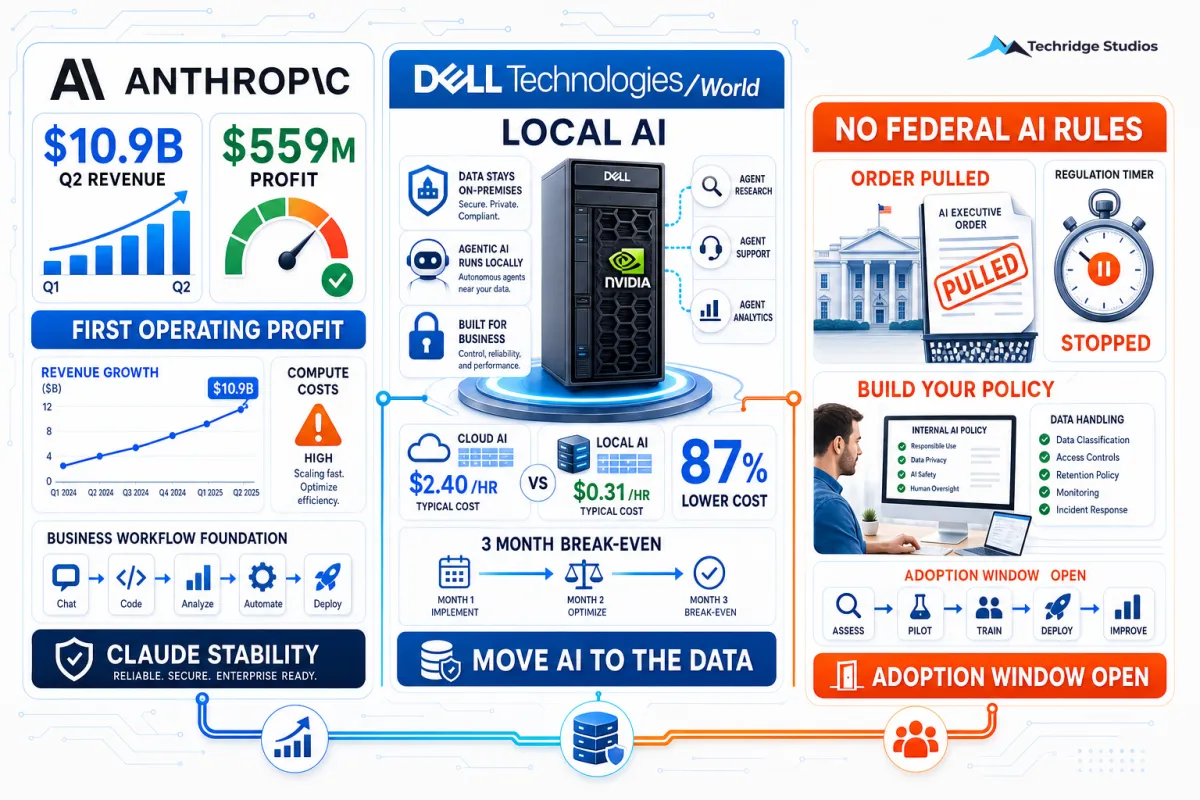
Anthropic is projecting $10.9 billion in revenue for Q2 2026, more than double the $4.8 billion it posted in Q1. The company expects to report an operating profit of approximately $559 million — its first time in the black. TechCrunch and CNBC reported the figures on May 20th and 21st, citing disclosures made to investors during a recent funding round.
For most people, this is a tech finance story. For small businesses, it is something more specific.
A significant portion of the AI tools on the market today are Claude-powered — either directly through the Claude interface and API, or through third-party platforms that use Anthropic's models under the hood. When the underlying model provider is burning cash, there is always risk: price changes, feature cuts, or a forced pivot to enterprise-only access if the consumer and SMB markets do not pencil out. That risk just got smaller.
Anthropic becoming profitable does not mean prices go up. It means the company has a sustainable path forward without being forced to restructure its product to cater to the highest-spending accounts. For small businesses, that is meaningful stability to plan against.
There is a caveat worth tracking: Anthropic committed $1.25 billion per month to SpaceX for compute capacity through 2029. That is a high fixed cost that could compress margins as growth normalizes. Watch Q3 numbers when they are released.
The action for today: If your business uses Claude, ChatGPT, or any AI platform, review your current plan tier and lock in annual pricing if you are on a month-to-month plan. Stability signals are a good time to extend contracts before any platform recalibrates pricing upward.
Trump Pulls the AI Executive Order — Here Is the Real Takeaway for Small Business
President Trump scrapped a planned AI executive order on May 21st, 2026, hours before it was set to be signed. The proposed framework would have required AI companies to voluntarily submit advanced models to federal agencies for up to 90 days of security review before public release. Trump's stated reason: "I didn't want to do anything to get in the way of that lead" — referring to the United States' position ahead of China in AI development. His AI adviser, David Sacks, and several major tech executives also opposed the order.
The U.S. now has no federal AI oversight framework, and based on the speed with which this one was pulled, none appears imminent.
For small businesses, the temptation is to read this as a political story and move on. That would be a mistake. This is a planning signal.
There is a group of small business owners who have been waiting — consciously or not — for federal guidance before making significant AI commitments. Waiting for clarity on compliance requirements, waiting to see what data handling rules look like, waiting for some defined standard before investing. That wait is not going to be rewarded anytime soon.
The businesses pulling ahead right now are not waiting for government permission. They are building internal AI policies, selecting tools based on their own security and data handling standards, and treating AI adoption as a business infrastructure decision rather than a compliance exercise.
The practical steps available today: establish a one-page internal AI use policy that specifies which data can go into AI tools and which cannot; select tools that offer clear data-processing terms; and assign one person on your team to own AI vendor relationships. None of these requires a federal framework to execute.
Dell Says AI Infrastructure Belongs On-Premises — And the Cost Math Is Starting to Work
Dell Technologies World 2026 ran May 18th through May 22nd in Las Vegas, and the consistent theme across four days of keynotes and product announcements was this: AI is no longer a feature — it is infrastructure. Dell CEO Michael Dell said it plainly in his opening keynote: "Just as electricity transformed the world when it left the power plant, AI will transform the world when it leaves the screen."
The more operationally relevant statement came from Dell COO Jeff Clarke: "Don't move the data to the AI. Move AI to the data."
That framing addresses one of the most common barriers small businesses cite to going deeper into AI: sensitive data. Financial records, healthcare information, legal documents, and customer data are not things most small businesses are comfortable routing through public cloud AI platforms. The concern is valid. And until recently, the alternative — running AI on your own hardware — was either technically complex or prohibitively expensive.
Dell's new Deskside Agentic AI system changes the cost calculation. The system runs autonomous AI agents on-premises using NVIDIA hardware, with Dell projecting costs up to 87 percent lower than equivalent cloud AI workloads and break-even economics in as little as three months. A demo shown during the keynote illustrated the point: one developer running a team of ten AI agents generated one billion tokens in 24 hours. In the cloud, that costs $3,400. On a local workstation, the marginal cost was near zero.
For small businesses with 10 to 50 employees, a full deskside AI build-out is probably not the right step today. But the message from Dell is directionally important: the era of assuming AI workloads belong in the cloud is ending. Local AI inference is becoming a legitimate option, and the hardware and software to support it is maturing rapidly.
The action for today: If your business has been hesitant about AI because of data sensitivity concerns, this is the moment to ask your IT provider or managed services partner what on-premises AI options look like for your business size. The conversation two years ago would have been premature. In 2026, the timing is right.
What This Means for Your Business
This week's three stories point to the same conclusion. AI infrastructure is becoming as standard and stable as accounting software, email, or networking. Anthropic's first profit signals financial durability in the tools you use. Washington stepping back means no compliance delay is justified. Dell normalizing on-premises AI means even data-sensitive businesses have fewer excuses to stay on the sidelines.
The one action to take this week: pick the story above that is most relevant to your business, and spend 30 minutes identifying one decision you have been deferring because of uncertainty in that area. Then make the decision.
Sources
TechCrunch — https://techcrunch.com/2026/05/20/anthropic-says-its-about-to-have-its-first-profitable-quarter/
CNBC — https://www.cnbc.com/2026/05/20/anthropic-revenue-explosive-growth-ipo-profitable-quarter.html
Axios — https://www.axios.com/2026/05/21/trump-ai-executive-order-postponed-why
CNBC — https://www.cnbc.com/2026/05/21/trump-ai-executive-order-postponed.html
Channel Pro Network — https://www.channelpronetwork.com/2026/05/21/dell-technologies-world-2026-prepare-for-ai-native-smb/
SiliconAngle — https://siliconangle.com/2026/05/22/open-source-ai-agents-drive-dells-agentic-moment-delltechworld/