AI Is Reshaping Where Customers Find You, What Tools Cost, and What Your Office Runs On
This week brought three stories that are easy to miss individually but tell a clear story together: the platforms customers use to find businesses are changing, the cost of AI tools is collapsing, and workplace software built before the AI era is starting to face real competition. Here is what each means for your business.
Pie AI Is Betting 23.7 Million Dollars That Local Search Has Moved to ChatGPT
If you have ever typed a question into ChatGPT asking for a recommendation — a plumber, a salon, a contractor — you already understand the business problem Pie is trying to solve. A new AI platform that emerged from stealth on June 30, 2026, Pie raised 23.7 million dollars led by Lightspeed Venture Partners to help local businesses appear in those AI-powered search results, not just in Google.
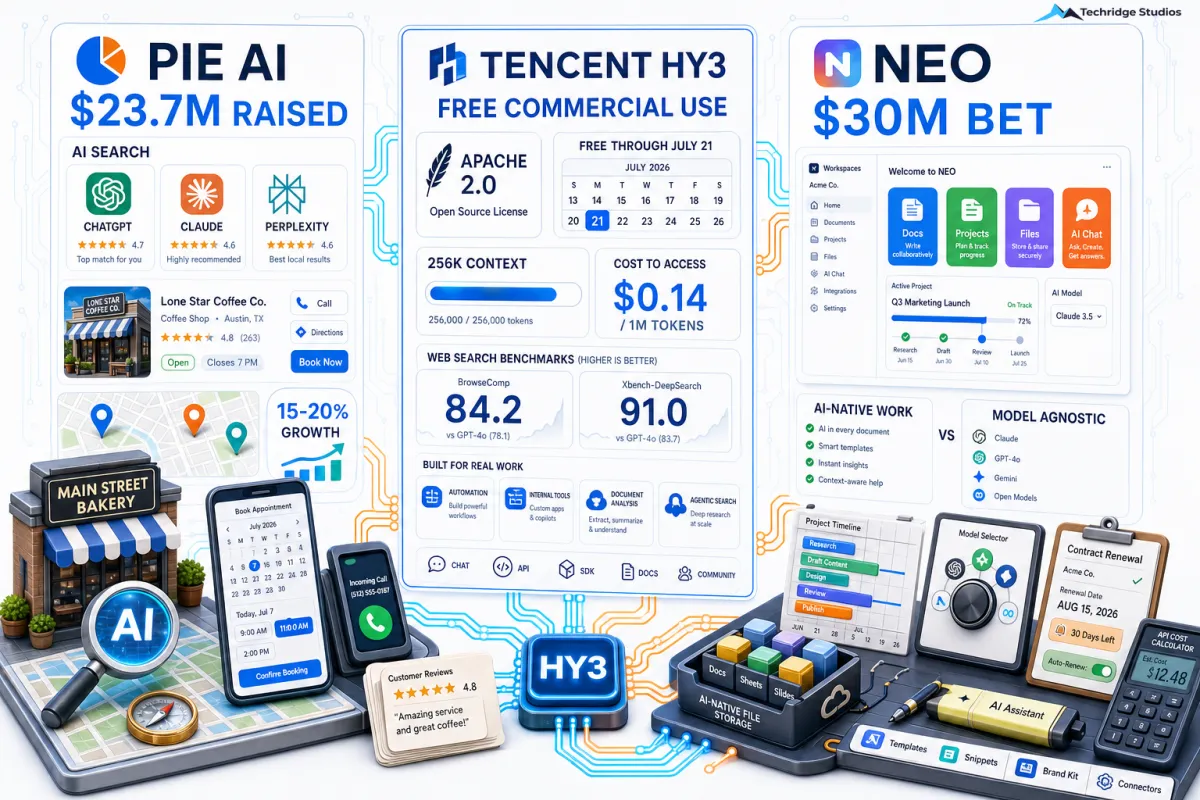
Pie was founded by Syed Ali and Akhil Mantripragada, former operators at Square and Toast who spent 15 years building software for small businesses. The platform runs three products. AI Search optimizes your business information so you appear in AI-powered discovery platforms like ChatGPT, Claude, and Perplexity, which are increasingly the starting point for consumers asking local buying questions. Growth helps businesses acquire customers across high-intent platforms like Google Maps, Yelp, and Nextdoor. Front Desk is an AI product that answers your phone calls 24/7, takes bookings, and responds to customer questions — without a staff member or answering service.
The numbers Pie cites from its early customer base are notable. Customers on the platform are seeing 15 to 20 percent year-over-year sales growth. For a franchise operator like Moxie Management Group — which runs 65 Supercuts locations — Pie replaced the agency model that required long contracts and opaque retainers. Pie also partners with vertical software platforms like Tekmetric, which serves over 15,000 auto repair shops, to distribute its tools directly inside the software that those businesses already use.
The action item here is straightforward: if your business serves local customers, test what happens when you type a "who should I use" question into ChatGPT for your category and market. If your business doesn't come up, that is the gap Pie is built to close. You can learn more at getpie.com. More importantly, this is a signal to check how your business profile information is structured across platforms — AI search pulls from structured data, reviews, and profile completeness in ways that differ from traditional search engine optimization.
Tencent Hy3: A Frontier AI Model Is Now Free for Any Business to Use
The cost of AI is collapsing faster than most small business owners realize. On July 6, 2026, Tencent released Hy3, a 295-billion-parameter Mixture-of-Experts AI model that delivers near-frontier performance at a fraction of the cost of major commercial APIs — and under an Apache 2.0 license that grants businesses full commercial freedom to use, modify, and deploy it without royalties or geographic restrictions.
Hy3 uses a Mixture-of-Experts architecture, which means that while the model has 295 billion total parameters, only 21 billion are active on any given task. This makes it dramatically cheaper to run than its parameter count implies. The model has a 256,000-token context window — large enough to process a full book, a long legal contract, or months of email history in a single pass. On agentic web search benchmarks, where the model is asked to navigate information across the web to complete tasks, Hy3 scores 84.2 on BrowseComp and 91.0 on DeepSearchQA, outperforming GPT-5.5 on those specific tasks.
For businesses that do not run their own servers, Hy3 is available on OpenRouter at no cost through July 21, 2026. After that, Tencent Cloud lists pricing at approximately 0.14 dollars per million input tokens — compared to 5 dollars per million for GPT-5.5 and 3 dollars per million for Claude Sonnet 5. That is roughly a 95 percent cost reduction for similar quality on the tasks Hy3 handles well. The model is also available on Hugging Face for self-hosting under the Apache 2.0 license.
The practical action for small businesses depends on how you currently use AI. If you are using AI tools through a subscription, such as ChatGPT Plus or Claude Pro, this model does not directly affect your bill. But if your business has any developer resources building internal tools, automations, document processors, or customer-facing AI features on an API, Hy3 is worth testing before the free window closes. The Apache 2.0 license also means you can build commercial products on it without the restrictions that came with some earlier open models from Chinese labs.
Neo: A 30 Million Dollar Bet That Microsoft Office Needs to Be Replaced, Not Updated
The debate in enterprise software right now is whether you can add AI to existing tools and get full value — or whether AI requires rebuilding from the ground up. Bhavin Turakhia has a clear position: you have to rebuild. He is personally investing 30 million dollars to prove it.
Turakhia is a serial entrepreneur who has previously built and sold companies, including Directi, Radix, and Titan, and is currently the CEO of banking software firm Zeta, which he also self-funded through early growth. His new venture, Neo, is an AI-native work platform that combines project management, documents, file storage, and AI into one product — designed from the first line of code to treat AI as a core participant in work, not a sidebar assistant. Notably, Neo is model-agnostic, meaning businesses can switch between AI providers without being locked into a single vendor.
Turakhia makes the case this way: "If you want to build an iPhone, you can't take the parts of a Nokia and somehow convert it into an iPhone." His argument is that Microsoft, Google, and Notion are all working from the wrong architectural foundation — they built tools for a world where humans did all the work, and they are now retrofitting AI into that structure. Neo was built in approximately three months using AI-assisted development, which Turakhia estimates would have taken a conventional team more than a year.
For small businesses, the relevance is straightforward. Microsoft 365 Business with Copilot became a permanent standard offering on July 1, 2026, with pricing starting at $23.50 per user per month. That is a meaningful cost per seat for a team of ten or twenty. Neo is currently in rollout to mid-sized businesses in technology, consulting, and professional services, with broader access expected this fall. If your business is due to review its office software contracts before the end of the year, Neo is worth adding to the evaluation list at neo.work.
What This Means for Your Business
This week's stories share a common thread: the AI economy is bifurcating into businesses positioned to benefit from these shifts and those that are not. Pie is capturing value for small businesses whose customers are already using AI for local discovery. Hy3 is making frontier-quality AI accessible to businesses that cannot afford major API costs. Neo is building for the businesses that will no longer accept paying a premium for software that was designed for a pre-AI workflow.
None of these require immediate action today. But each deserves 30 minutes of your attention. Search for your business in ChatGPT and note whether it appears. Check your current AI tool costs against what Hy3 could do for the same workflows. And if your Microsoft 365 renewal is coming up, look at what alternatives exist before you sign another year.
Sources
Business Wire — https://www.businesswire.com/news/home/20260630636582/en/Pie-Raises-$23.7M-to-Bring-AI-Powered-Growth-to-Main-Street-Businesses
TechCrunch — https://techcrunch.com/2026/07/01/indian-tech-tycoon-bets-30m-to-build-an-ai-alternative-to-microsoft-office/