The Upgrade Happening Inside Your Business Tools — Whether You Know It Or Not
Three stories today that connect across a single theme: the AI improvements that will matter most to small businesses this year are not happening at the surface. They are happening in the infrastructure, in government data, and in the daily workflow tools most owners take for granted.
Exa Labs Just Raised $250 Million to Power the Search Layer Inside Your Business Software
When most people think about AI funding, they picture chatbots and image generators. The $250 million round that Exa Labs closed on May 20th, 2026 is a different kind of story.
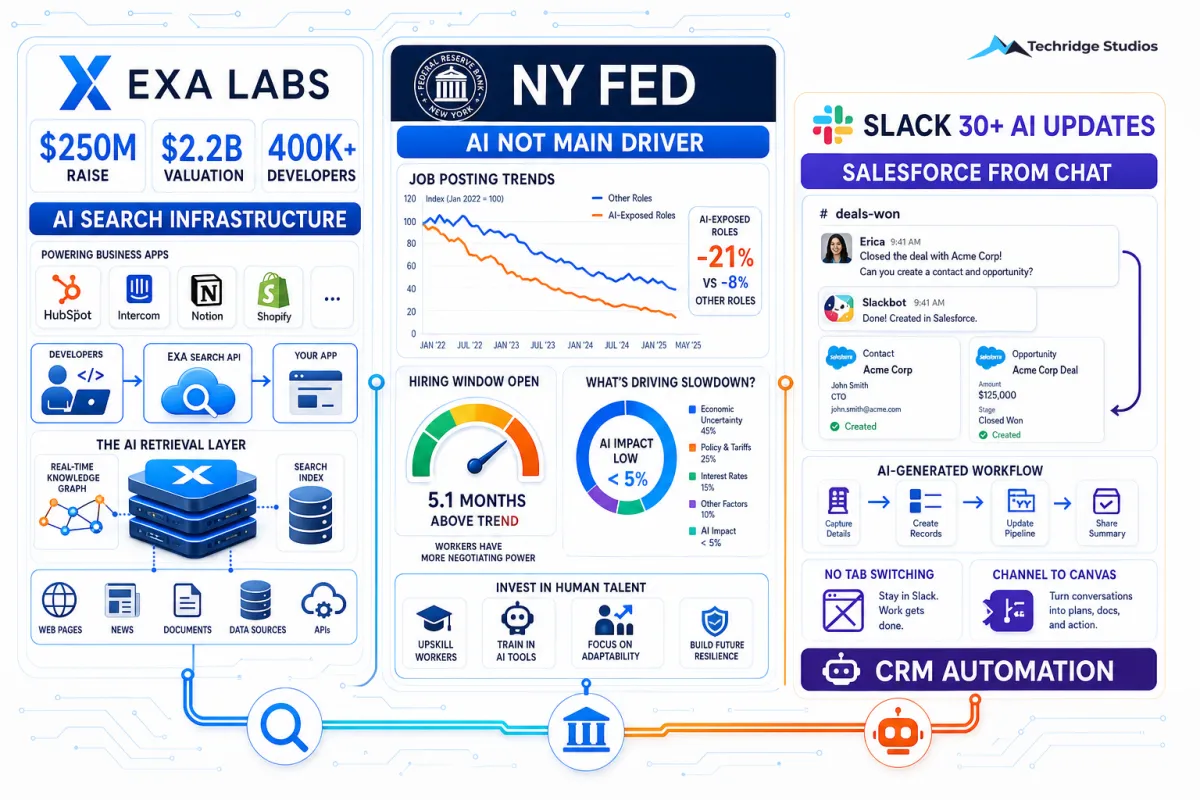
Exa Labs builds search infrastructure — the retrieval layer that AI agents and business software use to find accurate, relevant information in real time. Think of it as the plumbing that makes AI-powered features work inside tools like HubSpot, marketing platforms, and customer service dashboards. More than 400,000 developers build on Exa's technology, and companies like HubSpot have integrated it into their AI-powered product features.
Andreessen Horowitz led the round, valuing the company at $2.2 billion — more than three times its valuation from just last fall, when it raised $85 million at $700 million. That growth rate signals where institutional money sees the next AI wave going: not into models, but into the retrieval and search systems that make those models useful in real business contexts.
For small business owners, the practical implication is straightforward. The AI features inside tools you already subscribe to — the smart suggestions in your CRM, the AI-powered search in your help desk software, the automated research in your content tools — all of them depend on infrastructure like Exa's. As that layer gets better funded and more capable, those features improve automatically. You do not need to buy a new tool. You just need to be using tools that are built on solid AI infrastructure. This funding round is a strong signal that the ones built on Exa are.
Watch the broader trend here: Exa is not alone. Parallel Web Systems, led by former Twitter CEO Parag Agrawal, recently raised $100 million at a $2 billion valuation. Tavily is growing fast. A wave of capital is flowing into AI search infrastructure, and that is going to compound the intelligence of every business software product built on top of it.
The Federal Reserve Bank of New York Just Released the Most Useful Hiring Data of the Year
There has been a lot of noise about AI replacing jobs. The data from the Federal Reserve Bank of New York's Liberty Street Economics team, published in mid-May 2026, is the most grounded look yet at whether that is actually happening.
The short answer: AI is not the main driver of the current hiring slowdown. Economists Richard Audoly, Miles Guerin, and Giorgio Topa analyzed job posting data across industries and occupations to test whether AI-exposed roles were being cut disproportionately. They found that while overall hiring has slowed since ChatGPT launched in late 2022, the evidence from job postings does not show a distinct, AI-driven collapse in labor demand.
What is driving the slowdown? Primarily the same forces that have driven economic softness for the past two years: elevated interest rates, companies correcting for the overhiring that happened during the post-pandemic boom, and a weak overall labor backdrop.
For small business owners who have been holding off on hiring because they thought AI would make those positions obsolete, this data is a practical green light. You still have a real window to hire and develop human talent in roles that AI may eventually affect. The window is not closed.
But there is a nuance you need to read carefully. The Fed's data does show that job postings for AI-exposed occupations have declined at a faster rate than postings for other roles — and that divergence started before ChatGPT even launched. The implication is that companies are already, quietly, and perhaps unconsciously, posting fewer roles in functions where AI is likely to take on more of the work.
The actionable takeaway for small businesses: if you need to hire someone in a customer-facing, administrative, content, or data-processing role, do it now while the market still expects humans to fill those seats. Use that time to build AI fluency into the job from day one. The businesses that win the next phase of this transition will be the ones that staffed up with AI-ready humans during the window the Fed just confirmed is still open.
Slack's May 2026 AI Update Wave Just Changed How Lean Sales Teams Work
Slack shipped more than 30 AI-powered updates in its May 2026 release wave, and for small businesses running any kind of sales or customer success operation, the most important change deserves a closer look.
Slackbot can now create and update Salesforce records directly from a Slack conversation, targeting general availability in May and June 2026. That means a sales rep can close out a call, type a message in Slack, and have Slackbot log the deal stage change, create a new contact, or update an existing account — all without leaving the conversation thread. No switching tabs. No copying information from chat into a CRM field. No data entry lag between when the conversation happened and when the record reflects reality.
For a small business with one or two people managing sales, this is not a minor convenience. It is the difference between CRM data that reflects what actually happened and CRM data that lags two hours behind because nobody had time to log it.
The update goes further. Slack's May wave includes a new Generate AI Response step that can be added to any Slack automation, pulling from knowledge sources like channels, canvases, and lists to produce contextually accurate answers. Teams can now create Slack canvases directly from channel summaries, and AI-generated workflow steps reduce the technical overhead of building internal automations.
For small businesses that have hesitated to invest in workflow automation because it felt too technical, these updates lower the barrier significantly. Slack is building a layer where plain-language instructions trigger real business processes — and the Salesforce integration is the clearest proof yet that this is not just a demo capability. It is going to general availability this month.
What This Means for Your Business
Today's three stories share a theme: the AI that will affect your business most in the next six to twelve months is not showing up as a dramatic announcement. It is showing up as a funding round in an infrastructure company you have never heard of, a government research paper with a nuanced workforce finding, and a software update in a tool your team already uses every day.
The action from today's brief is simple. If you use Slack and Salesforce, turn on call delegation and test the Salesforce integration this week. If you are hiring, move now — the Fed's data confirms the human-hiring window is still open, but it is not permanent. And if you are evaluating which business software to use going forward, ask whether the tools you are considering are building on modern AI search infrastructure. That invisible layer is about to become a major differentiator.
Sources
SiliconANGLE — https://siliconangle.com/2026/05/20/exa-labs-raises-250m-2-2b-valuation-ai-search-tools
Liberty Street Economics, Federal Reserve Bank of New York — https://libertystreeteconomics.newyorkfed.org/2026/05/do-job-postings-show-early-labor-market-effects-of-ai/
eWeek — https://www.eweek.com/news/slack-ai-update-salesforce-slackbot-2026/