Your AI Tool Stack Is Now a Legal Decision
For the past two years, choosing an AI tool was mainly a performance and price question. This week, the U.S. government made it a legal one. Three stories converged on July 24th that small business owners need to understand: a White House accusation of AI theft that could trigger overnight sanctions, the stable release of one of the cheapest production-ready AI models on the market, and the launch of an enterprise AI agent platform that signals where the whole market is heading.
UPDATE: White House Accuses Moonshot AI of Copying Anthropic's Fable to Build Kimi K3
On July 22nd, White House OSTP Director Michael Kratsios publicly accused Chinese AI firm Moonshot AI of conducting "large-scale, covert industrial distillation" of Anthropic's Fable model to build Kimi K3. In plain terms, the allegation is that Moonshot fed Anthropic's model outputs into its training pipeline at scale — capturing the value of billions of dollars in Anthropic's research investment to build a competing product without permission.
Kimi K3 is not a fringe product. When it launched on July 16th as the largest open-weight AI model ever released, with 2.8 trillion parameters, it immediately ranked first on the Frontend Code Arena benchmark with a 76% win rate against Claude Fable 5. The AI industry was already watching closely when Moonshot announced the free release of K3's open weights for July 27th. After this week's accusations, the audience got significantly larger and more cautious.
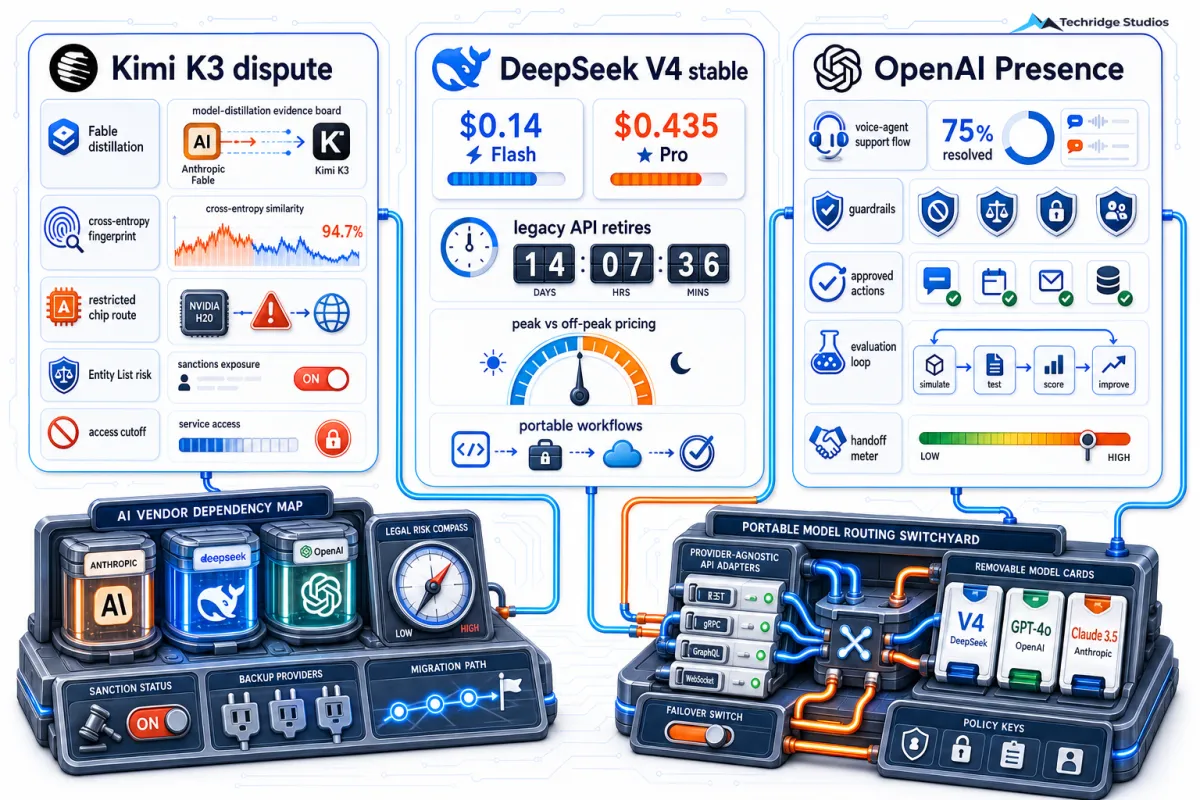
The accusation has technical support. Redwood Research Chief Scientist Ryan Greenblatt published a cross-entropy analysis finding that Kimi K3 identifies itself as Claude at statistically anomalous rates across a large set of prompts — the kind of behavioral fingerprint that distillation disputes rely on as evidence. A single screenshot of a model misidentifying itself proves little. A systematic pattern measured across many prompts and compared against a baseline of other models is a different kind of claim. The analysis is suggestive; it is not a legal finding.
The business implication is more immediate than the legal debate. Kratsios separately alleged Moonshot accessed restricted Nvidia GB300 chips routed through Thailand — a potential export control violation with well-established enforcement mechanisms. The U.S. Treasury Department is now weighing whether to add Moonshot to its Entity List. An Entity List designation would prohibit U.S. companies and individuals from accessing Moonshot's products without a special license. That can happen quickly and without advance warning. If your team uses Kimi K3 or any Moonshot product, this is the week to understand your exposure.
DeepSeek V4 Exits Preview — Stable GA Lands in the Middle of the Controversy
DeepSeek's V4 model family officially exits preview and enters stable general availability today, July 24th. The legacy API aliases — deepseek-chat and deepseek-reasoner — retire at 15:59 UTC today. V4 comes in two tiers: V4 Pro at $0.435 per million input tokens and V4 Flash at $0.14 per million input tokens. A new peak/off-peak pricing mechanism doubles rates during Beijing business hours (9 AM–12 PM and 2–6 PM Beijing time), which is worth factoring into workflow scheduling if you run batch jobs.
For small businesses doing high-volume AI tasks, the pricing difference matters. A task that costs $1.00 on a major U.S. frontier model could cost $0.03 or less on DeepSeek V4 Flash. That gap compounds quickly for teams doing document processing, customer support automation, or content generation at scale. Third-party providers including Together AI, Fireworks AI, AWS Bedrock, and Azure AI Foundry now offer V4 with data residency outside China at a modest premium — an option worth considering if data sovereignty matters for your business.
DeepSeek has not been accused of anything in this week's news cycle. But it is a Chinese company, and the policy environment around Chinese AI providers is tightening regardless of the specific allegations targeting Moonshot. The same Entity List risk that applies to Moonshot today could, in a different political moment, apply to any Chinese AI provider. That is not a reason to avoid DeepSeek categorically. It is a reason to build your workflows to be portable.
The right approach is to treat provider access the same way you treat any critical vendor dependency: document it, understand your exposure if it disappears, and have a migration path ready. Teams that hard-code a single provider's API into every layer of their system find out the cost of that decision at the worst possible moment. Teams that maintain provider-agnostic architecture can swap in 48 hours.
OpenAI Presence — The AI Agent Governance Standard Just Got Set
On July 22nd, OpenAI launched Presence, an enterprise platform for deploying AI agents across customer support, outbound sales, procurement, IT services, and HR workflows. Presence is not a new model — it is a deployment and governance layer. It packages the infrastructure that production AI agent deployments actually need: shared company context, documented policies and standard operating procedures, guardrails, approved action lists, simulation environments for testing, evaluation pipelines, and a Codex-powered feedback loop that continuously improves agent performance.
The numbers OpenAI cited are real production results. Presence already handles OpenAI's own English-language phone support line and resolves 75% of inbound calls without a human. A Codex-driven improvement loop cut human handoffs by 15 percentage points within 10 days of go-live. Those come from a live deployment in a complex support environment, not a controlled demo. BBVA, SoftBank, and IAG are among the enterprises exploring it.
For now, Presence is out of reach for most small businesses — every implementation requires OpenAI's Forward Deployed Engineers or approved systems integrators, which means enterprise-tier pricing. There is no self-serve API path. This is OpenAI moving into consulting territory: solving the integration, change management, and governance work that software licenses alone cannot do. It is the right call for closing enterprise deals; it is not a small business product.
What matters for small businesses is the governance framework, not the price tag. The layer Presence establishes — policies that govern agent behavior, guardrails that prevent unauthorized actions, approved action lists, human handoff triggers, continuous evaluation — is not proprietary to OpenAI. It is the baseline any responsible AI agent deployment should have, at any scale. If your team is deploying AI agents today, even simple ones answering customer questions or routing support tickets, building these layers now costs almost nothing. Waiting until you have 10x the traffic to retrofit them costs significantly more.
What This Means for Your Business
The story of this week is about trust and portability. Three major AI developments arrived at the same time, and the common thread is that the tools your business relies on are more fragile and more contested than most operators realize. Sanctions can cut off access to a tool you depend on. Providers change pricing overnight. Legal accusations can shift market access in days, not months. The businesses that will navigate this well are the ones treating AI providers the way they treat any critical vendor: with documented dependencies, backup options, and governance built into the workflow before the stakes get high.
The concrete action for today: spend 30 minutes mapping every AI tool your team uses. Note who builds it, where they operate, and what your backup plan is if that tool becomes unavailable tomorrow. That exercise costs almost nothing. Not doing it could cost significantly more.
Sources
Dataconomy — https://dataconomy.com/2026/07/23/white-house-accuses-moonshot-of-copying-anthropic-ai/
DeepSeek API Docs — https://api-docs.deepseek.com/news/news260424/