The AI Tools Reshuffle: SpaceX Acquires Cursor, Pinterest Goes AI-First for Ads, and Google Starts Cutting
Three stories landed in the last 48 hours that, taken together, make the same argument: the AI tools your business depends on are not stable infrastructure. They are assets being acquired, built into platforms, and deprecated on accelerating timelines. Here is what happened, why it matters, and what to do about it.
SpaceX Acquires Cursor for 60 Billion Dollars — Every Major AI Coding Tool Now Has a Corporate Owner
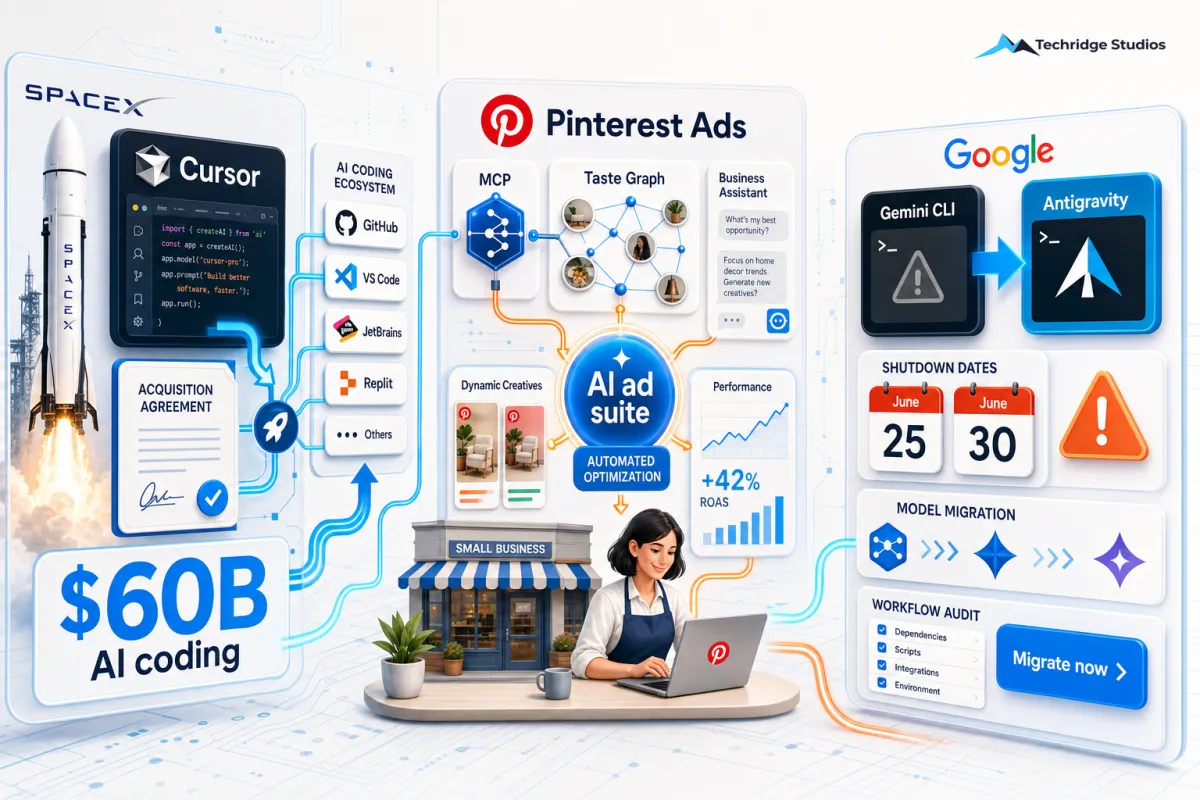
SpaceX filed an SEC Form 8-K on June 16, 2026, confirming a binding merger agreement to acquire Anysphere Inc. — the company behind AI coding assistant Cursor — for 60 billion dollars in all-stock. The deal is the largest AI software acquisition on record, surpassing any prior software M&A deal. Closing is expected in Q3 2026, pending regulatory approval. Cursor will survive as a wholly owned subsidiary of SpaceX.
The strategic logic is straightforward: SpaceX's AI division, built around xAI (which merged with SpaceX in February 2026), needed a proven enterprise distribution channel. Cursor had it — approximately 4 billion dollars in annualized recurring revenue, a large developer customer base, and an IDE-level product that GitHub Copilot and Claude Code hadn't fully displaced. SpaceX also confirmed that the two companies have been jointly training a new AI coding model on xAI's Colossus supercomputing infrastructure, which will ship in both Cursor and Grok Build in the near term.
The deal completes a consolidation that happened remarkably fast. As of June 18, 2026, every major AI coding tool has a tech giant behind it: GitHub Copilot (Microsoft), Claude Code (Anthropic), Codex and Windsurf (OpenAI), and Cursor plus Grok Build (SpaceX). The only notable exception is Tabnine, which serves enterprise customers who need on-premise deployment. The independent AI coding tool market, which existed for less than three years, is now closed.
For small businesses, this matters in two ways. First, the tools you use will increasingly reflect the priorities of their parent companies — model selection, pricing tiers, and feature roadmaps will all serve larger strategic goals. Second, Cursor under SpaceX will almost certainly shift toward the jointly trained SpaceX-xAI model as its default, which could reduce or eliminate support for Claude and GPT within Cursor over time. If your development team uses Cursor specifically because of its multi-model flexibility, that feature may not survive the acquisition intact. Now is a good time to document which AI coding tools your team depends on and what your backup options are.
Pinterest Launches AI Ad Suite at Cannes Lions — A New Layer for Small Business Advertisers
Pinterest took a meaningful step at Cannes Lions 2026, unveiling a three-part AI ad suite: a Model Context Protocol (MCP) integration, an AI Business Assistant, and upgraded Pinterest Performance+ creative capabilities. For small businesses advertising on Pinterest, the Performance+ update is the most immediately useful — it uses a new AI model to dynamically select the best creative variant per ad impression, replacing manual A/B testing with automated optimization. That means fewer hours spent testing creative and more consistent ad performance without expanding your team.
The MCP integration is the more forward-looking piece. Pinterest MCP connects the platform's campaign analytics, keyword data, and its proprietary "Taste Graph" — Pinterest's internal map of user preferences and purchase intent — directly into the AI copilots and agentic tools advertisers already use. Alpha partners include PMG, Pacvue, Dentsu, Havas, Innovid, and Omnicom's Jump450. For small businesses using AI-assisted marketing tools, this means Pinterest-specific insights can start flowing into your existing workflow rather than requiring a separate login and manual reporting pull.
Pinterest also announced "Ask Pinterest," an experimental standalone app that brings conversational AI to product discovery. Users can describe what they're looking for in natural language — similar to asking a knowledgeable friend — and the app draws on Pinterest's visual search catalog and Taste Graph to surface relevant products. It's currently in limited access, but the intent is clear: Pinterest is positioning itself as an AI-powered shopping destination rather than just an image board. For merchants, that shift means purchase intent on Pinterest is becoming more actionable.
The broader significance of these announcements is that Pinterest is building AI directly into its advertising infrastructure, rather than bolting it on as a separate tool. For small businesses running social ads on limited budgets, a platform that handles creative optimization automatically and surfaces audience insights through your existing tools is a meaningful productivity upgrade. If you advertise on Pinterest and haven't explored Pinterest Performance+ recently, the updated creative capabilities are worth a fresh look.
Google Retired the Gemini CLI Today — Two More Models Gone June 25th
If your business has any integration with Google's AI tools — including automations built on the Gemini API, content pipelines using Gemini 2.0, or developer workflows using the Gemini CLI — you need to run a check today. As of June 18, 2026, Google officially retired the Gemini CLI and replaced it with the Antigravity CLI, the new command-line interface that shipped at Google I/O 2026 alongside the Antigravity platform for agentic development. Any CI/CD pipeline, automation, or developer script that calls the Gemini CLI by name will have stopped working this morning.
The deprecation wave is broader than just the CLI. Gemini 2.0 models were already shut down earlier this month. Two more — gemini-3.1-flash-image-preview and gemini-3-pro-image-preview — shut down on June 25th, one week from today. Video generation models (the predecessors to Veo) follow on June 30th. Google's replacement guidance: migrate standard inference to the gemini-3.5-flash or gemini-3.1-flash-lite models; migrate image and video generation to the Veo 3.1 preview model IDs. The new Gemini 3 GA models are stable and production-ready.
The urgency here is greater than that of typical API deprecations because the timelines are compressed. The June 25th deadline is seven days away. If you are running a no-code automation platform that uses Gemini under the hood — many do, including some AI writing tools, customer service platforms, and content schedulers — the platform may handle the migration on its end. But if your team or a developer built a custom integration, you need to verify which model IDs it calls and test against the new versions before the 25th.
The practical steps: log in to your Google AI Platform account and check which model IDs your integrations are calling. If you see any Gemini 2.0 model IDs, those need to be migrated now. If you see the image preview model IDs, those need to be updated before June 25th. Google's official migration guide is in the Gemini API release notes, linked in the sources below. If you don't have a developer on staff, reach out to whoever built your integration and forward them the deprecation schedule — this is not something that resolves itself.
What This Means for Your Business
All three stories today point to the same underlying dynamic: the AI tools layer is maturing fast, and that maturity looks a lot like consolidation, platform integration, and accelerating version cycles. SpaceX's acquisition of Cursor means fewer independent AI coding tools. Pinterest embedding AI into its ad platform means the advertising surface you buy is now AI-managed. Google's deprecation cycle means the AI APIs you build on have shorter stable lifespans than traditional software.
The businesses that will navigate this well share one characteristic: they know their AI stack. They can list every AI tool they use, who owns it, what it costs, and what they would do if it changed. If you cannot do that right now, this week's news is a practical reason to build that list. It does not need to be complicated — a simple spreadsheet with tool name, vendor, use case, and renewal date gets you most of the way there. The one action for today: if you use any Google AI integration, check it before June 25th.
Sources
TechCrunch — https://techcrunch.com/2026/06/16/spacex-to-acquire-cursor-for-60b-in-stock-days-after-blockbuster-ipo/
Pinterest Newsroom — https://newsroom.pinterest.com/news/cannes-2026/
Build Fast With AI / Google AI for Developers — https://www.buildfastwithai.com/blogs/ai-news-today-june-17-2026