Apple, Intuit, and Figma Just Made AI Moves — Here Is What It Means for Your Business
Three companies that millions of small businesses depend on made significant moves in AI this week. Apple teased a major AI platform. Intuit restructured its entire workforce around AI. And Figma shipped a native AI assistant inside the tool that your team may already use. None of these are future promises — they are changes happening right now to software you may already pay for.
Apple Is Building a Generative AI Hub — and You Will Choose Which AI Powers Your Devices
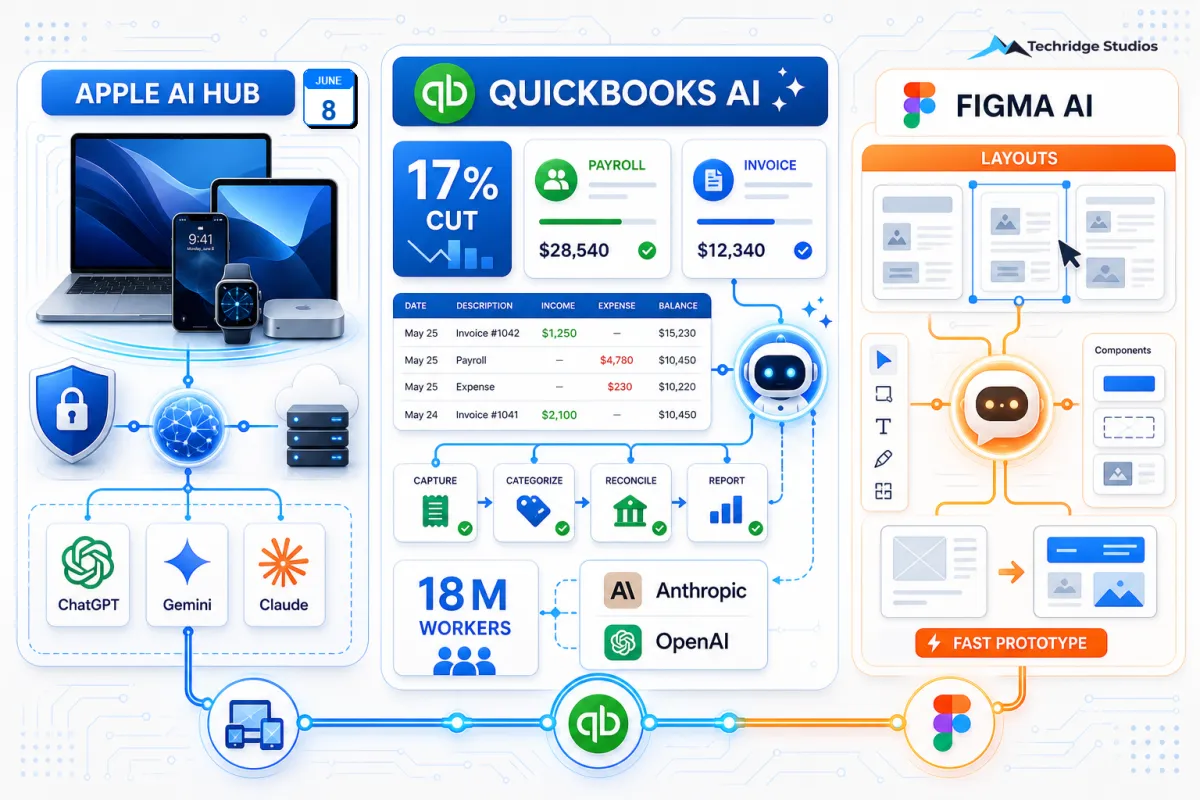
Apple registered the subdomain genai.apple.com on May 25, 2026. The address is not yet live, but its registration ahead of the company's Worldwide Developers Conference on June 8th signals that a dedicated hub for generative AI tools is coming. Apple typically previews its biggest software initiatives at WWDC before rolling them out in fall operating system updates.
Bloomberg has confirmed Apple plans to allow users to select their preferred AI model — ChatGPT, Claude, or Gemini — as the default supporting AI on their device. This is a significant shift. Until now, Siri was the only option. iOS 27, expected to debut at WWDC, is also expected to bring a dramatically improved Siri with stronger natural language understanding and the ability to complete tasks across apps.
What makes Apple's approach notable for businesses is its privacy architecture. Apple is building these features around Private Cloud Compute, which processes AI requests on-device or through Apple's own servers — not through third-party AI companies' infrastructure. For business owners handling sensitive customer data, that distinction matters.
If your business runs on Apple devices — and most small businesses do — the tools you use every day are about to get significantly more capable. The practical action right now: mark the WWDC keynote on June 8th on your calendar and watch which AI integrations Apple confirms. The choices made that day will shape your device ecosystem for the next year.
Intuit Is Rebuilding QuickBooks Around AI — and Changes Are Already Live
Intuit announced on May 20, 2026, that it is cutting approximately 3,000 employees — about 17 percent of its 18,200-person global workforce. CEO Sasan Goodarzi told staff the company is "reducing complexity" and redirecting the freed capital toward AI partnerships with Anthropic and OpenAI. The final employment date for affected U.S. staff is July 31.
This is not a distress signal. QuickBooks Online Accounting revenue grew 22 percent in Q3. The business is performing well. Intuit is choosing to invest aggressively in AI while it has the resources to do so — before competitors force its hand.
The most important change for small businesses is already live. QuickBooks Workforce — an AI-native human capital management product — launched on May 6th and integrates with existing payroll accounts. It now serves 18 million U.S. workers. Over the coming months, Intuit has signaled that automated bookkeeping, AI-powered financial recommendations, and an agent-style support model will replace many of the manual workflows small business owners currently handle themselves.
One practical concern for some users: with 3,000 fewer employees, human customer support will become harder to reach on lower-priced plans. If your team has relied on QuickBooks support, now is a good time to explore the AI features already available in your account so you can self-serve more routine questions.
Figma's AI Assistant Puts a Designer Inside Your Canvas
Figma released a built-in AI assistant for its collaborative design canvas in May 2026. The assistant can generate layouts, suggest and iterate on design components, answer design questions in the context of your specific file, and help non-designers produce polished visual output — all without leaving the Figma workspace.
Figma is used by millions of teams worldwide — not just product designers, but marketing teams, operations managers, startup founders, and small business owners who use it to create presentations, pitch decks, landing page concepts, and social media assets. For many of those users, getting from an idea to a usable visual has always required either design skills or a designer's budget.
The built-in assistant changes that. You do not need a new tool or a separate subscription. If you already use Figma, the AI is available in your existing workspace.
For small businesses that produce any visual content — which is virtually every business with a website, a social media presence, or a product — this is worth exploring immediately. Open Figma, describe what you need, and see how far the AI can take you before you need to involve a human designer.
What This Means for Your Business
This week's moves follow a pattern: the tools small businesses already pay for are getting AI built directly into them. You do not need to find new software. You need to learn what the software you already use can now do.
The one action to take this week: log into QuickBooks and review the AI features in your account. Then add Apple's WWDC keynote on June 8th to your calendar. Two things to learn, zero new subscriptions required.
Sources
TechCrunch — https://techcrunch.com/2026/05/20/intuit-to-lay-off-over-3000-employees-to-refocus-on-ai/
TechCrunch — https://techcrunch.com/2026/05/20/figma-adds-an-ai-assistant-to-its-collaborative-canvas/