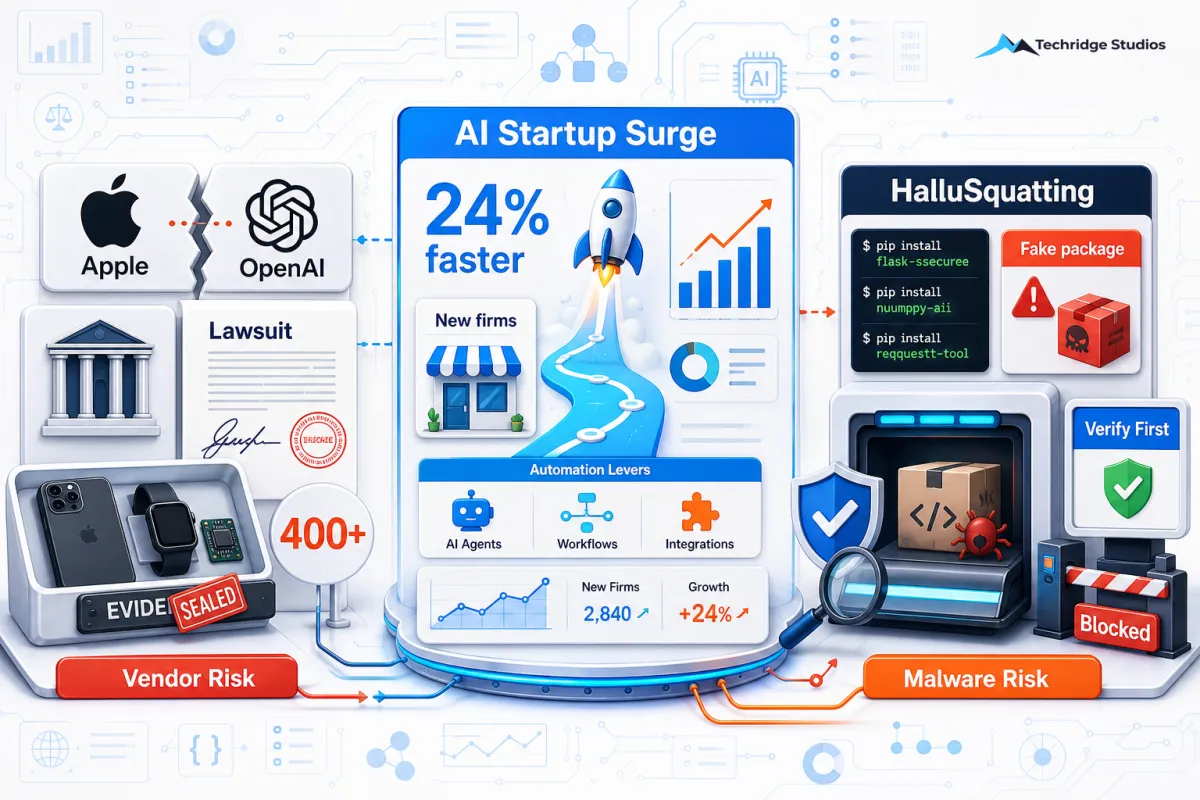
Apple Sues OpenAI, Startups Are Surging, and Malware Is Getting Smarter
The AI landscape is moving faster than most businesses can keep up with. This week brought a blockbuster lawsuit, a data point that should reframe how you think about competition, and a new security threat that most IT policies do not cover. All three stories land directly on small businesses. Here is what happened and what to do about it.
Apple Takes OpenAI to Court — and the Integration You Were Counting On Is at Risk
Apple filed a federal lawsuit against OpenAI on July 10, 2026, alleging that hundreds of former Apple employees who moved to OpenAI engaged in systematic trade secret theft. The complaint, filed in the U.S. District Court for the Northern District of California, describes the alleged scheme as operating "at every level" of OpenAI — from individual contributors up to OpenAI's chief hardware officer.
The named hardware chief, Tang Tan, is a former Apple vice president who Apple alleges directed job candidates still employed at Apple to bring "actual parts" from Apple's unreleased product lines to show-and-tell sessions during job interviews. A second named defendant, Liu, allegedly failed to return a company laptop, accessed a former colleague's work computer after his departure, and downloaded "dozens of Apple's confidential hardware-related files, including voluminous, detailed information about unreleased products."
The timing matters. OpenAI has been moving aggressively into the hardware space since acquiring Jony Ive's startup, IO Products, for $6.4 billion. Apple views that move as a direct competitive threat. The 2024 partnership between the two companies — which was supposed to embed ChatGPT into iOS, macOS, and Siri — has cooled significantly, and this lawsuit may effectively end it.
For small businesses that were counting on Apple's AI integrations to arrive as a seamless, included feature, that timeline is now uncertain. OpenAI denied the allegations and said it remains focused on building innovative technology. Whatever the outcome of the lawsuit, a legal battle of this scale creates uncertainty in product roadmaps. Identify which AI tools your business depends on, and ensure you have alternatives if any single integration goes dark.
AI Is Lowering the Barrier to Start a Business — Which Means More Competition Is Coming
Bloomberg reported on July 10, 2026, that artificial intelligence is set to produce a record number of new business startups. In some sectors, the number of new firms projected to launch in the next 12 months is 24 percent higher than the same period last year. The data comes from Gusto economist Aaron Terrazas, whose firm works directly with hundreds of thousands of small businesses.
The driver is straightforward: AI has collapsed the cost of building and operating a company. Tasks that previously required a marketing hire, a bookkeeper, a customer service team, or a developer can now be handled by AI tools at a fraction of the cost. A two-person team with the right AI stack can execute what took ten people and twice the runway in 2022.
That is good news for new entrants. It is a warning for existing businesses. The new competition entering your market is not building on legacy systems or old processes. They are starting AI-native — no inherited tools, no outdated workflows, and no reluctance to automate everything from day one. They are also entering with lower overhead, which means they can price aggressively and still be profitable.
The action item is the same whether you see this as a threat or an opportunity. Audit your AI usage today. Are you using AI across operations, marketing, and customer-facing functions? Are you automating tasks that do not require human involvement? If not, the new entrants coming into your market almost certainly are. The tools are available to every business equally. The advantage goes to those who use them first.
HalluSquatting: The AI Security Threat Your IT Policy Probably Does Not Cover
SecurityWeek reported on July 10, 2026, that a new attack technique called "HalluSquatting" is actively targeting developers, technical teams, and businesses that use AI tools for coding or research. The attack exploits a well-known weakness in AI models: hallucination.
Here is how it works in practice. A developer or business owner asks an AI assistant — ChatGPT, Claude, Copilot, or any similar tool — to help them build a feature, install a plugin, or configure a system. The AI generates a recommendation that includes the name of a software package. The name sounds plausible. But the package does not exist. The AI invented it.
This is where the attacker steps in. Hackers monitor AI models and preemptively register the fake package names they observe AI tools inventing. When an unsuspecting user runs the install command the AI suggested, they are not getting the tool they expected. They are downloading a botnet — malicious software that turns their machine into part of an attacker-controlled network.
The SecurityWeek report identifies an active campaign using this method to target technical workers across multiple industries. Small businesses are at elevated risk because most do not have dedicated security reviews of AI-generated outputs. The attack requires no phishing email, no social engineering, and no known vulnerability in your existing software. It only requires one person to trust an AI recommendation without checking it first.
The mitigation is simple and must be turned into a written policy. Before anyone on your team installs software, a package, a library, or a tool that an AI recommended, verify it independently in the official repository or on the vendor's official website. Verify the publisher is who they claim to be. Do not run install commands from AI outputs without a manual review step. This single habit blocks the entire attack vector.
What This Means for Your Business
This week's three stories share a common thread: AI has become load-bearing infrastructure for business, and that comes with real structural risks. Vendor relationships can collapse overnight. The competitive landscape can shift in a quarter. And the same AI tools that make your work faster can be exploited as an attack surface if your team does not verify what they are acting on.
The single action to take this week: run a quick AI audit. List every AI tool your team uses. Note which ones are load-bearing — meaning your operations would break down or slow significantly if they were removed. For each one, identify a backup. Then document a one-rule policy for AI-generated technical recommendations: verify before you install. Both steps take less than an hour and give you meaningful protection against all three of today's threats.
Sources
TechCrunch — https://techcrunch.com/2026/07/10/apple-sues-openai-over-alleged-trade-secret-theft/
SecurityWeek — https://www.securityweek.com/hallusquatting-turns-ai-hallucinations-into-botnet-delivery-mechanism/