ChatGPT Gets Bank Access, HubSpot Tracks Your AI Rank for Free, and Amazon Kills Rufus
Three of the biggest platforms in tech made quiet but significant moves this week — and all three landed directly in the daily operations of small business owners. AI is no longer just a productivity tool you use occasionally. It is now woven into your banking, your search visibility, and how customers buy from you.
ChatGPT Can Now Read Your Financial Accounts
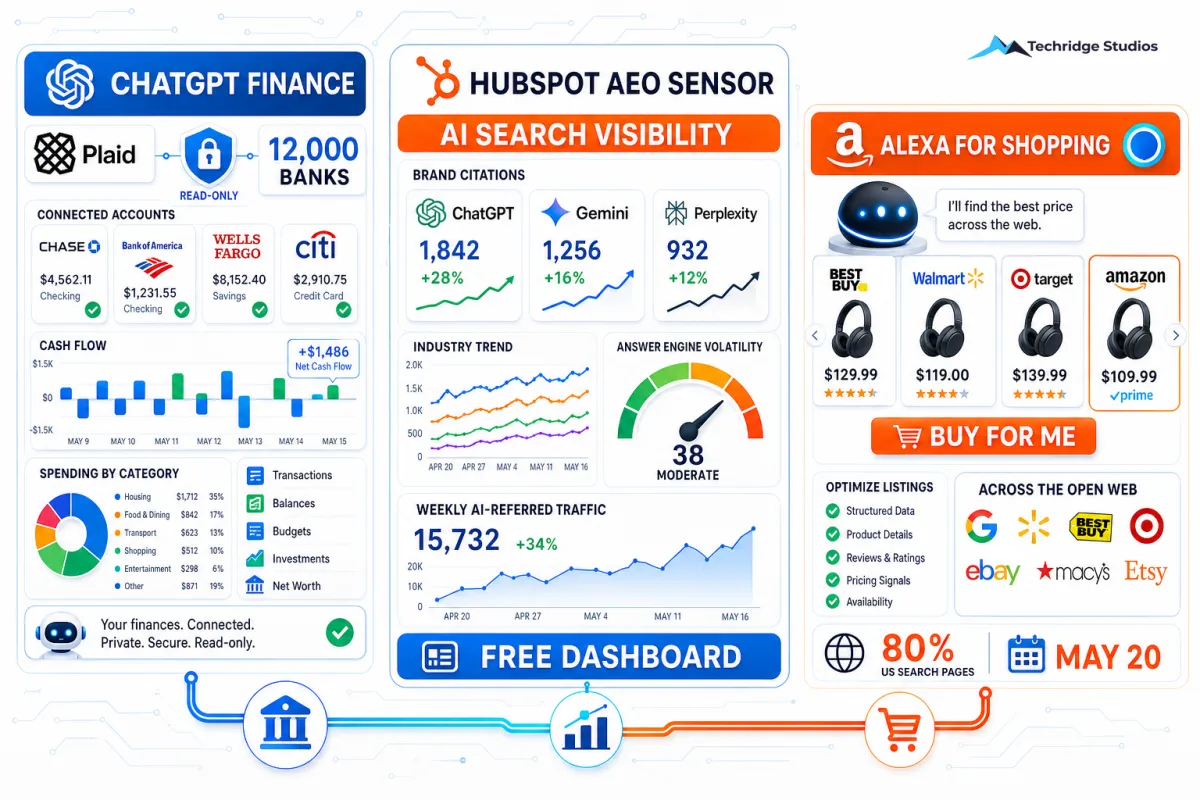
On May 15, 2026, OpenAI launched ChatGPT Personal Finance in partnership with Plaid, the financial data infrastructure company that connects software to over 12,000 banking and investment institutions. The feature is live in preview for ChatGPT Pro subscribers in the United States, with a rollout to Plus subscribers planned based on early user feedback.
Setup is simple. Users click "Finances" in the ChatGPT sidebar, connect their accounts through Plaid, and ChatGPT gains read-only access to balances, transactions, investments, and liabilities. It cannot execute transactions or see full account numbers. From there, it answers plain-language questions about spending patterns, cash flow timing, savings rates, and budget gaps using your actual data — not averages or estimates.
OpenAI said it plans to add support for Intuit in the near future, which would allow questions about tax implications and credit scenarios to be answered using live financial data. That would make this tool meaningfully more powerful for business owners who track profit and loss through QuickBooks or similar platforms.
For small business owners who manage cash flow personally or blend personal and business finances in the same accounts, this is a meaningful development. It turns ChatGPT into something closer to an on-call financial analyst: one that reads your real numbers, speaks plain English, and costs nothing beyond an existing subscription. The practical action today is to connect your primary checking account if you are a Pro subscriber and ask ChatGPT where your biggest monthly expenses are trending. You will have a working baseline before the tool ever reaches Plus users.
HubSpot Launched a Free Tool That Tracks Your AI Search Visibility
On May 14, 2026, HubSpot launched AEO Sensor, a free, public dashboard that tracks how frequently ChatGPT, Gemini, and Perplexity cite brands in AI-generated responses, organized by industry. No login is required. No subscription is needed. The dashboard monitors daily answer engine volatility, weekly AI-referred traffic volumes, and brand citation trends by sector, covering historical data back to February 2026.
The launch follows HubSpot's April 2026 rollout of its paid AEO product, which starts at 50 dollars per month and monitors individual brand performance in AI search. AEO Sensor is positioned as the industry-level companion: a shared instrument that shows any marketer or business owner how their sector is performing in AI search, at no cost.
The data behind the tool reveals something important. According to HubSpot, ChatGPT sent the lowest volume of referred traffic to businesses in April 2026 compared to any point in the preceding twelve months — even as more users turn to ChatGPT as a primary search replacement. The implication is that ChatGPT is answering more questions internally rather than routing users to external websites. For businesses that depend on inbound web traffic from search, this is a significant shift and warrants active monitoring.
For small businesses, AEO Sensor answers a question many owners have been asking without knowing how to measure it: is ChatGPT recommending my business to potential customers? The free version gives you the industry baseline. The paid version gives you your specific brand's standing. Either way, AI search visibility is now a trackable metric — and ignoring it is an active choice, not a default position. A quick visit to HubSpot's AEO Sensor dashboard takes two minutes and tells you whether the tools your customers use to find products are sending them your way.
Amazon Replaced Rufus With an AI Agent That Shops the Entire Web
On May 13, 2026, Amazon retired Rufus — its AI shopping chatbot launched in 2024 — and replaced it with Alexa for Shopping, a significantly more capable AI agent that can research, compare, and purchase products from any website on the internet, not just Amazon's own marketplace. The rollout begins appearing in 80 percent of U.S. Amazon search result pages starting May 20, with full Echo Show voice integration across all models by June 2026.
The most significant new capability is "Buy for Me" — a feature that lets Alexa for Shopping identify, evaluate, and complete a purchase from a non-Amazon retailer on a user's behalf. This makes Amazon's AI not just a recommendation engine but a procurement agent: one that acts on behalf of the customer across the entire commercial web, not only within Amazon's ecosystem.
For small businesses that sell on Amazon, the algorithmic stakes just increased. Alexa for Shopping's recommendation logic draws on individual purchase histories, behavioral signals, and product listing quality at a scale no individual seller can replicate. Sellers currently have no visibility into why a product surfaces or fails to surface for a given query type. That opacity already existed with Rufus — it is now extended to open-web purchasing decisions as well.
The practical response is the same as it has always been for search optimization: make your product listings as clear, complete, and structured as possible. Every field filled, every buyer question answered in the listing text, consistent and accurate pricing, high-resolution images, and recent positive reviews. An AI shopping agent evaluates products the way a highly methodical buyer would — it just does it in milliseconds and acts on the result immediately.
What This Means for Your Business
This week's three stories share a single through-line: AI is moving from optional to operational. It is now reading your financial data, tracking your search visibility, and facilitating your customers' purchasing decisions — whether you have engaged with it or not.
The businesses that will fare best in this environment are those that actively structure their operations and digital presence to be AI-compatible. That means clean, accessible financial data that AI tools can analyze, product listings that answer every likely question before it's asked, and consistent brand information that AI search engines can read and recommend. Start with the AEO Sensor today. It is free, takes two minutes to check, and tells you exactly where you stand in the AI search ecosystem your customers are already using.
Sources
TechCrunch — https://techcrunch.com/2026/05/15/openai-launches-chatgpt-for-personal-finance-will-let-you-connect-bank-accounts/