ChatGPT Enters Your Mac Inbox, the Agent Deployment Gap, and Google's Open AI Milestone
AI crossed three boundaries this week that matter for small businesses: it moved into the everyday messaging app on Mac, new data quantified why most AI agent projects stall, and free AI confirmed its legitimacy at massive scale. Each story points to the same underlying shift — AI is becoming infrastructure, not a feature.
ChatGPT Just Moved Into Apple Messages on Mac
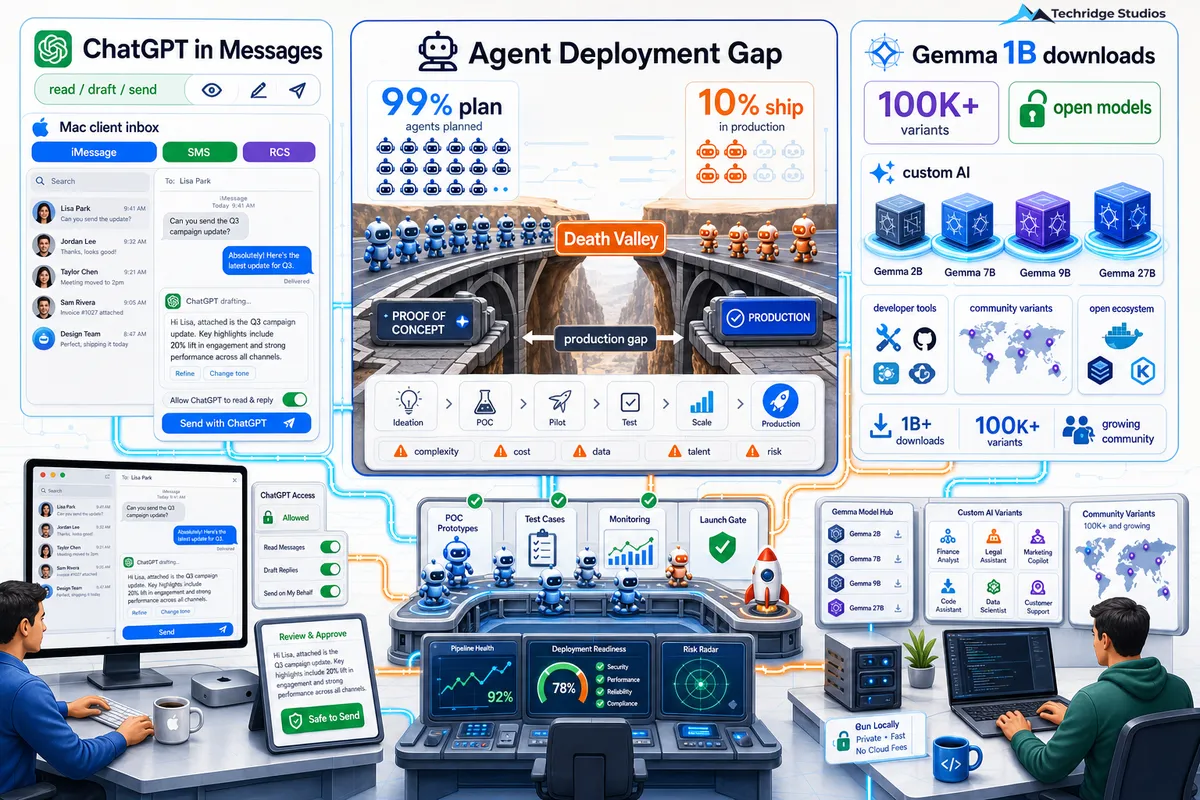
OpenAI has integrated ChatGPT directly into Apple Messages on macOS, allowing the assistant to read, draft, and send messages within the app after users grant explicit permission. According to 9to5Mac, the feature connects ChatGPT into one of the Mac's most personal communication environments, working across iMessage, SMS, and RCS, and is available on all ChatGPT plans in the Mac desktop app.
This is a meaningful shift in how AI interacts with business communication. Instead of pausing a client conversation to open a browser tab and prompt an AI, the AI lives in the same thread where the conversation is already happening. For service-based businesses, consultants, and anyone managing client relationships over iMessage, this is immediately practical.
OpenAI says it processes Messages data locally and does not create a separate index of user conversations. That answers the most immediate privacy question. However, prompt injection — where a malicious message tricks the AI into taking an unintended action — is a known risk when AI agents have broad access to communication apps. Start narrow before going broad.
For small businesses on Mac, the immediate action is simple: enable this in your ChatGPT settings, test it on a low-volume thread, and see how it handles your actual conversations before giving it access to high-priority client channels. The feature is live now.
The Agent Deployment Gap — 99 Percent Plan, Only 10 Percent Ship
New research highlighted by AI Agent Store on August 21st, 2026 found that while 99 percent of companies plan to deploy AI agents, only roughly 10 percent have actually shipped them to production. The analysis calls this gap "Death Valley" — the space between a proof-of-concept that impresses stakeholders and a system that actually runs reliably day-to-day.
This data point matters for every small business that has started an AI project and found it stuck. The problem is rarely the AI itself. It is the work required to move from a demo with clean inputs to a system that gracefully handles real-world messiness, edge cases, and the occasional failure.
The bottleneck tends to fall in three areas. First, data quality — the demo works because the input is controlled. Production breaks because real inputs are not. Second, governance — who reviews the agent's output, what happens when it makes an error, and who owns the process. Third, change management — the people whose workflows the agent touches need to trust it before they adopt it.
For small businesses, the practical fix is to define what "shipped" actually means for your next AI project before you start building. That includes how the agent fails gracefully, who reviews its output, and what metrics confirm it is working. That mindset is what separates the 10 percent from the 90.
Google's Open Gemma Models Hit One Billion Downloads
Google DeepMind announced that its Gemma family of open AI models has crossed one billion downloads, with developers publishing more than 100,000 custom versions and fine-tuned models since the family launched roughly two years ago.
One billion downloads is not a vanity metric. It means Gemma is deployed across cloud servers, laptops, edge devices, and research systems at meaningful scale. The 100,000-plus custom variants confirm that developers are actively building on it for real use cases — not just downloading it to explore.
For small businesses, the practical implication is straightforward: the gap between what you can do with a paid AI subscription and what you can do with free, open AI is narrowing. Gemma models can run on commodity hardware or standard cloud infrastructure without a per-message API fee. For high-volume use cases — document processing, internal Q and A systems, content generation at scale — open models can substantially cut costs.
The competitive pressure this puts on paid AI providers is also worth watching. As open models close the quality gap, commercial AI tools will need to justify their pricing through speed, support, or integrations. For small businesses, that trend means better deals and more leverage in vendor negotiations over the next 12 months.
What This Means for Your Business
All three stories share a common signal: AI is becoming part of everyday business infrastructure rather than a separate tool you open on purpose. Your messaging app, your project workflows, and your software cost structure are all changing at once.
Take one action this week. If you use a Mac, enable ChatGPT in Messages and test it on a low-traffic thread. If you have an AI agent project stuck in pilot mode, spend two hours defining what done actually looks like. If you are paying for AI subscriptions at high volume, pull up the Gemma documentation and check whether your use case could move to an open model.
Sources
9to5Mac — https://9to5mac.com/2026/08/20/chatgpt-update-adds-apple-messages-integration-on-mac/
AI Agent Store — https://aiagentstore.ai/ai-agent-news/this-week
Google DeepMind Blog — https://blog.google/innovation-and-ai/technology/developers-tools/gemma-one-billion-downloads/