Cheaper AI, a Slack Rival, and a Free Copilot Trial — Three Weekend Moves for SMBs
Three significant AI developments landed this weekend — a new model with better benchmarks at lower cost, a challenger to Slack built around AI agents, and a zero-commitment Copilot trial for small businesses. Individually, each is actionable. Together, they point to the same underlying trend: the cost of high-quality AI is falling, and the tooling layer is getting more accessible every month.
Claude Opus 5: High Performance, Lower Price, Fewer Restrictions
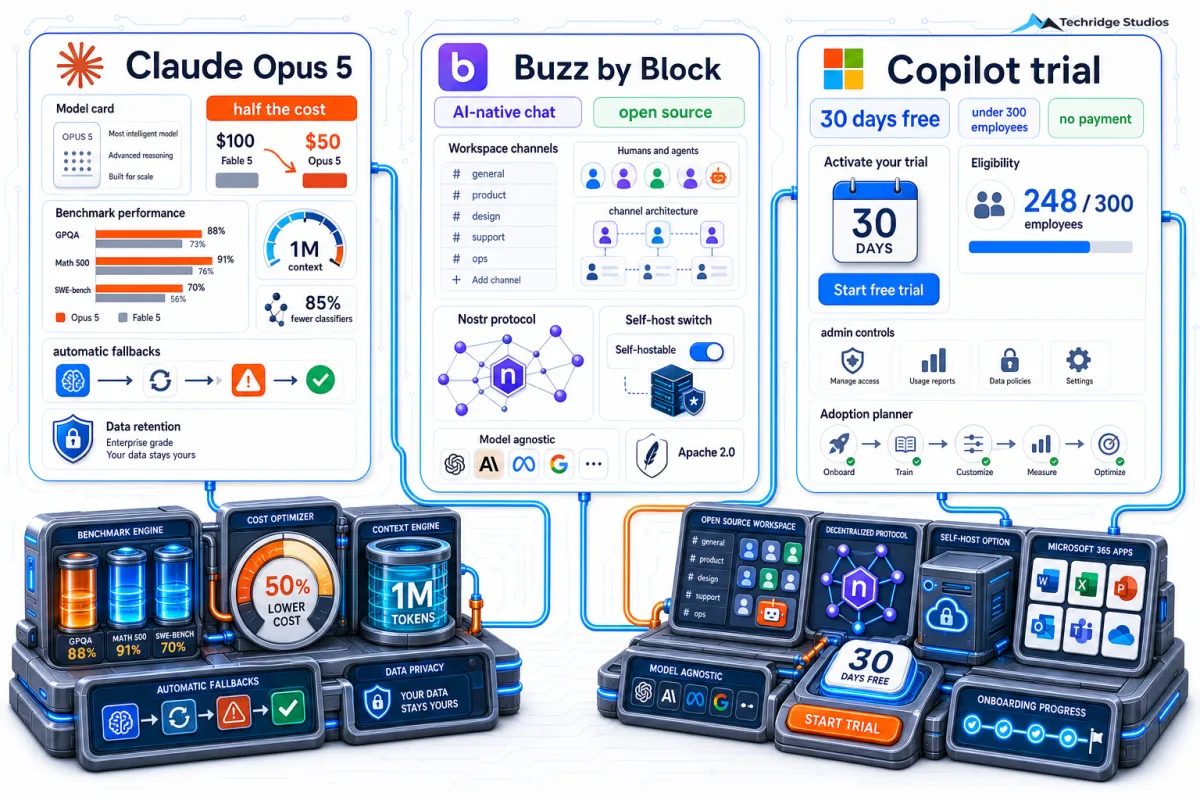
Anthropic launched Claude Opus 5 on July 24, 2026, positioning it as the practical default for most advanced AI tasks — including the use cases that previously required Fable 5.
The headline number: Opus 5 starts at 5 dollars per million input tokens and 25 dollars per million output tokens. That is roughly half the cost of Fable 5, and it puts high-throughput agentic work within reach for small teams that previously found flagship pricing prohibitive.
The model does not just offer a price cut. According to Anthropic's benchmarks — reported in TechCrunch's coverage — Opus 5 actually outperforms Fable 5 on several measures, particularly in agentic coding and complex knowledge work. Anthropic cited testing in which the model wrote its own computer vision pipeline from an incomplete prompt, demonstrating the kind of iterative self-correction that long-form agent tasks require.
For API users, two practical upgrades stand out. First, Opus 5 is not subject to the 30-day data retention policy that applies to Fable and Mythos — a meaningful difference for teams working with sensitive documents or client data. Second, the new Automatic Fallbacks feature routes prompts that trigger safety classifiers to a lighter model rather than returning an error, which means fewer dead ends when building workflows. Safety classifiers activate 85 percent less often on Opus 5 than on Fable 5, reflecting the reduced restrictions applied to the model.
If you are running any AI-assisted workflows today — research pipelines, document analysis, customer support drafts, or multi-step agentic tasks — switching to Opus 5 is the simplest way to cut costs without sacrificing output quality.
Buzz: Jack Dorsey Builds the Slack Alternative AI Teams Have Been Waiting For
On July 21, 2026, Jack Dorsey's company Block launched Buzz — a team communication platform built from the ground up for organizations where AI agents and humans work together in the same channels.
Most AI team tools today are Slack add-ons: bots that respond to slash commands, integrations that pull in summaries, agents that live in separate tabs. Buzz takes a different approach. Agents are first-class participants in the workspace, joining channels, responding to threads, and triggering workflows the same way a human team member would. The distinction matters: in an add-on architecture, AI is a tool the team uses. In Buzz's architecture, AI is a member of the team.
The platform is built on Nostr, a decentralized open protocol, and the source code is available under an Apache 2.0 license. Organizations can self-host their own Buzz instance, which means no vendor lock-in, no dependency on Block's uptime or pricing decisions, and the ability to customize behavior at the infrastructure level. The platform is model-agnostic — teams can connect Claude, GPT, Gemini, or any open-weight model to their workspace.
Buzz includes channels, threads, direct messages, voice, media sharing, code repositories, and automated workflows — covering the core surface area of Slack plus basic GitHub project management in a single tool. A free desktop app is available now on macOS, Windows, and Linux.
The honest caveat: Buzz is early-stage and not ready for immediate team migration. But for a small business owner evaluating where collaboration tools are heading in the next 12 to 24 months, understanding Buzz's architecture now is the right move. The open source, self-hostable model is a meaningful departure from how every major collaboration platform in the market is structured today.
Microsoft Copilot: The Free 30-Day Trial Every Microsoft 365 Business Should Try
For any business already using Microsoft 365, there is now no excuse not to try Copilot.
Microsoft made a self-service free trial of Microsoft 365 Copilot Business available this month to eligible businesses with up to 300 employees. Eligible users can start the trial directly from Copilot Chat — no payment information required, no IT project, no sales call. Admins control and monitor the trial from the Microsoft 365 admin center.
Copilot integrates into the tools most SMB teams already use daily: Outlook for email drafting and summarization, Teams for meeting recording summarization and action item extraction, Excel for natural-language formula generation, Word for first-draft document generation, and PowerPoint for slide content from outlines. The value is not in replacing any of these tools — it is in reducing the time spent on the lowest-value tasks inside each one.
A separate partner-led program called Copilot in 30 launches August 1, 2026 through Microsoft's Cloud Solution Provider network. That program offers structured 30-day onboarding with coaching resources and a success planner tool coming mid-August that helps track which users are actually building habits with the tool versus just logging in once.
The practical action today: if your business is under 300 employees and uses Microsoft 365, open Copilot Chat and start the trial. If you want a more structured rollout with coaching, reach out to a Microsoft CSP partner before August 1st.
What This Means for Your Business
This weekend's three stories all point in the same direction: high-quality AI is getting cheaper and more accessible, and the gap between enterprise AI and what small businesses can actually use is narrowing quickly.
Claude Opus 5 brings near-flagship intelligence within reach of teams that build with APIs. Buzz is laying the architecture for how AI-native teams will collaborate in two years. And Microsoft's free Copilot trial removes the last friction point for any SMB that has been sitting on the fence.
Pick one and test it this week. If you use Microsoft 365, start a Copilot trial today. If you build with the Anthropic API, switch your default model to Opus 5. If your team is due for a collaboration tooling review in the next six months, download Buzz and explore the architecture.
Sources
TechCrunch — https://techcrunch.com/2026/07/24/anthropic-launches-opus-5/
Microsoft Partner Center July 2026 — https://learn.microsoft.com/en-us/partner-center/announcements/2026-july