Claude Takes Your Microsoft 365, Goldman Endorses Chinese AI, and the EU AI Act Gets a 16-Month Extension
Three distinct stories broke this week, and they share a common thread: the decisions businesses made cautiously six months ago are now becoming the obvious moves. AI is writing your emails. Your cheaper model options just got Wall Street's endorsement. And the compliance clock that most companies were racing got reset.
Claude Can Now Draft Email, Manage Your Calendar, and Update SharePoint Files
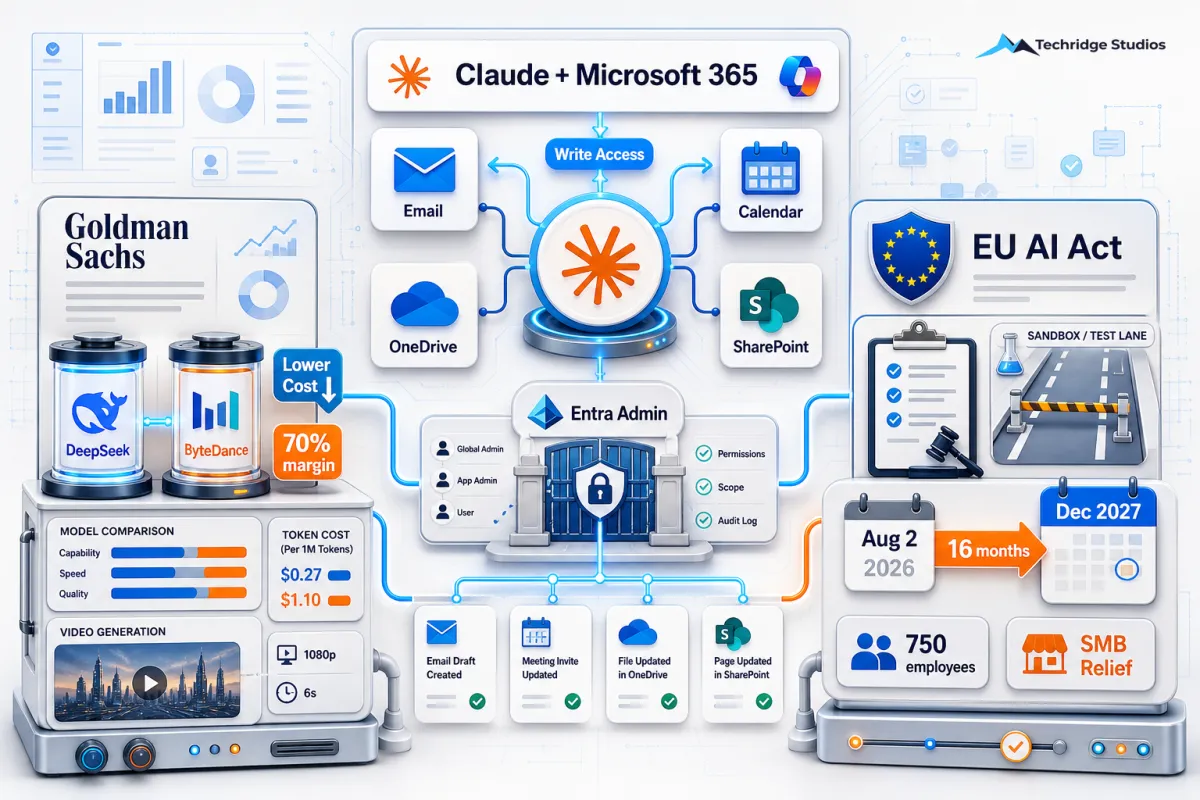
Anthropic released a significant update to its Microsoft 365 connector on July 7, 2026. Claude can now draft, send, and organize emails; create and update calendar events; and create or update files in OneDrive and SharePoint — all through plain-language instructions. Teams messaging remains read-only for now.
This is not a chat overlay bolted onto Microsoft 365. It is write access, meaning Claude can take actions inside your most-used work tools. Tell Claude to draft a follow-up email to a vendor based on your last three messages and send it for your review. Ask it to schedule a client check-in for next Tuesday at 2:00 PM and block prep time the hour before. Instruct it to create a project status doc in SharePoint and populate it from your meeting notes. These are things you previously had to do yourself, step by step.
The update shipped alongside the expansion of Claude Cowork to web and mobile, meaning sessions no longer die when you close your laptop. Claude can draft an email while you're in a meeting, finish a document while you're traveling, and surface everything for review when you're ready.
One prerequisite: a Microsoft Entra administrator must consent to the updated permission set and enable write tools for the organization before members can use them. If your team operates inside a managed Microsoft 365 environment, that is a single administrative step — worth doing this week. Once enabled, the capability is available to everyone in the org through the Claude connector they may already have connected.
Goldman Sachs Formally Endorses DeepSeek and ByteDance — What It Means for Your AI Budget
Goldman Sachs published a competitive framework for Chinese AI models this week, naming DeepSeek and ByteDance as its preferred companies in the space. The report was explicit: Chinese open-source and open-weight AI models are "reaching a critical point of intelligence performance vs. global proprietary models." Goldman began formally recommending Chinese models to Wall Street clients the same week.
ByteDance leads the framework in video generation, driven by its Seedance model. The company reportedly runs gross margins as high as 70 percent on its AI products and has crossed 2 billion dollars in annual revenue run rate. For businesses doing video content, advertising, or social media production, Seedance is now a Wall Street-validated option for high-volume output at lower cost than comparable US tools.
DeepSeek leads in reasoning capability. For businesses using AI for analysis, document review, research synthesis, or customer support workflows, DeepSeek offers competitive performance at significantly lower cost per token than the leading US reasoning models.
For small businesses, the practical implication is straightforward: the cost of running AI workflows is negotiable. If you have been running everything through a single US provider and accepting the pricing, Goldman Sachs just gave you the institutional cover to look at alternatives. This week is a good time to test DeepSeek or ByteDance's tools against your current stack on a real workflow and compare the output quality and the bill.
EU AI Act Deadline Extended 16 Months — and the SMB Threshold Just Got Larger
On May 7, 2026, the European Union passed the EU Digital Omnibus, a legislative package that included a significant revision to the EU AI Act. The August 2, 2026, compliance deadline for high-risk AI systems — specifically the Annex III use-based obligations — has been extended by 16 months to December 2, 2027. For the many businesses that have been building toward an August compliance sprint, the runway just expanded significantly.
The extension applies to what the Act classifies as high-risk AI: systems used in hiring, credit scoring, education, law enforcement, critical infrastructure management, and a handful of other defined categories. If your business uses AI in any of these contexts, the August deadline you were tracking has moved to December 2027.
Equally significant is the change to the SMB compliance threshold. The simplified compliance framework — which includes reduced documentation requirements, proportional penalties, regulatory sandbox access, and standardized templates — was previously available only to companies with fewer than 250 employees. That threshold is now expanding to cover companies with up to 750 employees and 150 million euros in annual revenue. This is a material change. Many mid-size businesses that were preparing for full compliance documentation now qualify for a significantly lighter path.
The Article 4 AI literacy requirement, which mandates that companies ensure appropriate AI education for staff, has been in effect since February 2025 and remains unchanged. If you have not addressed that requirement, it is still due now regardless of any other deadline changes.
For US businesses selling into EU markets, the practical question is whether your AI tools touch any of the Annex III categories. If they do, December 2027 is the new target. If they do not, the original limited-risk transparency requirements still apply but carry a lower compliance burden.
What This Means for Your Business
This week's three stories map to a single decision most small businesses still have not made: which AI tools go into your permanent stack, at what cost, and with what level of compliance planning.
The Microsoft 365 update tells you that the AI layer is now inside the tools you already pay for — write access, not just search. If you run on Microsoft 365, this week is the time to enable it and test it on one real workflow.
The Goldman Sachs framework tells you that the Chinese alternatives are now institutionally validated. If you have not tested DeepSeek or ByteDance's tools against your current setup, the cost case is stronger this week than it was last week.
The EU AI Act extension tells you that the compliance pressure on high-risk AI use just eased — but the literacy requirement did not. If your team uses AI tools regularly and has not done any formal AI training, that gap is still open.
Pick one of these three and act on it this week.
Sources
Anthropic Release Notes — https://support.anthropic.com/en/articles/12138966-release-notes
CNBC — https://www.cnbc.com/2026/07/12/goldman-sachs-picks-its-favorite-chinese-ai-models.html
Latham & Watkins — https://www.lw.com/en/insights/ai-act-update-eu-resolves-to-change-rules-and-extend-deadlines