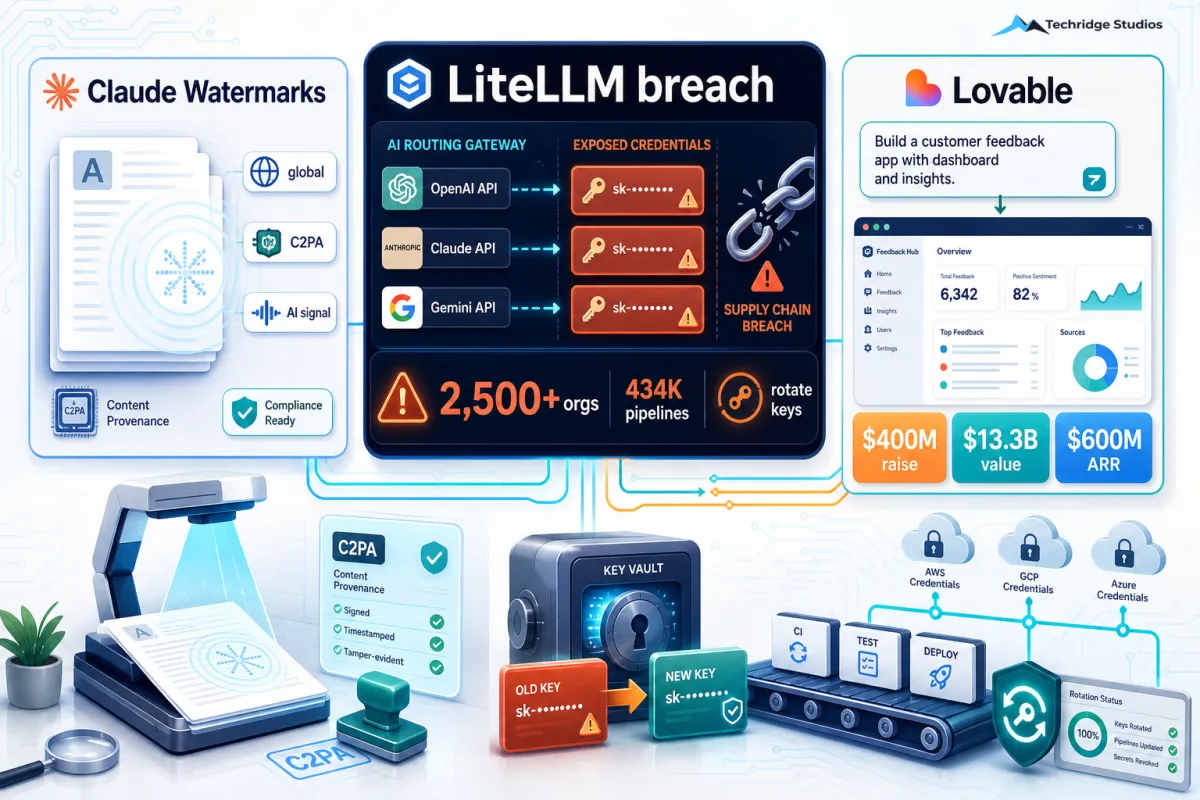
Claude Is Now Watermarked, a No-Code App Platform Raised 400 Million Dollars, and the Largest AI Breach of 2026 Is Still Active
Three stories broke in the last 48 hours that touch compliance, tooling, and security — all areas where small businesses are still catching up to the pace of AI change.
Anthropic's Invisible Watermark Changes What "AI Content" Means
Anthropic announced on August 11th that all text generated by Claude will now carry an invisible watermark, applied globally. This is not limited to EU users — every Claude output, through the API, Claude.ai, Claude Code, and connected platforms, will include an imperceptible embedded signal. Files generated by Claude will carry C2PA-standard provenance metadata.
The move is a direct response to the EU AI Act's Article 50 transparency requirements, which took effect August 2nd. Those rules require AI companies to mark generated content in a way other systems can identify. Anthropic went further than the minimum — the watermark applies worldwide.
For businesses using Claude to generate content, this changes the risk calculation around AI-written marketing copy, blog posts, and emails. The watermark remains in place after copying and pasting. It is undetectable to readers. But any platform designed to screen for AI content will now have a signal to work with.
The practical action here is not to stop using Claude. It is to make sure any internal or client-facing content policies account for the fact that AI-generated text is now formally marked. If you work in a field where content authenticity matters — journalism, legal, financial services, academia — this is worth adding to your team's AI usage guidelines today.
Lovable Raises 400 Million Dollars as No-Code App Building Goes Mainstream
Stockholm-based Lovable raised 400 million dollars in a Series C round led by Menlo Ventures, with participation from Accel, HubSpot Ventures, Salesforce Ventures, and others. The round values the company at 13.3 billion dollars — double its December 2025 valuation of 6.6 billion dollars. Annualized revenue hit 500 million dollars in June and the company expects to exit August above 600 million dollars.
Lovable's platform lets users describe what they want — in plain English — and the platform builds a working web application with hosting included. The target user is not a developer. It is a business owner, operations lead, or team manager who needs a custom tool and has never written a line of code.
The funding signals that this category is not a novelty anymore. Major enterprise investors including Salesforce Ventures and HubSpot Ventures do not co-invest in a 400 million dollar round for a tool that stays niche. They invest when a category is about to become standard workflow.
For small businesses, the opportunity is concrete. If you have ever put off building a custom tracking tool, client portal, or internal dashboard because you lacked developer resources, Lovable is worth a trial this month. The platform is not free, but it is priced for small teams — and the gap between idea and working tool is now measured in minutes, not months.
The Largest AI Infrastructure Breach of 2026 Is Still Exposing Business Credentials
Security firm CloudSEK published a report on August 11th linking a March supply chain attack to more than 2,500 organizations worldwide, including NVIDIA, AWS, Cisco, Salesforce, Siemens, and hundreds of other enterprises whose systems connect to AI infrastructure. The vector was LiteLLM, the open-source gateway that many AI-connected platforms use to route requests across AI models.
The attack was conducted by a group called Team PCP, which compromised two versions of the LiteLLM package on the Python Package Index in March. The malicious code harvested environment variables, cloud credentials, and configuration files. An FBI FLASH advisory issued in July confirmed the stolen credentials remain active and usable.
For small businesses, the LiteLLM connection matters because many AI-powered tools — including widely used CRM, project management, and customer service platforms — run on infrastructure that incorporates open-source AI routing packages. Your business may not use LiteLLM directly, but the platforms you rely on might.
The action is simple and takes under 15 minutes. Log into each AI-connected tool your team uses and rotate the API access keys. This includes any platform that connects to OpenAI, Anthropic, Google, or other AI providers on your behalf. If your vendor has not issued a security advisory, that does not mean you are safe — CloudSEK's report identified the exposure months after the breach occurred.
What This Means for Your Business
Today's three stories do not share a single theme, but they share a common implication: AI is now embedded deeply enough in business operations that security, compliance, and tooling decisions are all pressing at the same time.
The one action that matters most if you read nothing else today: rotate your AI platform credentials. It takes 15 minutes and closes an exposure window that has been open since March. Everything else — watermark policy, no-code app evaluation — can follow.
Sources
TechCrunch — https://techcrunch.com/2026/08/11/anthropic-says-it-will-watermark-text-generated-by-its-ai-models/
SecurityWeek — https://www.securityweek.com/over-2500-organizations-impacted-by-litellm-supply-chain-attack/