Your AI Tools Changed Today — The Data on Why That Matters
AI is no longer something to plan for — it's changing your tools in real time. Microsoft pushed a major Copilot update live today, OpenAI released data showing where enterprise AI is actually delivering results, and new research reveals the trust gap your business needs to close with customers. All three stories connect around one idea: the gap between businesses using AI effectively and those still experimenting is widening, and the details now matter.
Microsoft Copilot Is One App Now — But Three Features Didn't Make the Cut
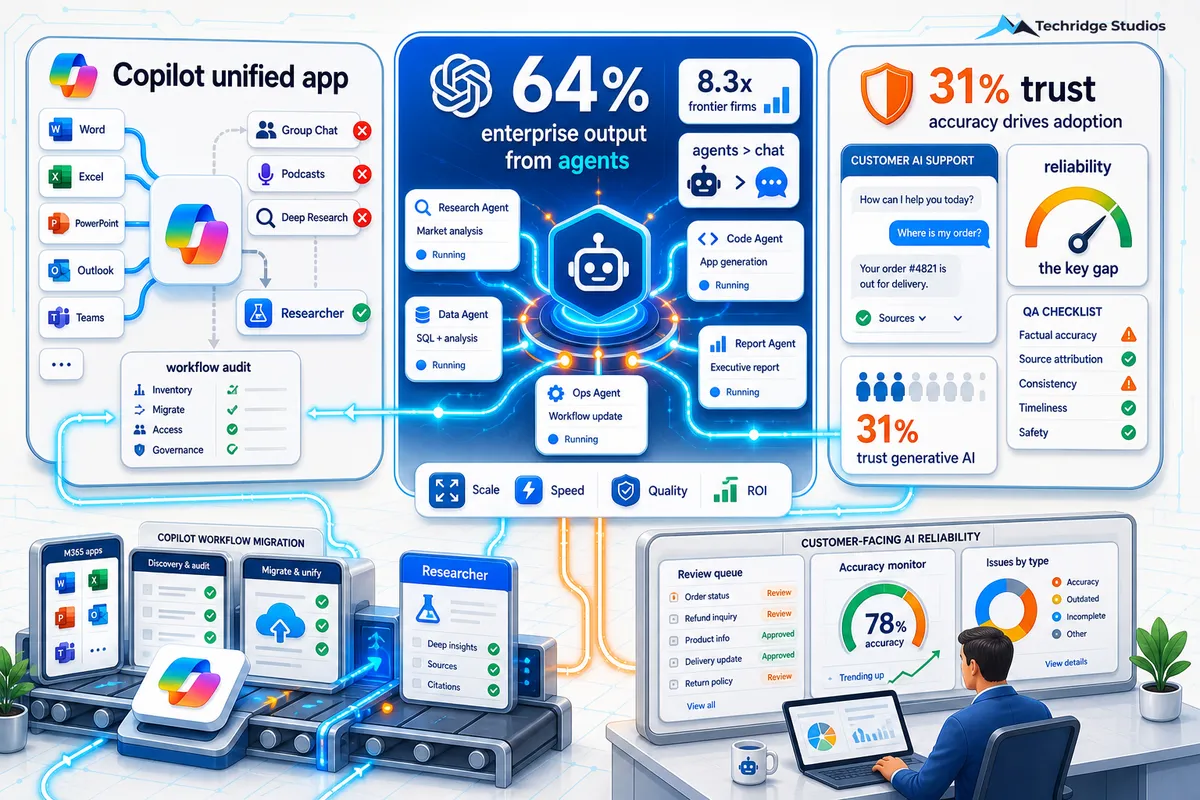
Microsoft began rolling out a merged Copilot experience today, August 18th, 2026, bringing its consumer Copilot and Microsoft 365 Copilot together under one name, one icon, and one sign-in flow. The visual changes — a new icon, new navigation, and a revised URL — are the least important part of this update.
The part that matters is what retired today: Group Chat, Podcasts, and Deep Research. Deep Research, which had become a reliable tool for competitive intelligence and customer research tasks, is being replaced by a new feature called Researcher. Microsoft describes it as an improvement, but Researcher is not a direct substitute. Small businesses relying on Deep Research workflows should test the new feature this week before assuming parity.
The broader shift is strategic. Microsoft is consolidating all AI interaction — personal, professional, and agentic — into a single surface. This simplification is good for onboarding and reduces confusion between accounts, but it comes at the cost of features that business users had built habits around. If your team had Copilot workflows involving any of the retired features, this week is the time for a quick audit.
Practical action: ask one team member to test Researcher against a task they previously ran in Deep Research. Identify any workflow gaps before mid-September when the full rollout completes. A short internal note explaining the change is worth writing before the support questions start.
OpenAI Data Shows Agents, Not Chat, Are Where Enterprise AI Is Actually Working
OpenAI released its latest Enterprise Signal report on August 13th, 2026, and the headline finding is direct: agentic AI — AI that runs tasks rather than answering questions — now accounts for 64 percent of all enterprise output tokens. Nearly two-thirds of every AI output inside enterprise organizations is coming from Codex and similar agent-based tools, not from chat interfaces.
The adoption gap within companies is equally notable. Frontier firms — those in the top 10 percent of AI usage — generate 8.3 times more output per active user than average firms. That ratio was 2.6 times in January 2026. The gap is widening fast. Growth is sharpest in legal (108 times more agentic usage since February), sales and recruiting (41 times), and marketing (26 times) — compared to just 5 times in engineering.
What this tells small businesses is direct: the organizations seeing the largest returns from AI are not the ones using better chat tools. They are the ones that have moved AI off the keyboard and into automated processes. AI that runs a workflow, monitors an inbox, or processes a document library compounds over time. AI that answers questions one at a time does not.
If your AI use is currently limited to drafting emails and asking questions, you are in the majority — and increasingly in the minority of organizations seeing meaningful returns. The practical shift is picking one repeating task this quarter and building an automated workflow around it, even if it starts simple.
Why Your Customers Still Do Not Fully Trust AI — And What Actually Fixes It
A study published this month in the Transactions of the Association for Computational Linguistics analyzed more than 230,000 Reddit posts about generative AI, spanning ChatGPT, Claude, LLaMA, and other major systems. The finding is counterintuitive: trust (31 percent of posts) barely outpaces distrust (26 percent), and the remaining 43 percent of posts express no strong view either way.
The research team at Drexel University found that the primary drivers of trust were competence, reliability, and familiarity. The primary drivers of distrust were unreliability and incompetence — not data privacy concerns, not ethics, not job displacement fears. People do not distrust AI because they think it will take their jobs. They distrust it because it gives them wrong answers.
This has direct implications for any small business using AI in customer-facing roles. If your AI customer service tool, your AI-written content, or your AI-generated recommendations are producing inaccurate outputs — even occasionally — you are training your customers to distrust the technology. That is hard to reverse. Right now, accuracy is a competitive differentiator.
The practical action is not to slow down AI adoption. It is to add a human review layer to any customer-facing AI output until your accuracy rate is high enough to trust independently. Track error rates. Measure correction frequency. Set a threshold for what accurate looks like before you remove the review step.
What This Means for Your Business
Today's three stories point in the same direction. The tools are changing faster than most businesses are keeping up. The organizations winning with AI have moved past chat-based tools into automated workflows. And the biggest barrier to customer adoption of AI is not fear of the technology — it is AI that gets things wrong.
The action for this week: audit one Microsoft 365 Copilot workflow for the feature retirements, identify one repeating business task to automate with an agent rather than a chat tool, and add a review step to any AI output your customers actually see.
Sources
Bank Info Security — https://www.bankinfosecurity.com/enterprise-ai-token-spend-shifts-from-chat-to-agents-a-32539
The AI Insider — https://theaiinsider.tech/2026/08/14/drexel-researchers-examine-how-much-people-really-trust-generative-ai/