Countdown, Threat, and Upgrade: Three AI Moves That Matter for Business Owners Today
Today's brief connects three separate stories by one shared reality: AI is now changing the tools your team uses every day, the threats your business faces over the phone, and the marketing platform that drives your customer relationships. None of these stories require a technical background to act on. All three require a decision this week.
Your Team's Android Assistant Changes Forever on September 4th
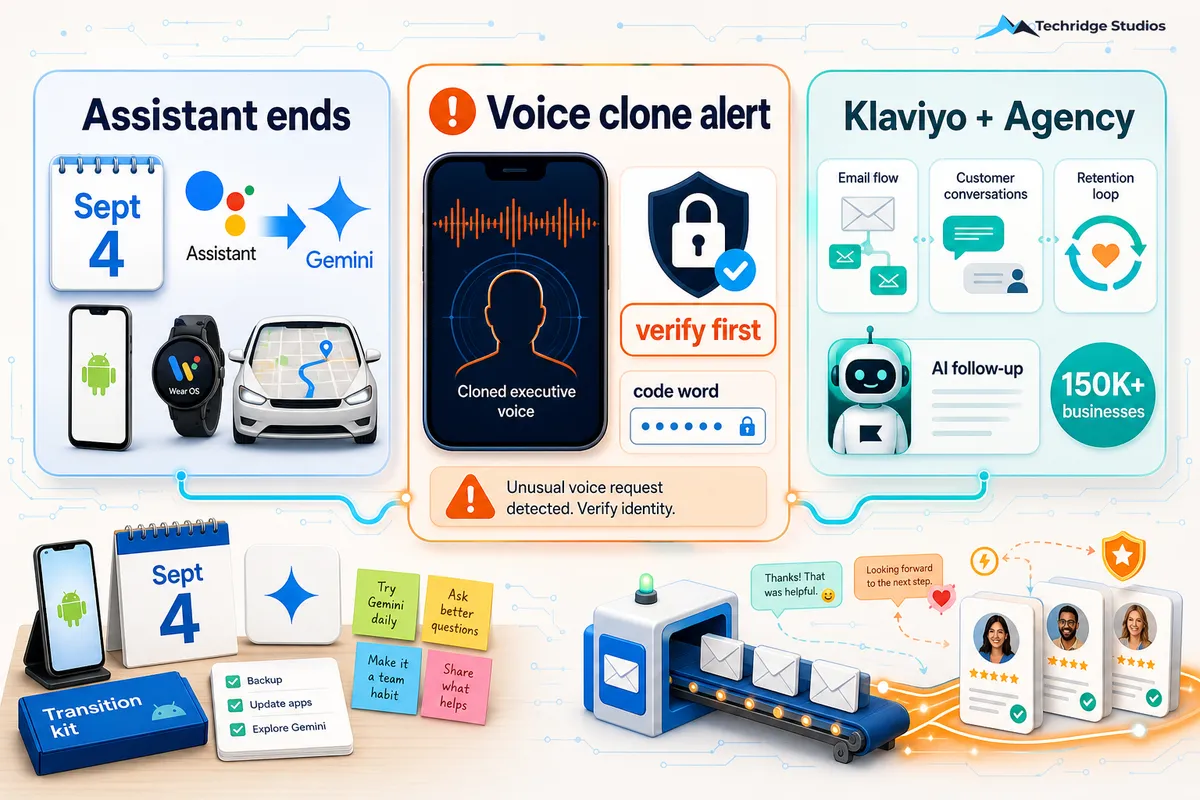
Google has set a hard cutoff. On September 4th, 2026, Google Assistant will be removed from all Android phones, Wear OS devices, paired headphones, and Android Auto. Once it's gone, users cannot switch back. Gemini becomes the only assistant experience on Android — full stop.
For small businesses, this is a workflow change whether you plan for it or not. If your team uses voice commands to set reminders, draft messages, read notifications, or manage calendars on Android phones, those habits built around Assistant will need to transfer to Gemini. Gemini handles most of the same tasks but behaves differently, integrates more deeply with Google Workspace, and responds to different natural language patterns.
The practical move is to get ahead of this now. Spend 15 minutes with your team before September 4th walking through the Gemini interface. Focus on the tasks your team uses voice for most: timers, texts, calendar lookups, and navigation. The transition is manageable with preparation. Without it, you will lose a work morning on the day it switches.
Google is framing this as an upgrade, and in many respects it is. Gemini connects directly to Google Workspace tools, can access your Docs and Drive, and handles more complex requests than the old Assistant. The September 4th date is firm. Use the next 29 days.
AI Voice Clones Are Calling Your Employees — Not Just Wall Street's
Bloomberg reported this week that attackers used AI-generated voice clones of real executives to social-engineer employees at Point72, Citadel, Two Sigma, and several private equity firms. Two Sigma detected the attempt and shut it down with no impact. Others are still assessing.
The tools that made this attack possible are not proprietary. Commercial AI voice-cloning services can replicate a voice from a short audio sample — a podcast appearance, a LinkedIn video, a recorded presentation. Once cloned, an attacker can generate a phone call that sounds like your CEO, your operations manager, or your accountant asking for an urgent wire transfer or a file share.
For small businesses, the threat is more acute, not less. Major financial firms have dedicated security teams and fraud protocols. Most small businesses do not. An employee who would never fall for a phishing email might still trust a phone call that sounds exactly like their boss asking for something urgent.
The defense is simple and free: establish a code word. Any phone request involving a financial transaction, sensitive data transfer, or emergency access requires that code word before anyone acts. No code word, no action. This single protocol collapses most social engineering attacks at zero cost. Set it with your leadership team today and make it part of your onboarding for new hires.
Klaviyo Gets an AI Customer-Success Team Built In
Klaviyo announced this week that it has acquired Agency, an AI customer-success startup founded by serial entrepreneur Elias Torres. Torres joins Klaviyo as chief product officer, bringing his 25-person team and their agents directly into the platform. Those agents are being integrated into Klaviyo's existing Composer and Customer Agent products.
For the 150,000-plus small businesses using Klaviyo for email marketing and customer communication, this is a meaningful acceleration. Agency was built specifically around AI-powered customer follow-up — the kind of persistent, personalized outreach that drives repeat purchases and retention. Embedding that capability natively into Klaviyo means you will not need a separate tool or a separate subscription to access it.
The practical implication: watch your Klaviyo account this quarter for new agent features in Customer Agent. If you have been manually handling customer follow-up sequences or relying on basic automation rules, the incoming functionality will let you hand that workflow to an AI agent that acts on customer behavior in real time. The competitive pressure this creates on rival platforms — HubSpot, Mailchimp, ActiveCampaign — means similar moves are likely before the end of the year.
For businesses already on Klaviyo, this is a reason to stay. For businesses evaluating email platforms, it is a reason to take a serious look.
What This Means for Your Business
Three different stories, one pattern: AI is becoming infrastructure. It is embedded in the phone your team carries, the voice on the other end of a call, and the email platform driving your customer relationships. The businesses that move first — on the Gemini transition, on the phone verification protocol, on the Klaviyo features — will be ahead before most of their competitors even read the headline.
One action for today: set up your code word for phone-based verification requests. It takes five minutes and it closes the door on one of the fastest-growing attack vectors in business.
Sources
9to5Google —https://9to5google.com/2026/08/04/google-assistant-september-2026-shutdown/
Gizmodo / Bloomberg —https://gizmodo.com/ai-powered-vishing-attacks-reportedly-targeted-top-hedge-funds-2000794923