Your Customers' Favorite Apps Now Have AI Agents Built In
Meta opened its Business Agent to every business on WhatsApp and Instagram. Apple let AI into iMessage for the first time. And a company that manages HR for 16,000 small businesses just raised 150 million dollars to go AI-first. This week's stories share one thread: the tools and platforms your customers already use every day are becoming AI-native — and you do not need to build anything to benefit.
Meta Business Agent Is Live — and It Is Free to Start
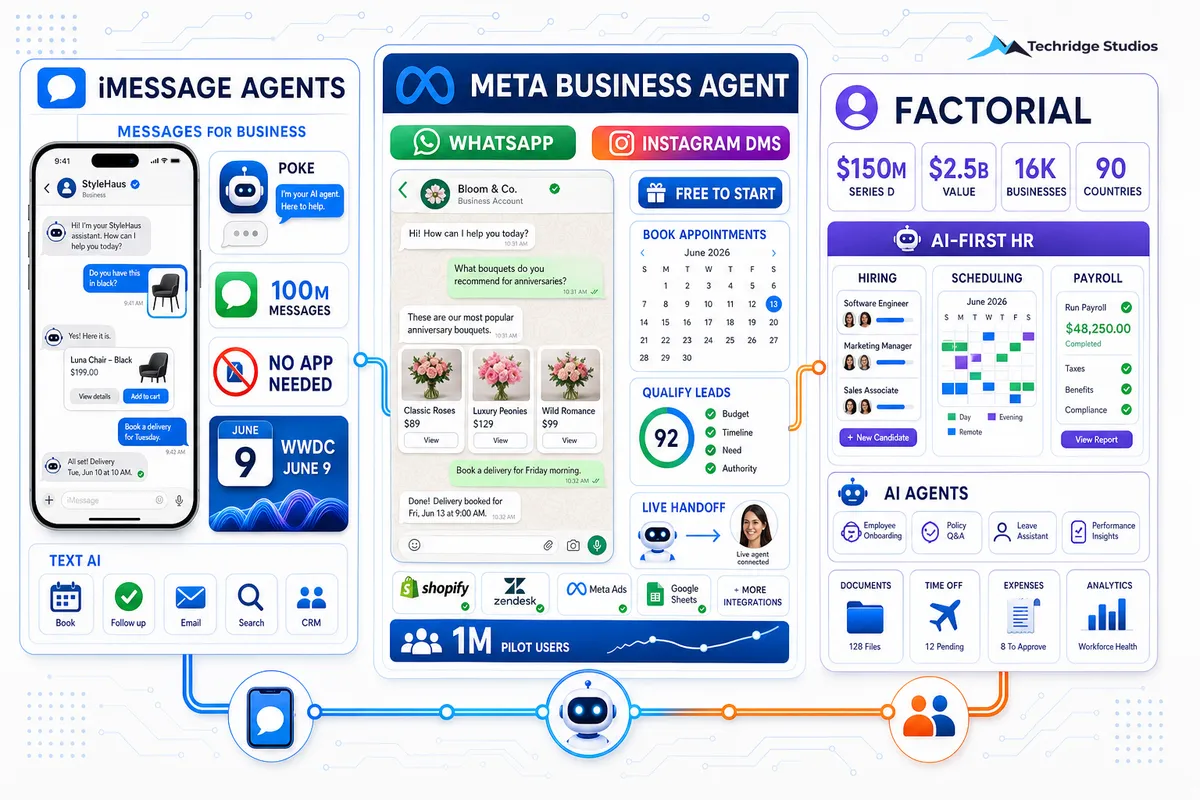
For the past two years, Meta has been quietly testing an AI customer service tool in WhatsApp Business markets across India, Mexico, and Brazil. As of June 3, 2026, that test is over. Meta Business Agent is now available to every business in the world through WhatsApp Business and Instagram DMs.
The agent handles the entire front end of customer interactions. It answers questions, recommends products, books appointments, qualifies leads, and routes complex inquiries to a live team member when needed. It works across languages and time zones, which means a customer messaging you at 2 AM gets a real response — not a "we'll get back to you" auto-reply.
Getting started costs nothing. Meta's longer-term monetization plan involves token-based billing through WhatsApp Business Premium tiers, but initial access is free for businesses of any size. If you already have a WhatsApp Business account, activation happens through your Business Suite settings. No developer required.
Meta is also building out features beyond basic support: overnight chat briefings, market research tools, and integrations with platforms like Shopify and Zendesk for businesses that need deeper connections. The Business Agent platform is designed to grow with your operation as you add more tools and workflows.
For a small business owner, the practical implication is straightforward. WhatsApp has 3 billion monthly active users. Instagram has another 2 billion. These are already where your customers are. A free AI agent that qualifies leads and handles questions while you sleep is no longer a pilot program — it is available now.
Apple Just Let AI Into iMessage for Business
Apple's Messages for Business platform has existed for years as a way for large companies — airlines, hotel chains, retail brands — to communicate with customers through iMessage. Until this week, it had never admitted an AI agent.
On June 4, 2026, that changed. Apple approved Poke, a startup built around the idea that AI agents should be as easy to use as sending a text message, as the first AI agent on the Messages for Business platform. Poke has already relayed 100 million messages across SMS, Telegram, and WhatsApp. Its capabilities include calendar management, customer follow-up, flight check-ins, web search, image generation, and integrations with tools such as Microsoft Outlook, Gmail, and GitHub — all via text.
The approval process was not simple. Poke spent months verifying live support availability, submitting testimonies from messaging providers, and customizing its interface to meet Apple's design guidelines — including using link previews instead of inline links and following Apple's button and interface standards. The process took long enough that Poke's co-founder noted any competitor trying to replicate it will face the same multi-month timeline.
The timing is deliberate. Apple's Worldwide Developers Conference kicks off on Monday, June 9th. Multiple reports indicate Apple will announce a revamped version of Siri with significantly expanded AI capabilities, along with new developer tools for building AI-powered apps. The Poke approval signals that Apple is moving to open its messaging ecosystem to AI — not just for consumer use, but for business interactions.
For small businesses, this matters because of who uses iMessage. In the United States, iPhone users represent a significant and often premium customer segment. Being able to handle customer interactions through iMessage — with an AI agent, without building an app — is a meaningful expansion of what is possible without a large technology team. Watch what Apple announces on June 9th. The Messages for Business platform may be about to become a lot more interesting.
Factorial Raised 150 Million Dollars to Make AI Do Your HR Work
Factorial is not a name most American small-business owners know, but it is about to become harder to ignore. The Barcelona-based company provides workforce operations software — HR, scheduling, payroll, compliance, and finance tools — to more than 16,000 small and mid-sized businesses in 90 countries. On June 3, 2026, it closed a $ 150 million Series D led by General Catalyst at a $ 2.5 billion valuation. General Catalyst also committed an additional 540 million dollars through its Customer Value Fund, bringing the total capital behind Factorial to more than 700 million dollars.
The funding is not about maintaining the status quo. Factorial is explicitly pivoting from a traditional software platform to an AI-first workforce operations system. That means AI agents are embedded into the day-to-day tasks that consume the most time in a small business: reviewing job applications, scheduling shifts, tracking compliance deadlines, managing onboarding documents, and running payroll. The goal is to automate the administrative layer of running a team — not just speed it up.
The investment thesis reflects a broader market shift. Venture capital firms have historically viewed HR tech as a secondary category. The size of this round — and the General Catalyst Customer Value Fund commitment, which is structured around generating measurable outcomes for customers — suggests that AI-powered workforce operations for small and mid-sized businesses are now being treated as a primary growth category.
For small business owners, the Factorial story matters even if you never use the product. It confirms that the AI tools coming to the HR and operations space are being built with businesses with fewer than 200 employees in mind, not retrofitted from enterprise tools. Hiring, scheduling, and people management are about to get AI-native alternatives priced for smaller teams. Whether it is Factorial or a competitor, the category is being funded at scale.
What This Means for Your Business
This week's three stories point to the same shift: AI is moving into infrastructure. It is not a separate tool you purchase and configure. It is being embedded into WhatsApp, iMessage, and the HR software your team already uses.
The practical action for any small business owner is to audit which of these channels you already have active. If you have a WhatsApp Business account, the Meta Business Agent is available now and costs nothing to try. If your customer base skews toward iPhone users, watch Apple's WWDC announcements on June 9th. And if hiring, scheduling, or HR compliance is consuming more hours than it should, AI-first alternatives to whatever tool you are currently using are coming fast.
The companies that will pull ahead over the next 12 months are not the ones with the most AI tools. They are the ones who embed AI into the channels and operations they already run — and do so before their competitors even realize it is possible.
Sources
TechCrunch — https://techcrunch.com/2026/06/03/metas-ai-agent-for-whatsapp-business-is-now-available-globally/
TechCrunch — https://techcrunch.com/2026/06/04/apple-approves-poke-as-the-first-ai-agent-on-its-messages-for-business-platform/
Tech.eu — https://tech.eu/2026/06/03/factorial-raises-150m-series-d-at-25b-valuation-to-expand-across-europe/