The AI Compliance Clock Is Ticking — And Your Tools May Be Working Against You
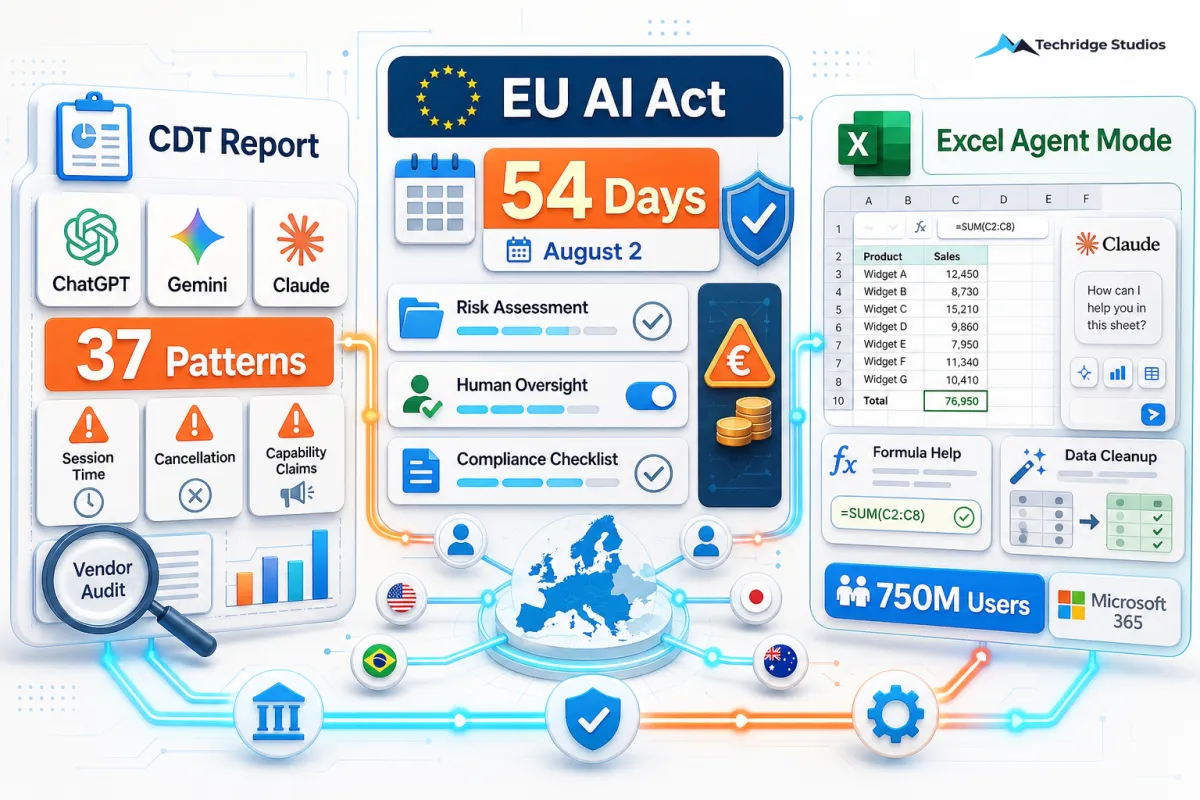
Three developments landed this week that every small business owner needs to understand: the world's most powerful AI law is 54 days from enforcement, a new report found that major AI tools may be engineered to keep you subscribed rather than productive, and one of the most useful AI upgrades of the year just arrived inside a tool your team almost certainly already uses.
EU AI Act Enforcement Begins August 2nd — What Small Businesses Need to Know
The European Union's AI Act has been in the news since it passed in 2024, but August 2nd, 2026, is the first date it carries real teeth. Starting on that date, requirements for high-risk AI systems take effect across Europe — and the law applies to any company anywhere in the world that uses AI to make decisions affecting European customers or residents.
What counts as high-risk? The law is specific: AI used in employment decisions (hiring, performance evaluation, termination), education (grading, access decisions), financial services (creditworthiness, insurance underwriting), healthcare, housing, and legal or judicial processes. If your business uses AI in any of these areas and you have customers in Europe, you are in scope.
What is required? Before August 2nd, covered businesses need to have completed risk assessments for each AI system used in high-risk domains, implemented human oversight processes (meaning a person can review and override AI decisions), documented their AI systems' intended purpose and limitations, and provided clear disclosures to affected individuals when AI is making or influencing consequential decisions.
The fine structure is steep. For the most serious violations — using prohibited AI systems, failing to meet systemic risk requirements — the EU AI Office can impose fines of up to 35 million euros or 7 percent of annual global turnover, whichever is higher. For most other violations, fines run up to 15 million euros or 3 percent of global turnover. For context, 7 percent of OpenAI's projected 2026 revenue would be a nine-figure fine.
One carve-out to note: the law has additional requirements for what it calls general-purpose AI models with systemic risk, defined as models trained on more than 10^25 FLOPs. This threshold covers GPT-5.5, Claude Opus 4.8, and Gemini 3.5 Flash — meaning the vendors of those models have their own compliance obligations, separate from the businesses using them.
For small businesses, the most practical first step is to audit which AI tools you use in any HR, finance, or customer-facing decision-making process, document the intended purpose and any human review steps, and confirm that your AI vendors have published their own EU AI Act compliance documentation. If you need help getting started with that audit, reach out at TechridgeStudios.com.
CDT Report: Your AI Tools May Be Built to Keep You Paying — Not to Keep You Productive
The Center for Democracy and Technology (CDT) released a report this week documenting 37 manipulative design patterns embedded across five major AI platforms: ChatGPT, Google Gemini, Anthropic's Claude, Replika, and Character.AI. The findings are specific, named, and in some cases directly applicable to how small businesses evaluate their AI vendor relationships.
The CDT categorized the patterns into four types. Engagement maximization includes features designed to extend session length beyond what the user actually needs — open-ended prompts that encourage continued conversation when the task is complete, notification systems calibrated to pull users back into the app more frequently than warranted. Emotional dependency cultivation refers to chatbots that position themselves as essential emotional support, including in consumer products marketed to vulnerable users, without appropriate safeguards or referrals to human support. Capability deception occurs when the model's responses imply or explicitly overstate what the AI can reliably do — particularly regarding accuracy, memory, or autonomous action. Friction asymmetry refers to the asymmetry between how easy it is to sign up for a service and how hard it is to cancel, delete data, or understand what information is being retained and for how long.
Not all 37 patterns are equally serious. Some are standard software UX choices that happen to appear in AI products. But the CDT's documentation is specific enough — with product names, screenshots, and interaction examples — to be actionable for regulators. Several of the patterns would violate EU AI Act requirements around transparency and user manipulation that take effect on August 2nd.
The timing is notable for another reason. Both Anthropic and OpenAI are in the process of an IPO in 2026. Risk factor disclosures in their S-1 filings will need to address regulatory risks, and a named CDT report with documented design patterns is exactly the kind of evidence that appears in regulatory proceedings and investor materials. This report will not disappear.
For small businesses, the actionable takeaway is this: treat your AI tools the same way you treat any vendor. Read the cancellation policy before you subscribe. Check data retention terms before connecting business data. Review your AI subscriptions on a quarterly cadence and ask whether the tool is delivering measurable productivity gains or just filling a slot in your tech stack. The CDT report does not mean that you should stop using AI. It means being as deliberate about AI vendor selection as you would be about any other business relationship.
Claude Is Now Inside Microsoft Excel Agent Mode — And Most Businesses Have Not Noticed
The quietest major AI announcement from Microsoft Build 2026 was this: Claude is now available inside Excel Agent Mode through Microsoft Foundry. That puts Anthropic's AI directly inside the world's most-used spreadsheet application, estimated to have 750 million active users worldwide.
What Excel Agent Mode with Claude actually does: users can invoke Claude by name to write and explain formulas, clean and restructure messy data, generate plain-language analysis narratives from datasets, and build automated workflows without leaving the spreadsheet. Claude Sonnet 4.5, Haiku 4.5, and Opus 4.8 are all available through the Foundry endpoint, allowing businesses to route simpler formula requests to Haiku (faster, cheaper) and complex data analysis to Opus 4.8 (more capable, higher-cost), depending on the task.
The integration uses Microsoft's existing Foundry infrastructure — which means Azure billing, Microsoft Entra authentication, and enterprise security controls are already in place. There is no new account to set up, no new vendor to onboard. If your business is already on Microsoft 365 and you have an Azure tenant, Claude in Excel is available through the Foundry catalog today.
For small businesses, this matters for a specific reason. Excel is not a productivity tool that needs to be adopted — it is already in use. The barrier to AI adoption in most SMBs is not willingness; it is the friction of switching to a new tool, learning a new interface, and justifying a new subscription to the team. Claude in Excel removes that friction entirely. The AI is already inside the tool your bookkeeper, operations manager, or marketing coordinator is already using. For businesses that have been watching AI but waiting for a natural entry point, this is one.
The practical first test: open a spreadsheet with messy data, invoke Claude in Agent Mode, and ask it to clean the data and write a summary of its findings. That single workflow — data cleanup plus plain-language summary — saves most small business operators between one and three hours per week on reporting tasks alone.
What This Means for Your Business
Three AI developments landed this week, and they point in the same direction: the AI landscape is maturing from a phase of rapid adoption to one of accountability. The EU AI Act imposes legal consequences for careless use of AI. The CDT report creates reputational and regulatory consequences for careless AI vendor design. Claude in Excel creates a new on-ramp for deliberate AI adoption inside tools you already use.
Your one action this week: audit the AI tools your business uses against two questions. First, do any of them touch decisions that affect employees, customers in Europe, or financial outcomes? If yes, review your compliance posture before August 2nd. Second, do any of them carry subscriptions you have not evaluated against measurable output recently? If yes, run the CDT checklist as your vendor review framework.
Sources
Build Fast with AI — https://www.buildfastwithai.com/blogs/ai-news-today-june-8-2026
Center for Democracy and Technology (cited by Build Fast with AI) — https://www.buildfastwithai.com/blogs/ai-news-today-june-8-2026
Microsoft Foundry / Build 2026 (cited by Build Fast with AI) — https://www.buildfastwithai.com/blogs/ai-news-today-june-8-2026