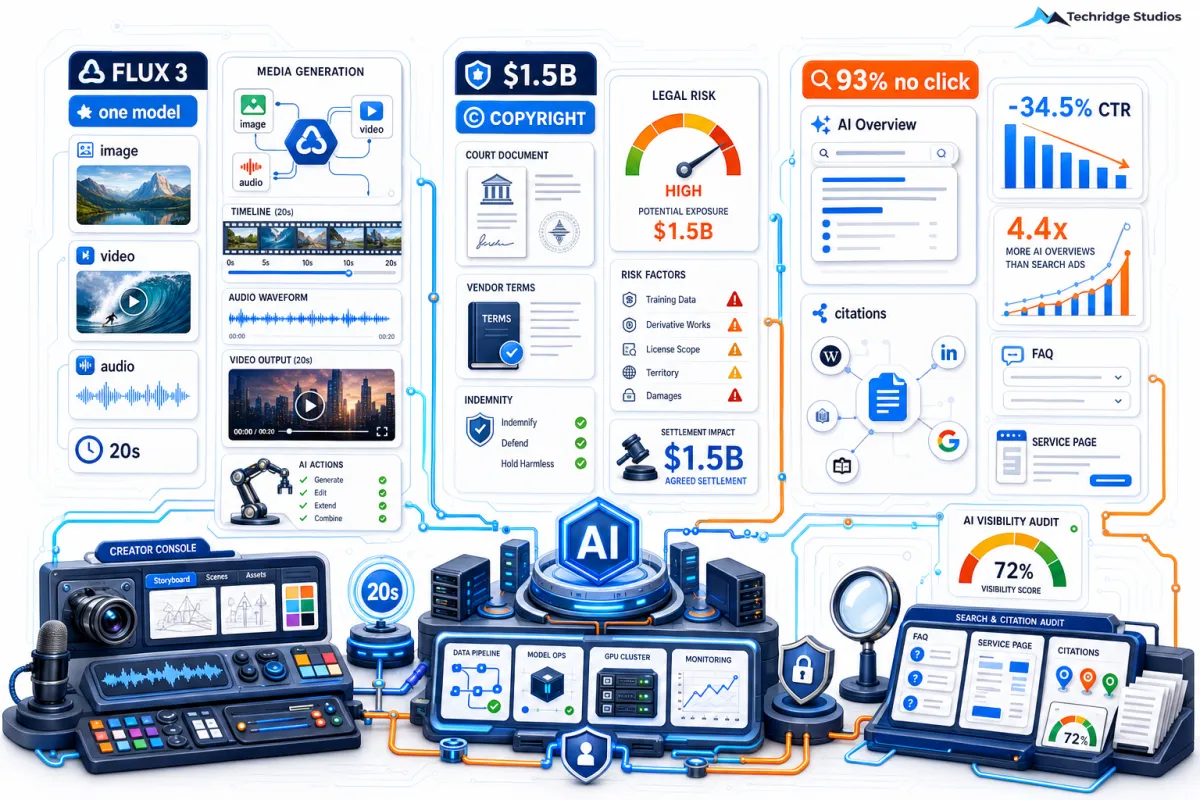
Three AI Shifts Hitting Small Businesses Directly Today
Content creation tools are consolidating, copyright law just found its market rate, and the search traffic your business depends on is quietly shrinking. Today's AI in 60 brief covers three stories with concrete, immediate implications for any business operating in 2026.
FLUX 3 Is Here: One Model for Images, Video, and Audio
Black Forest Labs launched FLUX 3 on July 23, 2026, and coverage has been building through this week as the early access rollout expands. FLUX 3 is the company's first multimodal foundation model — a single set of weights trained jointly on images, video, and audio. That architecture matters because it means the model understands the relationships between what things look like, how they move, and what they sound like, all at once.
In practical terms, FLUX 3 can generate up to 20 seconds of video with native synchronized audio from a single prompt. Dialogue tracks lip movement. Sound effects line up with on-screen action. Ambient noise matches what the scene depicts. That level of audio-visual coherence has required entirely separate models until now — one for image generation, another for video, another for audio.
The company, based in Freiburg, Germany, and founded by the team that built the latent diffusion architecture behind Stable Diffusion, has also extended FLUX 3 into industrial robotics. FLUX-mimic, a robotics model built on the FLUX 3 backbone in collaboration with Mimic Robotics, is already deployed on Audi production lines. That is a different market from most small businesses, but it signals the underlying model's capability range.
For most SMBs, the near-term opportunity is in content marketing. If your team currently pays for separate image generation, video creation, and audio production tools for social media, ads, or website assets, FLUX 3 represents a real cost consolidation opportunity once it opens broadly. FLUX 3 Video and FLUX 3 Action are available in gated early access now. FLUX 3 Image follows in the coming weeks, and an open-weight Dev backbone is planned for later. Apply at bfl.ai to join the early access program.
The First Billion-Dollar AI Copyright Settlement and What It Means for Your Business
On July 20, 2026, a federal judge in the Northern District of California granted final approval to the $1.5 billion class action settlement in Bartz v. Anthropic. It is the largest copyright settlement ever recorded, and it marks the first major legal resolution in dozens of similar AI copyright cases working their way through U.S. courts.
The core legal question in the case was whether using digitized books to train a large language model constitutes copyright infringement. The court drew a key distinction: training AI on copyrighted content can qualify as fair use, because the resulting model is transformative. But acquiring and storing pirated copies of those works to enable that training does not qualify as fair use. That second point is where Anthropic's liability was established.
The settlement covers approximately 482,000 works. Authors and publishers receive roughly $3,100 per title after legal fees. About 91 percent of eligible works have been claimed. NPR's July 27 coverage notes that author reactions are mixed — some see it as a meaningful precedent, others argue the per-title payout is too small given the scale of the training data involved and the ongoing commercial value derived from it.
The settlement's implications extend well beyond Anthropic. More than 30 similar cases are still pending against OpenAI (New York Times v. OpenAI alone could go to trial in late 2026 or early 2027), Meta, Google, and others. The $1.5 billion figure establishes a market rate for past AI training conduct. It signals to every AI company that copyright exposure is financially real, not just theoretical.
For businesses, the question is not whether you trained a model on pirated books — you almost certainly did not. The question is whether the AI tools you use and pay for carry indemnification for their own training data liability. Review your vendor contracts. Look specifically for language about copyright indemnification, training data sourcing, and what happens if a third-party IP claim arises from content the tool generates for you. Most enterprise-tier contracts include some version of this protection. Most individual and SMB-tier plans do not.
93 Percent of AI Search Sessions End Without a Click — What That Means for Your Website
VentureBeat published fresh analysis on July 28, 2026, drawing on data from Conductor, Ahrefs, and marketingcode.com that puts a sharp number on what many business owners have been sensing but not quite measuring: AI is answering questions that used to drive traffic to your website.
The core data point: 93 percent of AI-driven search sessions end without a single click to any website. ChatGPT, Google AI Overviews, Perplexity, and Claude handle the query entirely inside the conversation. The user gets an answer. No click. No visit. No lead generated by traditional search.
The downstream impact is measurable. Ahrefs analyzed 300,000 keywords and found that when a Google AI Overview appears, click-through rate for the number-one organic result drops an average of 34.5 percent. Google AI Overviews now appear in 48 percent of all searches. MarketingCode's analysis put it plainly: holding the top organic Google position now delivers 38 percent less traffic than it did 18 months ago, purely as a result of AI Overviews absorbing the intent.
Traditional SEO — optimizing to rank — was built on the assumption that a high rank produces a click. That assumption no longer holds at the same rate. The new imperative is answer engine optimization, sometimes called AEO or generative engine optimization. The goal is not to rank; it is to be cited as a source inside AI-generated answers. That requires a different kind of content: specific, structured, named, factual, and clearly answering one question per page.
The practical action is not complicated, but it does require a deliberate audit. Look at your website's most important pages — service descriptions, FAQs, About page, case studies — and ask one question for each: does this page answer a specific question that a customer would ask an AI? If the page is written to perform in search results (thin content, broad keywords, loose structure), it is probably not being cited in AI answers. Pages that explain one thing clearly, cite facts, name specific details, and are written to inform rather than rank tend to perform better in AI citations.
One piece of good news: AI-referred visitors, when they do arrive, convert at 4.4 times the rate of traditional organic visitors. They arrive with higher intent because AI tools pre-filtered the query. Lower volume, higher quality. That changes how you should measure the impact of an AEO strategy — not just traffic, but conversion rate and lead quality.
What This Means for Your Business
Three actions come out of today's brief, and none of them require a large budget.
First: if you run content marketing, visit bfl.ai and apply for FLUX 3 early access. You are not committing to anything — you are getting in line for what could be a meaningful consolidation of your creative tool stack.
Second: pull out your AI vendor contracts and search for the word "indemnification." If it is not there, ask your vendor directly what their policy is on copyright claims tied to generated content. Document what they tell you.
Third: pick your three most important website pages and rewrite them as if you are answering a specific question a customer just asked an AI. That is the new baseline for online visibility.
Sources
Black Forest Labs — https://bfl.ai/blog/flux-3