Free Agents, Cheaper Video, and a Cost Deadline: The AI Brief for August 1st
Three developments landed today that affect how small businesses build with AI, produce content, and manage their tool costs. One gives you something free to deploy right now. One drops the price on professional video creation. One sets a hard deadline on your current budget assumptions.
Y Combinator Just Open-Sourced the AI Agent System It Uses to Run Itself
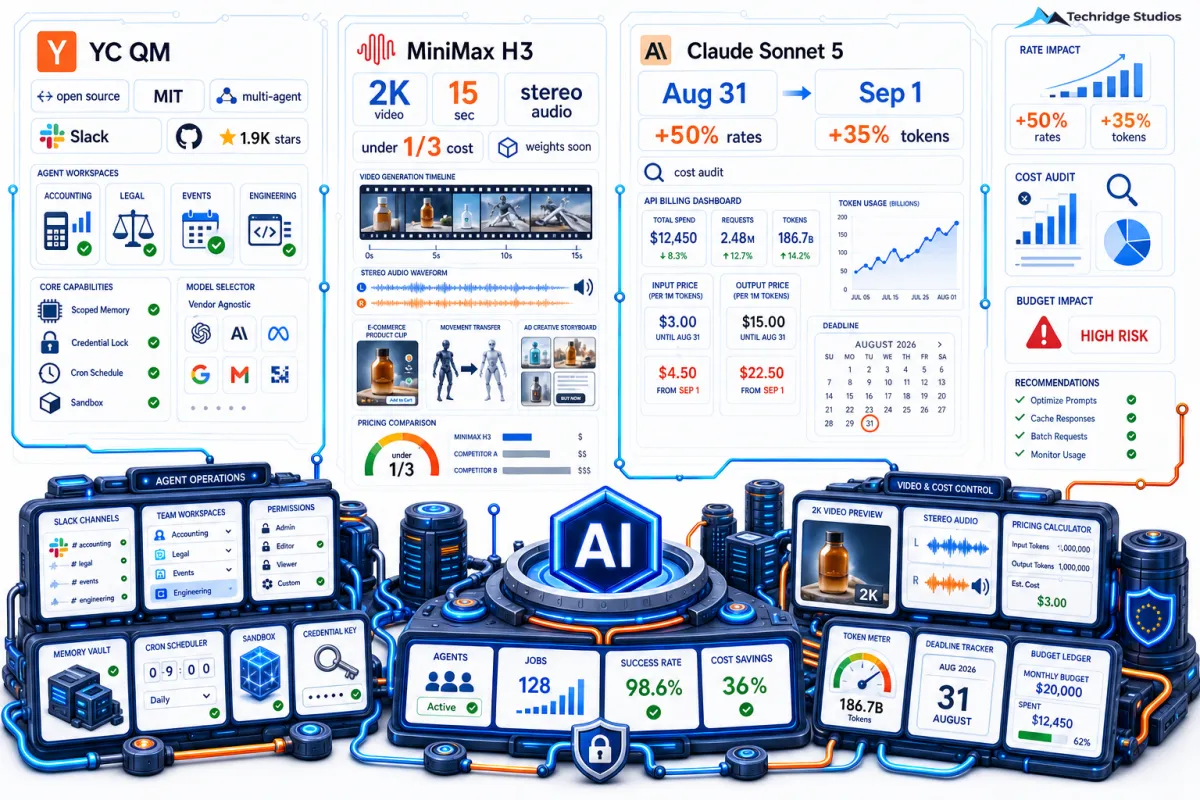
Y Combinator announced today that it is releasing QM — the multiplayer AI agent harness it built and has been running internally across its accounting, legal, events, and engineering teams — as free, open-source software under an MIT license. The repository is live at github.com/yc-software/qm.
This is not a demo or a side project. YC has been running QM in production long enough to work through the real problems: managing credentials across a team, keeping different employees' workspaces isolated, scheduling agent jobs reliably, and switching between model providers without rebuilding everything. The code reflects those operational scars, not just a prototype.
What QM does is give each person on your team, and each shared Slack channel, its own scoped memory, permissions, file access, cron jobs, and sandbox environment. That scoping is the key design decision. If your finance person and your engineer both use the same agent system, the credentials and context they each need to work with are completely different. QM handles that at the architecture level rather than leaving it as a policy problem for your team to manage manually.
For small businesses, the immediate action is straightforward: go to the repository, read the getting-started guide, and evaluate whether your highest-friction, most rule-based tasks — inbox triage, report generation, scheduling, document review — are good candidates for an agent. QM supports Pi, OpenCode, Codex, and Claude Code interchangeably, so you are not betting on a single vendor's roadmap.
MiniMax H3 Makes 2K AI Video Commercially Accessible
MiniMax, the Chinese AI firm known for open-weight model releases, published H3 this week — an omni-modal video generation model that produces 15-second clips in 2K resolution with native stereo audio. The model takes text, images, existing video, or audio as input and can generate new video, edit existing footage, or transfer movement between clips.
The commercial positioning is direct. MiniMax built H3 for advertising, e-commerce, product design, and gaming — the same categories that small businesses routinely outsource to production agencies or piece together from stock footage subscriptions. The company priced API access at less than one-third of mainstream competitors, and announced that model weights will be released within days.
That second detail matters most for budget-conscious teams. When model weights are available for download, businesses with even modest server access can run H3 at near-zero variable cost. The quality ceiling on self-produced video content just moved significantly higher, and the price floor moved significantly lower.
For small businesses specifically: if you produce product videos, social ads, e-commerce listings, or any visual content on a recurring basis, H3 is worth evaluating now via the MiniMax API before the open weights arrive. Get a sense of what it produces against your actual use cases so you can make an informed decision when the free option drops.
UPDATE: Claude Sonnet 5 Introductory Pricing Ends August 31st
Anthropic's introductory pricing for Claude Sonnet 5 ends at the close of August. On September 1st, the API rate increases from 2 dollars per million input tokens to 3 dollars per million input tokens, and from 10 dollars per million output tokens to 15 dollars per million output tokens. That is a 50 percent increase on the rate card.
The rate card increase is only part of the story. Claude Sonnet 5 uses a newer tokenizer that generates more tokens per equivalent input compared to earlier Claude models. According to cost analysis from Finout, this tokenizer can add up to 35 percent more billable tokens for the same text content. The effective cost increase for businesses already running on Sonnet 5 may be larger than the per-token rate alone implies, depending on the specific input types they work with.
This is not a reason to stop using Sonnet 5. The model is genuinely capable and well-suited to agentic workflows, which is exactly what many businesses are building right now. But it is a reason to open your API billing dashboard before August ends, run the numbers on your current monthly usage, and understand what your actual September cost will be — including the tokenizer effect. If you are running customer-facing workflows on Sonnet 5, those cost changes will be real and recurring, and they are 31 days away.
What This Means for Your Business
Today's three stories point in the same direction: the gap between small businesses that actively manage their AI stack and those that do not is getting harder to close by waiting.
QM gives you a production-grade agent platform for free. H3 gives you commercial-quality video at a fraction of prior costs. The Sonnet 5 deadline reminds you that introductory pricing always ends, and the businesses that built workflows on a cost assumption without auditing it will feel that on September 1st.
The single next action: check your Claude Sonnet 5 usage in the Anthropic console today, then spend 30 minutes on the QM repository to see if there is a task on your team's plate that belongs in an agent.
Sources
Startup Fortune / Y Combinator — https://startupfortune.com/y-combinator-open-sources-qm-the-ai-agent-harness-it-uses-to-run-itself/
MarkTechPost / MiniMax — https://www.marktechpost.com/2026/08/01/minimax-releases-minimax-h3-an-omni-modal-video-model-that-generates-15-second-2k-clips-with-native-stereo-audio/
Finout / Anthropic — https://www.finout.io/blog/claude-sonnet-5-pricing-2026-the-hidden-costs-and-real-savings-behind-the-cost-neutral-launch