Three AI Developments That Lower the Cost Floor This Week
This week, a major U.S. bank open-sourced a free security scanner, a design platform that handed enterprise-grade web building to every one of its 265 million users, and a frontier AI company shifted the way subscribers access its most powerful model. Each story points to the same underlying trend: the cost of building with and protecting AI is dropping fast — and the businesses that act now will be ahead by next quarter.
Capital One's VulnHunter Brings Enterprise Code Security to Every Dev Team
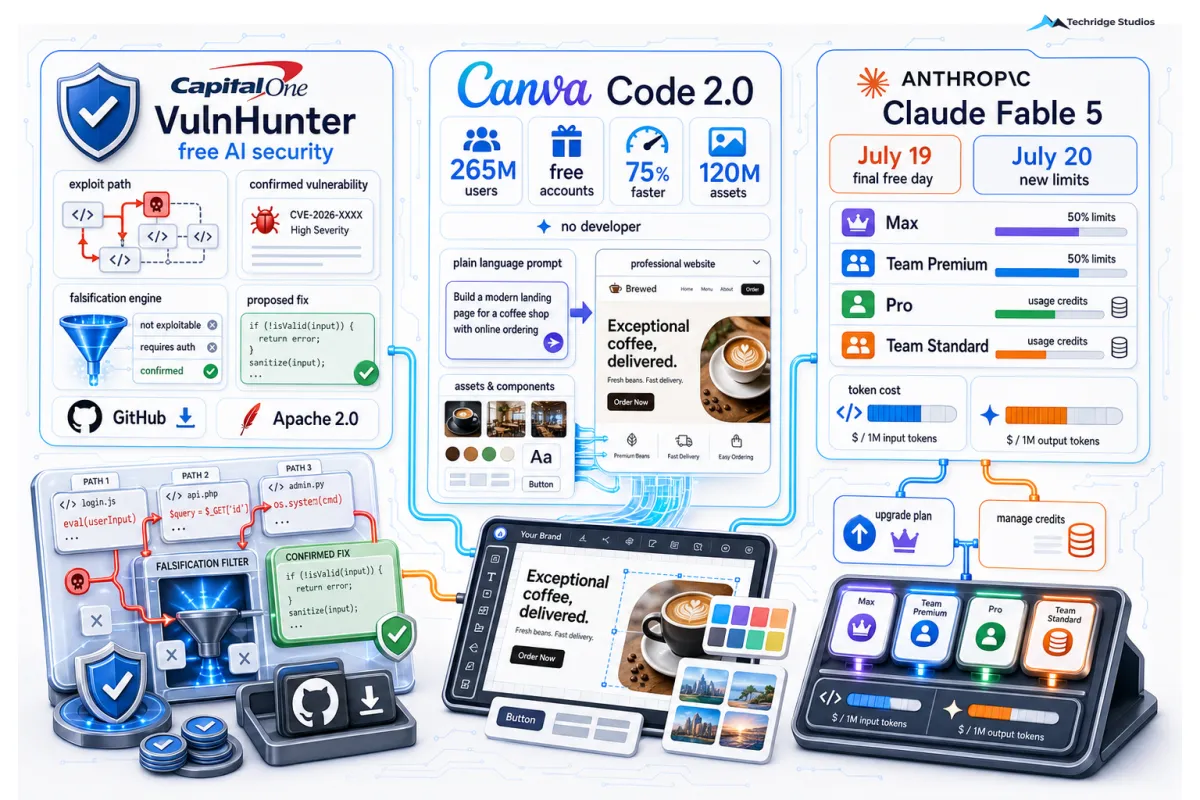
Capital One did something unusual for a major financial institution this week: it gave away a security tool. VulnHunter, released on GitHub on July 17th under an Apache 2.0 license, is an agentic AI code security scanner that goes well beyond traditional static analysis. Where most vulnerability scanners dump hundreds of alerts and leave developers to sort through them, VulnHunter builds an attacker's view of your codebase. It identifies exploitable vulnerabilities, maps the paths an attacker would use to reach them, and proposes targeted code fixes — before a single line ships to production.
What sets VulnHunter apart is its falsification engine. After surfacing a potential vulnerability, the tool runs a secondary reasoning pass that actively tries to disprove its own finding — hunting for logical gaps, unsupported assumptions, or conditions that would prevent the attack from succeeding. Only findings that the engine cannot disprove reach a human reviewer. When they do, developers receive a complete explanation of the exploit path alongside a proposed code fix. The result is fewer alerts, higher signal quality, and faster remediation.
For small businesses, the significance is straightforward: enterprise-quality code security has historically required contracts with specialized vendors or significant in-house expertise. VulnHunter requires access to Claude Opus 4.8 and a Claude Code environment, both of which are available on existing Claude plans. The tool itself is free to download and modify under the Apache 2.0 license.
If your team ships any customer-facing software — an e-commerce platform, a booking system, a client portal — this tool belongs in your development workflow. Pull the repository from GitHub, run it against your codebase, and review the findings. Capital One open-sourced it precisely because they believe defensive tools need to be as widely distributed as the codebases they protect.
Canva Code 2.0 Gives Every User an AI Website Builder — Including Free Accounts
Canva launched Code 2.0 this week, rolling out AI website and app building to its full user base of 265 million monthly users. The defining feature is who gets access: everyone, including users on the free tier. You type a plain-language description of what you want — a booking page, a product showcase, an event site — and Canva generates a working, interactive web experience that you can then edit using the same drag-and-drop tools you would use on any other Canva design.
The launch puts Canva in direct competition with dedicated vibe coding platforms like Lovable, Replit, and Bolt.new. But Canva's differentiation is design. While those platforms focus on generating functional code from text prompts, Canva bets that the real bottleneck is not getting the code to work — it is making the output look good. With access to a 120-million-asset design library and native brand kit integration, Canva's generated sites arrive with professional visual design built in. Brand colors, fonts, and imagery are available from the prompt. Code generation speed has improved by 75 percent over the previous version.
For small business owners, this removes two of the most common blockers to a strong web presence: cost and complexity. The typical path to a professional website has involved hiring a developer, contracting a design agency, paying for a premium website builder, or struggling to piece something together yourself. Canva Code 2.0 bypasses all of that. One text prompt delivers a working, branded web experience that any Canva user can iterate on without touching a line of code.
The specific action here is immediate: if your website is outdated, missing a landing page, or lacks an interactive experience for customers, open Canva and test Code 2.0 this week. Even if you choose not to publish the result, the exercise will show you how fast and inexpensive the process has become.
Anthropic's Free Fable 5 Window Closes Tonight — Here Is What Changes Tomorrow
Anthropic confirmed that July 19th, 2026, is the final day of the extended free access period for Claude Fable 5. The frontier model, which rivals GPT 5.5 on independent benchmarks, has been available at no extra cost to paid subscribers since its initial rollout — a period Anthropic extended multiple times as the company prepared its tiered access model.
Starting July 20th, access to Fable 5 splits by plan tier. Max and Team Premium subscribers retain Fable 5 as a standard feature at up to 50 percent of their weekly plan limits. That means roughly half of your plan's weekly capacity can run on the frontier model without drawing from usage credits or the API. Pro and Team Standard subscribers transition to a credit model: Fable 5 sessions are billed at 10 dollars per million input tokens and 50 dollars per million output tokens, drawn from prepaid usage credits.
This change has practical implications for how your team uses Claude day to day. If you are on Max or Team Premium, the shift is favorable — Fable 5 access becomes a permanent plan feature rather than a temporary promotional offering. If you are on Pro or Team Standard, the question is whether your current usage patterns require upgrading or whether the credit model is manageable given your actual Fable 5 usage. For teams that rely on Fable 5 as a daily workhorse for complex analysis, writing, or coding tasks, an upgrade to Max or Team Premium is likely to make financial sense.
Zoom out, and the story is bigger than one pricing change. Anthropic is preparing for an IPO, reportedly targeting approximately $ 47 billion in annualized revenue, with a confidential S-1 filed this month. As the company scales toward public markets, expect pricing structures across all major AI vendors to become more deliberate. The era of frontier model access as a promotional feature is ending. What replaces it will signal where the industry thinks the real long-term value lies.
What This Means for Your Business
This week's stories share a common signal: the cost of building, protecting, and running AI is compressing at the high end, while access broadens at the low end. Security tools that once required enterprise contracts are free on GitHub. Website builders that once required developers are free on Canva. The one exception is frontier model access, which is transitioning from promotional to structured pricing — and that shift is worth monitoring as every major AI vendor will follow suit.
The single action worth taking today: log into your Claude account before midnight and check your plan tier. If you have been relying on Fable 5 for high-stakes work, understand what changes tomorrow and whether your current plan still covers your needs.
Sources
VentureBeat — https://venturebeat.com/technology/canva-launches-code-2-0-offering-ai-website-building-to-every-user-including-free-accounts
BleepingComputer — https://www.bleepingcomputer.com/news/artificial-intelligence/claude-fable-5-stays-free-for-paid-users-until-july-19-as-anthropic-buys-more-time/