Free AI, Smarter Spending, and New Compliance Rules: What Every SMB Needs to Know Today
Three separate stories landed this week that each change something about how small businesses buy, use, and disclose AI. None of them are theoretical. All three require some kind of action.
OpenAI Just Made Free Unlimited
On August 7th, 2026, OpenAI refreshed the ChatGPT experience across all account tiers. For paid Plus and Pro users, the updated GPT 5.6 Sol now handles both immediate responses and extended reasoning in a single model. The company says the new version produces 68 percent fewer factual errors in high-stakes evaluations compared to GPT 5.5 Instant.
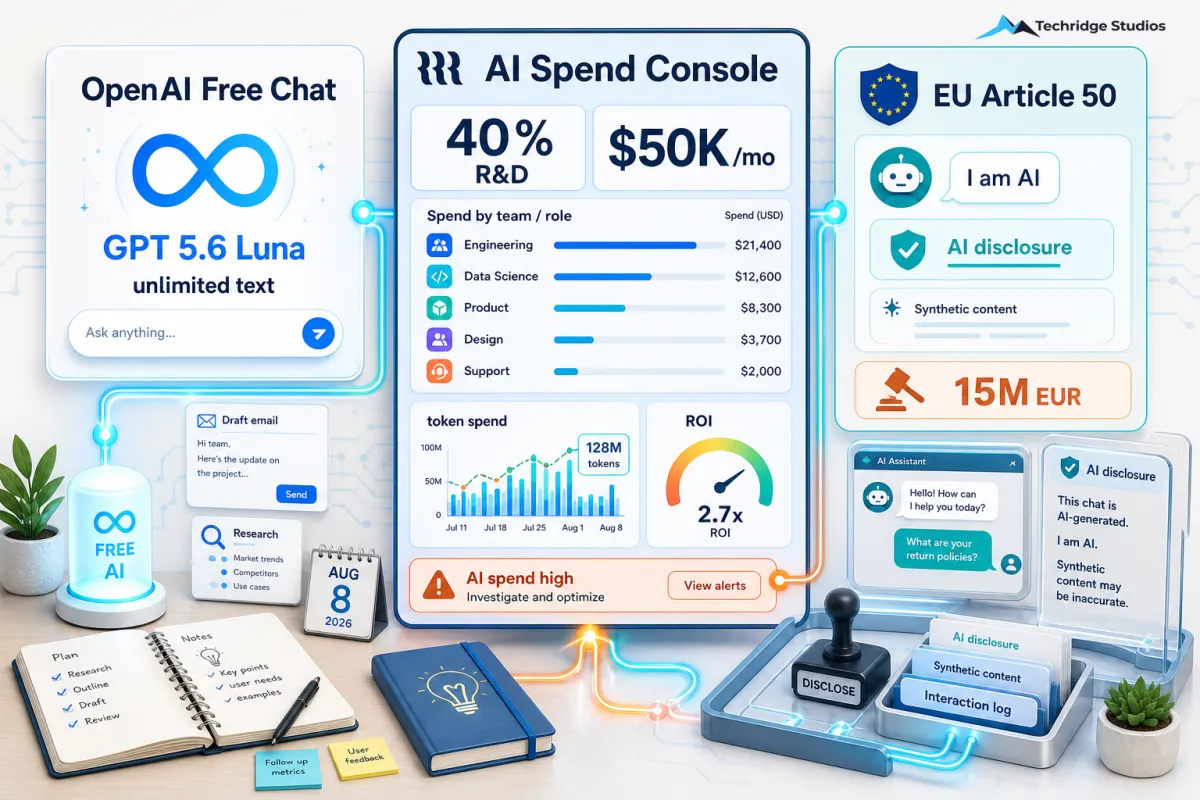
The more significant move is for free users. GPT 5.6 Luna is now the default model for free and Go accounts, and unlimited text chat is on with no cap. A "Think" button lets users invoke extended reasoning for harder questions. Image generation, file uploads, and voice features still have limits — but the core text experience is now unlimited at no cost.
For small businesses using the free tier for drafts, research, customer responses, and internal summaries: the ceiling just went away. If you have team members who have been holding back on AI because of cost uncertainty, this is the clearest signal yet that text-based AI is effectively zero cost at the baseline level. The time to build daily AI habits in your team is now.
Rippling's Wake-Up Call: One Engineer Spent 50,000 Dollars a Month
Rippling launched its AI Spend Console on August 7th, 2026, and the story behind the product matters as much as the product itself.
By March 2026, Rippling's CFO presented a startling number to the executive team: AI spending was on track to consume 40 percent of the company's entire R&D headcount budget. Spending was growing 80 percent month-over-month. One engineer alone was spending 50,000 dollars a month on AI tokens. That's not an edge case — it's a pattern that repeats across teams that integrate AI without any spending visibility.
Rippling built AI Spend Console to solve its own problem and then turned it into a product. The tool breaks down AI costs by individual employee, team, and role, and includes a gateway that actively routes requests to more cost-efficient models. It connects token usage to productivity data so teams can see not just who is spending, but whether that spending is generating results.
For small businesses, the takeaway is direct: if you're running usage-based AI tools without visibility into per-employee spend, you could be sitting on a problem you haven't seen yet. The fix doesn't have to be Rippling — but you do need some kind of visibility. Start by pulling your AI tool invoices and checking whether any are usage-based. If they are, find out who is using them and how much.
The EU AI Act Is Now Enforceable — and It Affects You
On August 2nd, 2026, Article 50 of the EU AI Act became enforceable. The European Commission now has active oversight and fining authority over general-purpose AI providers, and transparency obligations for AI chatbots and AI-generated content are live.
In plain terms: if you operate an AI chatbot — for customer service, lead generation, appointment booking, or anything customer-facing — and that chatbot interacts with users in the European Union, it must clearly disclose that it is an AI system. The same standard applies to AI-generated content that could be mistaken for human-created material.
Penalties are serious. National market surveillance authorities can issue fines up to 15 million euros, or 3 percent of global annual turnover, whichever is higher. Smaller businesses receive proportionality consideration, but that means the fine is scaled — not waived.
US-based businesses are not exempt if they serve European customers. If your website has a chatbot that European visitors use, you are potentially in scope. Review your chatbot implementation now, confirm it surfaces a clear AI disclosure, and document that decision. The European Commission has published compliance guidelines at commission.europa.eu for businesses unsure where to start.
What This Means for Your Business
Today's brief adds up to one theme: the cost and legal structure of AI is solidifying fast. Free text AI is real. Uncontrolled AI spend is a real risk. And AI compliance obligations are no longer theoretical — they're active, enforceable, and have teeth.
The single next action: do an AI audit this week. List every AI tool your team uses. Note which are usage-based versus flat fee. Check your chatbot for EU disclosure language. It takes an hour and could save you significantly more.
Sources
OpenAI Blog — https://openai.com/index/improving-gpt-5-6-sol-in-chatgpt/
TechRSeries — https://techrseries.com/employee-engagement/rippling-launches-ai-spend-console-to-track-ai-usage-and-roi-across-the-business/
European Commission — https://digital-strategy.ec.europa.eu/en/news/commission-starts-enforcing-ai-act-rules-and-new-transparency-requirements-2-august