Free Training, a Platform Overhaul, and a Compliance Deadline: Three AI Moves Every Small Business Needs to Know About Right Now
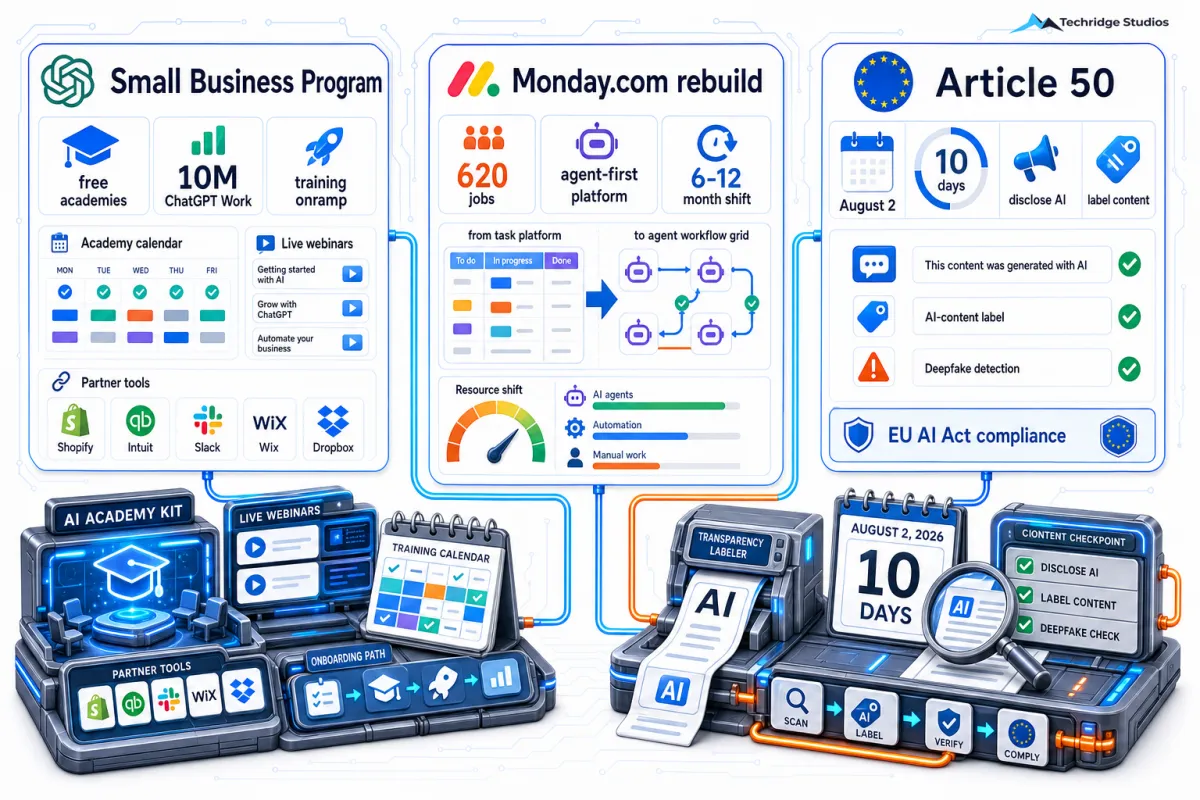
Today brought three distinct AI developments for small businesses — a structured onramp into AI tools, a major platform announcing it is rebuilding from the ground up, and a regulatory deadline arriving in 10 days. They are unrelated stories, but they share a theme: the window for treating AI as optional is closing faster than most business owners realize.
OpenAI Builds a Small Business AI Program — Here's What It Includes
OpenAI announced on July 21, 2026, the launch of its ChatGPT Small Business Program. Unlike a typical product release aimed at any user, this initiative is structured specifically around the workflows small business owners run every day — bookkeeping, customer outreach, marketing, inventory management, e-commerce operations.
The program has three components. First, product-specific webinars show business owners how to use ChatGPT Work in their actual day-to-day operations, with demos, prompts, and automations specific to accounting, marketing, and e-commerce use cases. Second, in-person Small Business AI Academies are being held across the U.S. through OpenAI's Academy team for those who want hands-on instruction. Third, new agents and tools specifically designed for small business workflows are being introduced through an initial set of partners: Dropbox, Shopify, Intuit, Slack, and Wix.
The timing coincides with OpenAI reporting it now has 10 million active users on ChatGPT Work, the agent product it launched on July 9th. ChatGPT Work is designed for complex, multi-step tasks that go beyond a typical chat request — scheduling, research synthesis, document drafting, workflow automation. The 10 million user milestone is the clearest sign yet that the product is past the early-adopter phase.
The partner list is worth paying attention to. Shopify, Intuit, and Wix are tools many small businesses use to sell, manage money, and maintain their online presence. Slack handles internal communication. Dropbox handles file storage. These are not aspirational integrations — they are the operational stack a lot of small businesses already run on. That means the AI tools coming through this program are designed to slot into systems you already have, not replace them.
If you want to explore the program, the webinar calendar and academy locations are at openai.com/index/introducing-chatgpt-small-business-program/. If your team is already on ChatGPT Work, the partner integrations are active now. If you are not yet on ChatGPT Work, this program is a reasonably structured starting point.
Monday.com Is Rebuilding Its Entire Platform Around AI — What That Means for Your Team
Monday.com announced on July 22, 2026, that it is laying off approximately 620 employees — roughly 20 percent of its global workforce, including 350 positions in Tel Aviv. Co-CEOs Roy Mann and Eran Zinman were explicit that this is not a cost-cutting move or a human-for-AI substitution. They described the cuts as a reallocation of resources toward what they called "the largest product change in company history": a full redesign of the Monday.com platform around human-and-agent collaboration.
The context around this announcement matters. Monday.com's stock (MNDY) is down roughly 50 percent year-to-date and more than 80 percent from its peak. That financial pressure shapes how to read the announcement — this is a company making a major strategic bet that rebuilding around AI agents is its path back to relevance and growth, not an AI pivot from a comfortable position. Whether that bet pays off is genuinely uncertain.
What "human-and-agent collaboration" means in practice has not been detailed in a public product roadmap. The direction is clear enough though: Monday.com believes the future of project management software is not a task tracker that humans update manually, but a system where AI agents take on assigned work — scheduling tasks, moving items through workflows, surfacing blockers, drafting status updates — while humans retain decision-making authority over what happens next. Several major enterprise platforms have moved in this same direction over the past year.
If your team uses Monday.com as a core operations tool, nothing changes in the short term — the current product continues to operate. But a full platform redesign of this scale typically plays out over 6 to 12 months, and the product your team uses today will function differently by the end of that window. The practical move right now is to document your key workflows, understand which automations or custom fields you rely on, and note where your data lives. That is not a reason to leave Monday.com — it is basic operational hygiene for any time a platform you depend on announces a major architectural change.
EU AI Act Article 50 Takes Effect August 2nd — Three Things You Must Do Before Then
On August 2, 2026, Article 50 of the EU AI Act enters enforcement. This is the transparency chapter of the law, and its scope is broader than most business owners realize. It does not apply only to companies building AI models or to systems classified as high-risk. It applies to any business that deploys AI tools to customers in the European Union — including businesses that use ready-made platforms like ChatGPT, Canva, Notion AI, or any customer-facing chatbot. If you serve EU customers and use AI tools, you are in scope.
The European Commission published implementation guidance on July 20, 2026, clarifying exactly what the three obligations are. First: any system that interacts with users in real time using natural language must disclose it is an AI at the start of each conversation. If your website runs an AI chat tool, that chatbot must identify itself as AI before the conversation begins. Second: content that was generated or materially edited by AI must be labeled as such. This applies to text, images, audio, and video — AI-written blog posts, AI-edited photos, AI-generated product descriptions. Third: deepfakes — synthetic representations of real people — must be marked as artificial.
The guidance also clarified that "anyone using a ready-made AI tool bears their own obligations." That is the key line for small businesses. If you use a third-party platform to send AI-generated emails, run a chatbot on your website, or publish AI-assisted content, compliance is your responsibility — the tool vendor's own compliance does not cover you. This closes the "I just use ChatGPT" loophole.
The implementation steps are not technically complex, but they must be done before August 2nd. Audit your customer-facing tools: does your website have a chatbot or AI assistant that EU customers interact with? If yes, add a disclosure statement at the start of each session. Review your content workflow: if you use AI to write or edit posts, emails, or landing pages visible to EU users, add a visible label — a statement as simple as "Created with the assistance of AI" satisfies the requirement. Check your visual content: if you use AI-generated images or synthetic video showing real people, add a clear disclosure. These steps take hours, not weeks. The main barrier is knowing the requirement exists — which, as of today, you do.
Note: systems deployed before May 2026 have until December 2, 2026 to add the machine-readable version of these labels. The visible disclosure requirement starts August 2nd.
What This Means for Your Business
Two ideas from today's brief are worth holding together. The first: structured, practical AI onboarding for small businesses now exists in a way it did not six months ago. OpenAI built a program around your actual workflows, with partners you already use. The barrier to getting started has dropped significantly. The second: the window to adopt AI tools without paying attention to compliance is closing. Article 50 is the first enforcement date many small business owners will encounter directly — and more regulatory milestones will follow.
This week's practical actions: sign up for a ChatGPT Small Business Program webinar, run a 30-minute audit of your EU customer-facing content and chatbots for Article 50 readiness, and note the Monday.com product shift if your team operates there. None of these require a budget or a technical team. They require one hour and a decision to act.
Sources
OpenAI Blog — https://openai.com/index/introducing-chatgpt-small-business-program/
AI Weekly — https://aiweekly.co/ai-news-today
EU AI Act Guide — https://artificialintelligenceact.eu/transparency-rules-article-50/