Free Frontier AI, Cheaper Security, and a Smarter Notebook: What This Weekend's AI Launches Mean for Small Businesses
Three AI stories landed this weekend that share a single theme: the cost of powerful AI is dropping, and the tools that used to require an enterprise budget are becoming available to any business willing to pay attention.
Microsoft is entering the AI security market with a product priced for broad access. China's Moonshot AI just released the largest open-source AI model ever built, with free weights dropping in ten days. And Google quietly upgraded its free research tool to handle data analysis — no separate platform required. Here is what each development means in plain terms, and what you should do about it.
Microsoft Project Perception: AI Security Scanning Below Enterprise Pricing
For years, AI-powered vulnerability scanning has been a tool for large enterprise IT departments. Anthropic's Mythos, the leading product in this category, has API pricing roughly 100 percent higher than standard Claude Opus and 82 percent higher than GPT models — making it one of the most expensive AI tools in production use. The assumption has been that the complexity and sensitivity of security scanning justifies the premium.
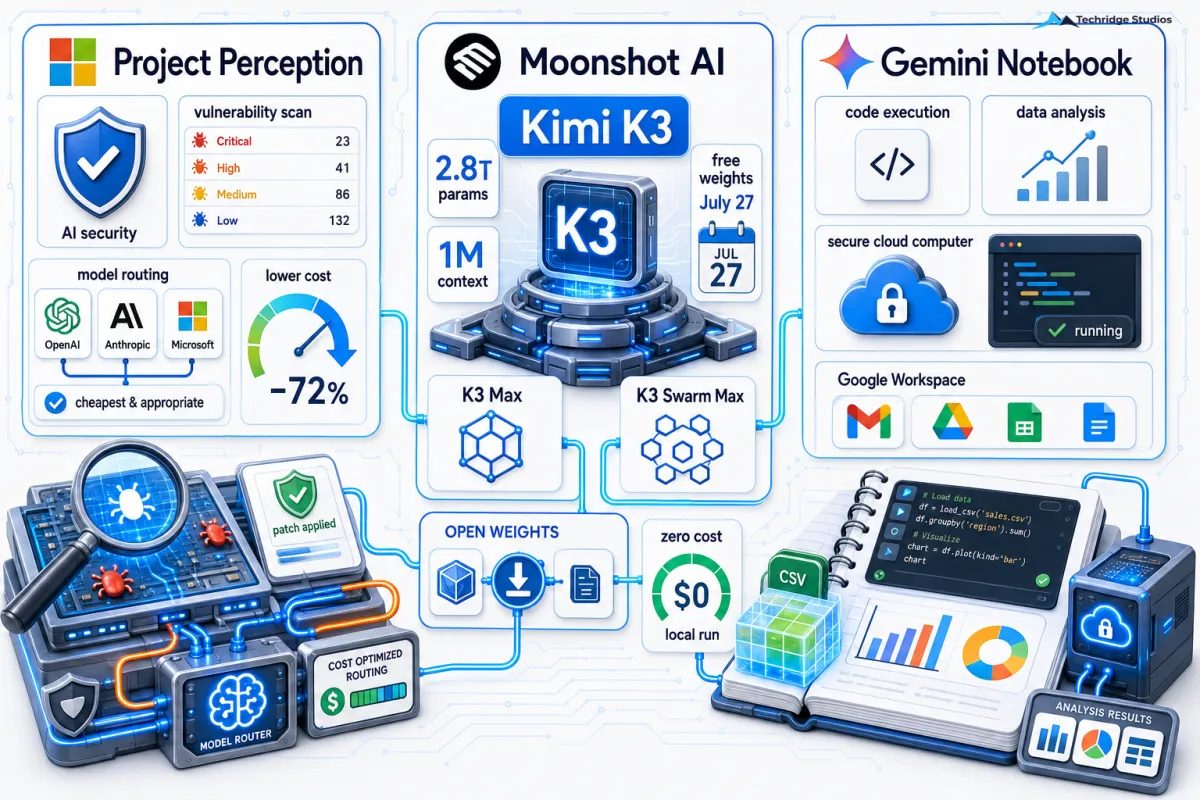
Microsoft is challenging that assumption with Project Perception, a new AI cybersecurity tool expected to launch in July 2026. According to TechRepublic, the product uses a combination of AI models from Anthropic, OpenAI, and Microsoft, routing each security task to the appropriate model based on cost and fit — the same model-routing strategy that AI development teams have been using for months to reduce API costs on complex workflows.
The competitive angle matters beyond the price point. Microsoft has distribution advantages that Anthropic currently lacks. Anthropic's most capable models have faced U.S. government export restrictions, limiting their global deployment. Microsoft, as the underlying platform for Windows and Azure, faces fewer of these headwinds and can move its security products across European and international markets more quickly.
For small businesses, the immediate implication is not to buy Project Perception today — pricing, supported workloads, and customer eligibility have not been officially announced. The implication is structural: when a large vendor enters a category with a lower-cost alternative, prices across that category fall. AI-powered security scanning is becoming a general market, not an enterprise-exclusive one. If you have been dismissing AI security tools as out of budget, revisit that assumption in the next 90 days.
The specific action to take today is to document your current security audit process and identify any gaps that a vulnerability-scanning tool could close. When Project Perception launches with full pricing, you will have a clear evaluation framework ready rather than starting from scratch.
Kimi K3: The World's Largest Open-Source AI Model, Free in Ten Days
Moonshot AI released Kimi K3 on July 16th, 2026, and it arrived as the largest open-source AI model ever built. At 2.8 trillion total parameters — roughly 75 percent larger than DeepSeek V4 Pro, which previously held the title — Kimi K3 is a sparse mixture-of-experts model with a 1-million-token context window, native visual understanding, and an always-on reasoning mode.
VentureBeat reported that independent benchmarks place Kimi K3 near the Claude Opus 4.8 and GPT 5.5 tiers on real-world task assessments. It ranked third overall on GDPval-AA v2, a benchmark that tests performance across 44 occupations and 9 major industries, behind only Claude Fable 5 Max and GPT 5.6 Sol Max. That is frontier territory — the class of models that costs organizations significant API spend to access through paid services.
Here is the business-relevant part: Kimi K3 is available via API right now at $3 per million input tokens and $15 per million output tokens. But the open model weights — meaning the full model you can download, run locally, and modify — are promised by July 27th, 2026, at no cost. That date is ten days away.
Running a model locally means paying no per-token fees. It also means your data stays on your own infrastructure, which matters for businesses that handle sensitive customer information. The trade-off is that you need compute infrastructure to run a 2.8-trillion-parameter model — this is not something you run on a laptop. For businesses with cloud infrastructure or a technical team, the economics shift significantly. For businesses without that, the API pricing at $3 input is still competitive against major paid services.
What Kimi K3's release makes clear, combined with last week's Inkling release from Thinking Machines Lab, is that the open-source AI arms race is now producing frontier-class models on a near-weekly schedule. Each release puts pressure on the price of paid AI services. If your business is currently paying premium API rates for tasks that a smaller or open-weight model could handle, now is a good time to audit that spend.
The specific action: put July 27th on your calendar. If you have a technical team or a cloud environment, test Kimi K3's weights against your actual workloads when they drop. If you do not, watch what the developer community builds on top of them — usable interfaces for non-technical business users tend to appear within weeks of a major open-source release.
Google Gemini Notebook: Your Free Research Tool Just Got Data Analysis Built In
Google has been on a renaming streak, and NotebookLM is the latest product to get a new identity. It is now called Gemini Notebook, folded into Google's Gemini brand alongside the company's other AI products. The rename is the least important part of the story.
What matters is what shipped with it. According to TechCrunch, Google added a secure cloud computer to the Gemini Notebook, allowing Pro users to run code directly in their notebooks. That means you can upload a spreadsheet, a PDF, or a set of documents, ask questions in plain English, and now also execute code against that data — all within one tool, without switching to a separate analytics platform.
Google also announced that Gemini Notebook will sync across the Gemini app and Google Search's AI Mode. The product serves more than 30 million users and more than 600,000 organizations — numbers that suggest it has moved well beyond early-adopter territory.
Before this update, Gemini Notebook (then NotebookLM) was already one of the most useful free AI tools for business research. Teams used it to synthesize documents, generate audio summaries of long reports, and ask questions across multiple uploaded sources simultaneously. For businesses that needed to make sense of large volumes of content — vendor contracts, market research, customer feedback — it was a genuinely useful free tool.
The addition of code execution changes the tool's category. It is no longer just a research assistant. It is now closer to a lightweight data workbench. For small businesses that currently pay for separate data analysis or business intelligence tools, Gemini Notebook's new capability is worth testing before renewing those subscriptions.
The access point is straightforward: Google Workspace Pro users can access the new code execution feature in Gemini Notebook today at notebook.google.com. If your team already uses Google Workspace, the upgrade requires no new software purchase.
What This Means for Your Business
The pattern across all three stories is the same. Tools that required enterprise budgets six to twelve months ago are becoming accessible to smaller teams — either through lower-priced commercial products, through open-source alternatives arriving at no cost, or through capability upgrades to tools you already own.
The businesses that benefit from this are not the ones chasing every launch. They are the ones who maintain a clear picture of which AI tasks they are currently paying for, how much each task costs, and which new tools could replace that spend with equal or better output.
The single next action from this week: make a list of your current AI tool subscriptions, what each one does, and what it costs per month. Then set a reminder for July 27th, when Kimi K3's free weights drop. That list, alongside what's available for free, will make your next renewal conversation much clearer.
Sources
TechRepublic — https://www.techrepublic.com/article/news-microsoft-project-perception-ai-security-tool/
TechCrunch — https://techcrunch.com/2026/07/16/google-continues-its-renaming-streak-by-turning-notebooklm-to-gemini-notebook/