Google's AI Gets a Major Upgrade, Congress Confirms AI Creates Jobs, and a Free Model Just Dropped
Three separate AI developments landed this week — a rebuilt Google model, congressional testimony on small-business hiring, and a free, open-source AI from one of the industry's most credible newcomers. Together, they paint a clearer picture of where AI is actually heading for business owners.
Google Rebuilt Gemini 3.5 Pro From Scratch — Here Is What Changed
Google's Gemini 3.5 Pro officially launched today, July 17th, 2026 — but not as a routine update. Google scrapped the original model architecture entirely and rebuilt from scratch after enterprise testers identified three performance gaps: mathematical reasoning, complex SVG scene generation, and overall image quality. These are not minor benchmarks. Mathematical reasoning is a proxy for the structured, multi-step logic that financial modeling, code generation, and data analysis require. SVG quality reflects how well the model handles complex, relational information in diagrams and documents.
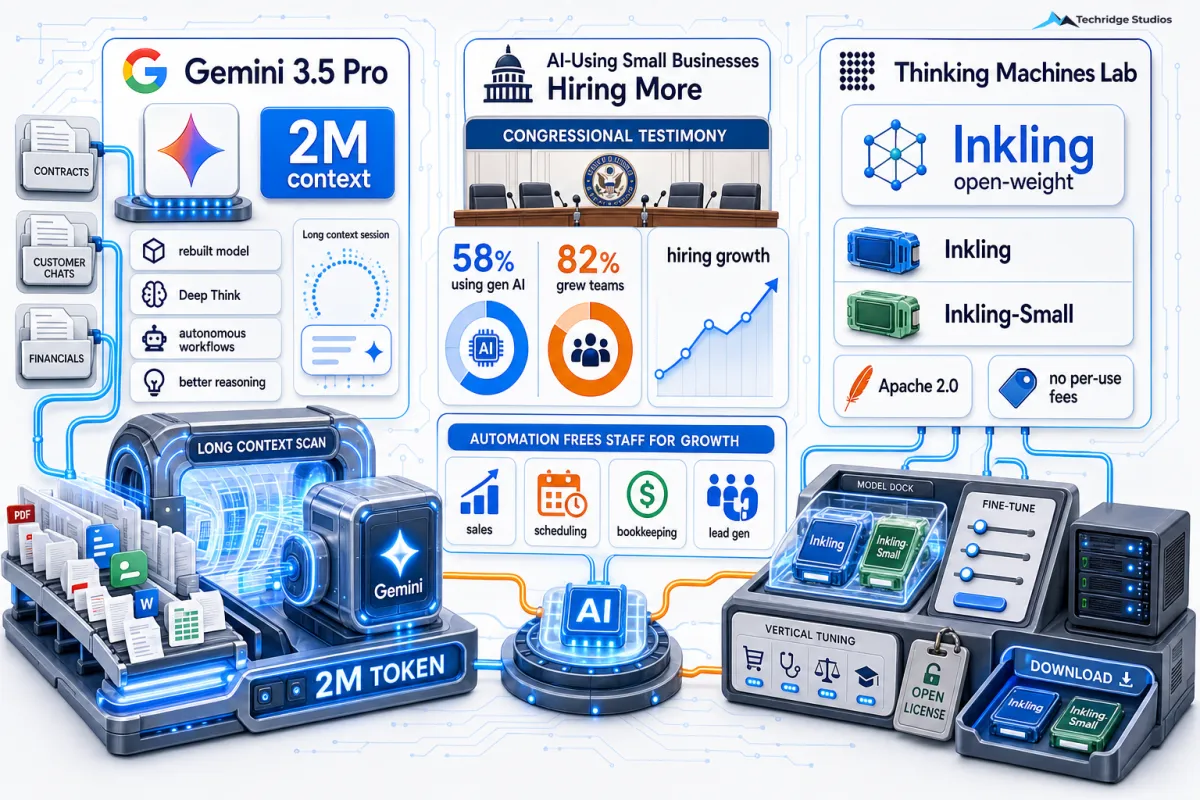
The rebuilt model introduces a 2-million-token context window — double the 1-million-token limit on Gemini 2.5 Pro. At that scale, the practical use cases shift considerably. A business can now process an entire contract library in a single AI session, feed a full year of customer support conversations alongside product documentation, or reason across a complete codebase without chunking the data into separate calls. These are not incremental improvements. They change the category of problem you can actually solve.
The model also adds Deep Think, a reasoning mode for extended multi-step problem-solving, and autonomous workflow capabilities that enable it to chain complex tasks with minimal human intervention. Pricing is expected to sit in the premium tier, with access to Deep Think gated behind the 250-dollar-per-month Ultra subscription. For businesses already on Google Workspace, the base Gemini 3.5 Pro capabilities will be available without the premium tier.
The practical step for any business on Google Workspace: open a Gemini session this week and try processing a document or data set that was previously too large. If you are on Vertex AI, request access to the Gemini 3.5 Pro preview through your Google account manager. The 2-million-token window is the most important feature to verify on your actual business documents — not on benchmark datasets.
Congress Just Confirmed What the Data Has Been Showing: AI-Using SMBs Are Hiring More
Witnesses testifying before the House Small Business Committee this week delivered a message that cuts against the most common fear about AI in the workplace: small businesses using AI are not cutting jobs — they are growing and hiring.
New data shared during the hearing shows 58 percent of small firms nationwide reported using generative AI last year, up from 40 percent in 2024 and 23 percent in 2023. More importantly, 82 percent of those AI-using businesses increased their headcounts over the same period. Witnesses representing retail, professional services, and food service described AI as a force multiplier rather than a replacement. When AI handles repetitive, time-consuming tasks, teams are freed to pursue more business. When business grows, hiring follows.
The tools cited at the hearing were not exotic. Claude and ChatGPT were named for automating back-office functions — bookkeeping, lead generation, scheduling, and research. These are tasks that occupy hours every week in a typical small business, and they are the clearest starting point for automation that actually moves the needle.
This testimony matters because it comes from a government setting, not an industry survey funded by an AI company. The witnesses were actual business owners, and the committee was asking hard questions. The 82 percent hiring growth figure held up under that scrutiny. For any owner who has delayed AI adoption because of fear about what it will do to their team, the current evidence points in the opposite direction.
If you are looking for a practical starting point, identify one task in your business that takes more than two hours per week and is largely rule-based. Automate it. Measure what the team does with that time over the next 90 days. The congressional testimony suggests the answer is usually: more business.
Thinking Machines Lab Released a Free AI Model — Here Is Why That Matters for Small Businesses
Thinking Machines Lab, the AI startup founded by Mira Murati — former CTO of OpenAI — released its first in-house AI model on July 15th. Called Inkling, it is a mixture-of-experts model with 975 billion total parameters, though it draws on only about 41 billion for any given task. It was trained on 45 trillion tokens of text, image, audio, and video, and it reasons natively across all four modalities.
The detail that matters most for small businesses: Inkling is free. The model weights are available for download via Hugging Face under an Apache 2.0 license, which means you can use them commercially, modify them, and deploy them however you need without paying per-token fees to a major AI provider. Thinking Machines also released Inkling-Small — a lighter 12-billion-parameter version with lower cost and latency — for businesses that need a faster, cheaper deployment.
Thinking Machines is positioning Inkling less as a finished product and more as a starting point. Businesses can fine-tune it for their specific industry through Tinker, the company's model-customization platform. A retail business could train Inkling on its product catalog and customer history. A service firm could fine-tune it on its past client work. The resulting model would reflect the business's own knowledge base, not just the broad internet data the original was trained on.
The broader context: open-weight models have been steadily closing the gap with closed, premium models. When a credible lab with this level of technical leadership ships a model of this size under an open license, the frontier moves. For small businesses that have been priced out of the premium AI tier, Inkling is the clearest signal yet that powerful AI does not have to mean a large recurring bill.
The first step is simple: go to Hugging Face, search for Inkling by Thinking Machines Lab, and download Inkling-Small to test on one of your business workflows. If it fits your needs at that scale, the full model is available at the same URL.
What This Means for Your Business
Three things landed this week that collectively lower the barrier to AI adoption for small businesses: a more capable standard model from Google, congressional data confirming that adoption leads to growth, and a free open-weight model from a credible new lab.
The practical implication is straightforward. If you are on Google Workspace, test the updated Gemini today on a document or dataset you previously could not process at full scale. If you are cost-sensitive and want to explore AI without monthly API bills, download Inkling-Small from Hugging Face and test it on one workflow this week. And if you still have reservations about whether AI will help or harm your team, the congressional record now gives you a data point from actual business owners under oath: 82 percent who adopted AI grew their headcounts. Start with the workflow that wastes the most time. The rest follows.