Your Developer Tools Just Got More Expensive, Your Marketing Agents More Transparent, and Apple's Biggest AI Push Drops Tomorrow
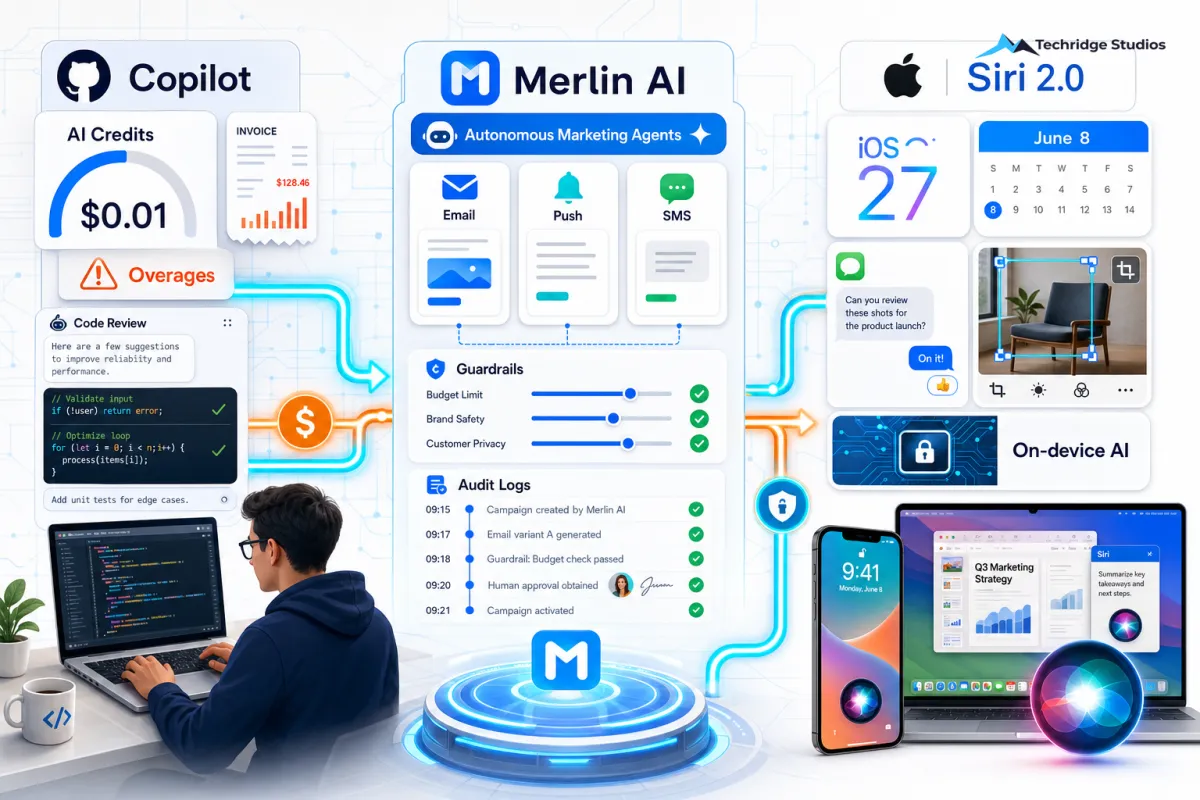
Three AI stories closed out this week that each touch a different layer of how small businesses operate: the cost of developer tools, the trustworthiness of marketing automation, and the devices your team uses every day. Together, they signal a clear direction — AI is moving from experimentation into operational infrastructure, and the terms are getting real.
GitHub Copilot's Billing Change Is a Wake-Up Call for Small Dev Teams
On June 1st, 2026, GitHub switched all Copilot plans to usage-based billing. The new billing unit is GitHub AI Credits, with one credit equal to one cent. Every paid plan includes a monthly allotment of credits — Copilot Pro at ten dollars per month includes ten dollars in credits, and Copilot Business at nineteen dollars per user includes credits at the same rate — but once those credits run out, usage keeps accruing.
The important carve-out: code completions and next edit suggestions remain unlimited on all paid plans. Everything else — Copilot agents, code review, chat sessions, and extended features — now burns through credits. That shift from unlimited to metered is where small teams are getting caught.
Developer backlash has been swift. Reports of "meter shock" — bills that look normal until a particularly heavy week of code review or agent use — are already circulating. For a small agency or startup without a dedicated engineering manager watching cloud spend, this is exactly the kind of cost that goes unnoticed until the invoice arrives.
The action for SMBs: log into your GitHub billing dashboard, find the AI Credits section, set a spending limit or alert, and understand which features your team uses most. If your developers are heavy chat or agent users, you may need to budget differently starting this month.
MoEngage's Merlin AI Agents Finally Show Their Work
The biggest complaint about AI in marketing has always been the same: you cannot see what it did. An AI generates an email campaign, and you have no way to trace the reasoning, the audience selection logic, or the timing decision. For businesses managing real customer relationships, that opacity is a dealbreaker.
MoEngage addressed this directly on June 3rd by launching Merlin AI Custom Agents. Marketers using MoEngage can now build workflow agents that run autonomously on their own customer data — with full activity logs showing every step, marketer-set guardrails around budget, audience rules, and review gates, and a clear decision trail for anything the agent executes.
The platform serves over 1,350 consumer brands. The practical use cases are ones that marketing teams spend hours on every week: QA-ing campaigns before they go live, building multi-step email and push notification flows, and generating analytics reports without opening a dashboard. With the new agents, those tasks can run on a schedule and surface results for human review.
MoEngage also opened an MCP connector, allowing external models like Claude and ChatGPT to access MoEngage data directly. For small marketing teams already using AI writing tools, this creates a pathway to connect your AI assistant to your actual campaign data rather than relying on memory.
The bigger signal here is maturity. Autonomous marketing agents are not new, but agents that show their work — that give a marketer the ability to see, correct, and approve every decision — represent the version that businesses can actually trust at scale.
Apple WWDC 2026 Opens Tomorrow — And It Could Change How Your Team Works
Apple's developer conference opens June 8th, and based on the clearest pre-event reporting yet, the headline is Siri 2.0. The new version of Siri is expected to be powered by Google's Gemini AI models and rebuilt for genuine in-app action — not just voice queries, but tasks like drafting a message, pulling context from your calendar and email, and navigating apps on your behalf.
iOS 27 is also expected to bring AI-powered image editing tools, including Extend, Enhance, and Reframe — capabilities that bring professional-level photo editing to the iPhone without third-party apps. Apple Intelligence, which had a slow and uneven rollout in 2025, is positioned for a significant second chapter at WWDC 2026.
Apple's underlying strategy is worth understanding: rather than routing every query to the cloud, Apple is investing heavily in on-device inference. That means AI features that run directly on iPhone and Mac chips, preserving privacy and reducing latency. For business users, the practical benefit is that AI-powered features work reliably even on a spotty connection, and sensitive business information stays on the device.
For small businesses, the stakes are tangible. If you are a business owner who manages customer communication, scheduling, document drafting, or team coordination on an iPhone or Mac, a genuinely capable Siri 2.0 could cut meaningful time from those workflows. The previous version of Siri was largely ignored in professional settings. If WWDC delivers on expectations, that changes this week.
Watch the keynote on June 8th at 1 pm Pacific Time. Focus specifically on the business workflow demonstrations — those will tell you whether this is a real productivity shift or another incremental update.
What This Means for Your Business
This week's three stories represent AI moving through different parts of the small business stack. GitHub Copilot's billing change is a cost management problem you need to address now. MoEngage's agent launch signals that trustworthy marketing automation is available today for teams ready to use it. Apple WWDC is a moment to watch — the outcome determines whether millions of Apple device users get a meaningful AI upgrade in the coming months.
The common thread: AI is no longer in pilot mode. The tools are live, the billing is real, and the decisions about how to use them are business decisions, not technology decisions. Treat them that way.
Sources
GitHub Blog Changelog — https://github.blog/changelog/2026-06-01-updates-to-github-copilot-billing-and-plans/
MoEngage / PR Newswire — https://www.prnewswire.com/news-releases/moengage-launches-merlin-ai-custom-agents-with-full-visibility-marketer-defined-guardrails-and-open-mcp-architecture-302789285.html
MacRumors WWDC 2026 Roundup — https://www.macrumors.com/roundup/wwdc/