Google I/O, a 25 Billion Dollar AI Cloud Company, and the Day Claude Topped ChatGPT for Business
Google opened its biggest developer event of the year, launched a 25 billion dollar AI cloud company with Blackstone, and Ramp payment data confirmed Claude has overtaken ChatGPT in US business AI spending — all in the same 24 hours.
Google I/O 2026: Gemini Omni and the Workspace Upgrades Every Business Needs to Know About
The Google I/O 2026 keynote opened this morning at 10 am Pacific at Shoreline Amphitheatre in Mountain View. For consumers and developers, the headlines center on a new Gemini model, Android XR glasses, and Googlebooks — a new line of AI-focused laptops from Acer, ASUS, Dell, HP, and Lenovo. For business owners running on Google Workspace, the stories that matter most are different.
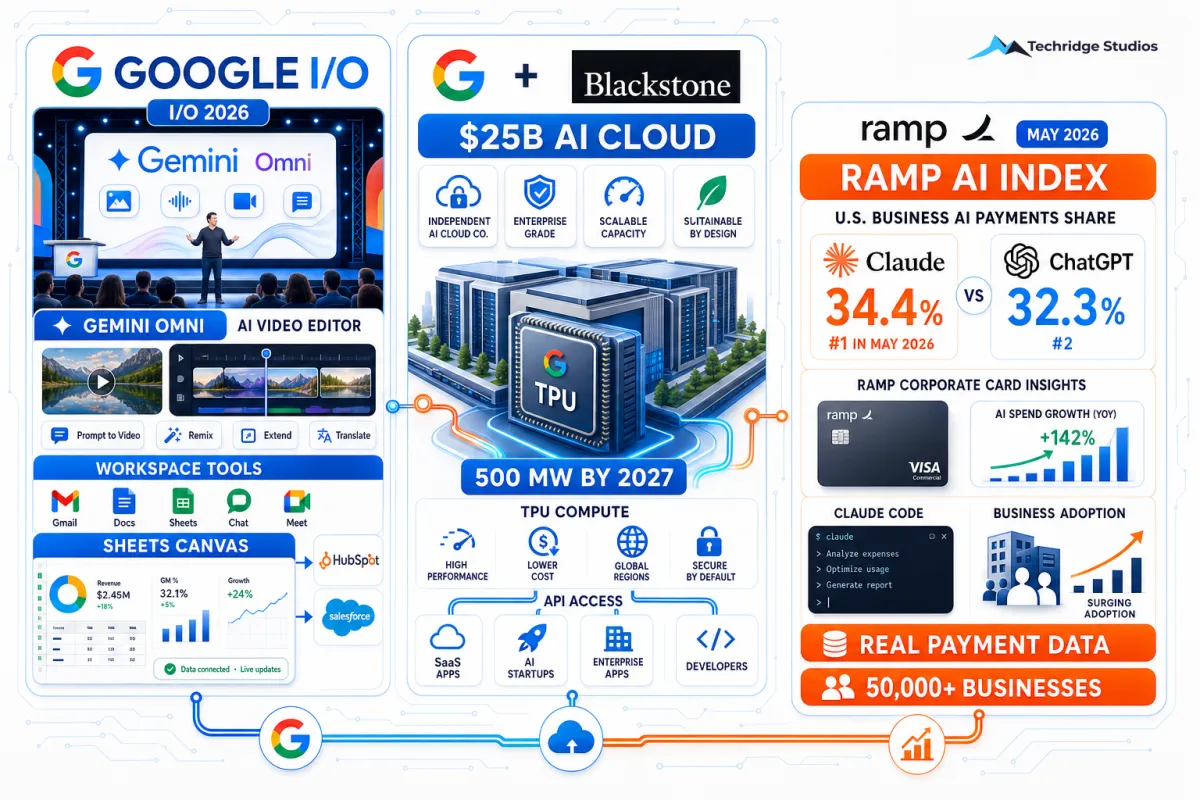
The marquee business announcement is Gemini Omni — a new multimodal AI model capable of generating and editing video directly inside the Gemini app. Users caught a glimpse of it in the days before I/O when it briefly surfaced in the Gemini app with the message: "Meet our new video generation model. Remix your videos, edit directly in chat, try a template, and more." Built on Google DeepMind's Veo architecture, Gemini Omni delivers higher prompt fidelity, better audio quality, and embedded background music compared to existing models. For a small business owner, that means AI-generated video content — social clips, product demos, training walkthroughs — is now available inside the tool your team already uses, without a separate subscription.
On the productivity side, two Workspace upgrades are rolling out immediately. Sheets is gaining a canvas mode that supports custom dashboards, heat maps, and kanban boards built directly in the spreadsheet — and it now supports live data imports from HubSpot and Salesforce with no integration development required. Gemini in Chat is evolving into a plain-language work command line: ask it to find a file by description, schedule a meeting, run a daily briefing, or connect tasks across Asana and Jira. These are not future roadmap items — they are confirmed rollouts tied to today's I/O keynote.
For businesses on Google Workspace Business Starter, Standard, or Plus plans, the action item is clear: check the What's New section in your Google Workspace admin panel within 48 to 72 hours. Major I/O feature releases typically appear in the admin rollout tracker within that window. If your team creates content or manages data from external CRMs, Gemini Omni and Sheets canvas are the two features to prioritize first.
Google and Blackstone's 25 Billion Dollar AI Cloud Company: What It Means for Small Business Costs
Also announced this morning: Google and Blackstone are forming a new, independent AI cloud company. Blackstone is the majority investor, contributing 5 billion dollars in equity, with total investment reaching 25 billion dollars, including leverage. The new company will offer customers access to Google's Tensor Processing Units — the custom AI chips Google has built specifically for training and running AI models — outside of Google's own cloud environment.
Benjamin Treynor Sloss, a Google veteran with more than two decades of experience building Google's global infrastructure, will serve as CEO. The company's first milestone is bringing 500 megawatts of AI compute capacity online by 2027, with plans to scale significantly from there. The entity is designed to compete directly with CoreWeave and other third-party AI cloud providers — and the fact that Blackstone, one of the world's largest asset managers, is the majority investor signals a new era in how financial infrastructure is being deployed toward AI.
The direct SMB impact is indirect but real. When AI compute becomes available through independent channels at this scale, competition increases. More compute supply competing for the same workloads has historically driven down API pricing. If your business pays per API call for tools running on Google's AI infrastructure — or on any infrastructure competing in the same tier — this expansion eventually translates to lower unit costs. There is also a secondary signal: Wall Street treating AI compute as essential infrastructure rather than experimental technology tends to accelerate development timelines and stabilize vendor roadmaps across the entire ecosystem.
Claude Overtakes ChatGPT in US Business AI Spending — What the Ramp Data Actually Says
The most actionable data point for any business making AI platform decisions this week came not from a vendor but from Ramp's May 2026 AI Index — a dataset built on actual corporate card and subscription payment flows from more than 50,000 US businesses. The finding: Claude now holds 34.4 percent of US business AI adoption versus OpenAI's 32.3 percent. This is the first time Anthropic has led OpenAI in this metric since the index began.
The velocity of the shift is the more remarkable story. A year ago, Anthropic held approximately 9 percent of the Ramp sample. It has added roughly 25 percentage points in 12 months, while OpenAI barely moved. Ramp's lead economist, Ara Kharazian, described it as "a stunning reversal in the competitive market dynamics for AI model providers." Total AI adoption across the full Ramp sample sits at 50.6 percent of businesses — meaning this entire gain came at OpenAI's expense within the half of the market that has already committed to paying for AI. The crossover did not come from net new adopters. It came from businesses switching.
Claude Code is the primary driver. Anthropic's terminal-native AI coding agent reached 2.5 billion dollars in annualized revenue by February 2026 and now accounts for an estimated 4 percent of all public GitHub commits worldwide, double its share from one month prior. Anthropic's total annualized revenue now stands at approximately 30 billion dollars, ahead of OpenAI's 24 to 25 billion dollars. Ramp analyst coverage published May 18th notes that OpenAI has responded by launching the OpenAI Deployment Company, backed by 4 billion dollars from TPG and Goldman Sachs, alongside the acquisition of London AI consultancy Tomoro — a direct counter to Anthropic's SMB and enterprise expansion.
For small businesses, three practical takeaways follow from this data. First, the AI market is actively shifting, and the platform that appears dominant today may not lead in six months — which means vendor lock-in is a real risk worth managing. Second, Claude Code's dominance in business spending reflects a broader trend: businesses are finding greater measurable ROI from AI tools that integrate directly into their existing development and operations workflows than from standalone chat interfaces. Third, and most important, the Ramp data is real payment information from real businesses — not survey sentiment or analyst speculation — making it the most reliable market signal available to SMBs choosing where to focus their AI spend.
What This Means for Your Business
Three major AI stories landed today, and the thread connecting them is the same: AI is becoming standard infrastructure, and the platforms and tools with the most integrated, always-on utility are winning on every metric — adoption, spending, and investment.
The single action to take today: if your team uses Google Workspace, check your admin rollout tracker for Gemini Omni and Sheets canvas mode availability within the next 48 hours. That is the fastest path to a real AI upgrade with no additional spend. If you are still deciding on a primary AI platform, the Ramp data gives you a benchmark grounded in real business payment behavior — not marketing claims.
Sources
Trending Topics EU — https://www.trendingtopics.eu/google-i-o-2026-ai-takes-center-stage-with-new-gemini-and-video-generator/
Blackstone Press Release — https://www.blackstone.com/news/press/blackstone-announces-joint-venture-with-google-to-create-new-tpu-cloud/
RoboRhythms / Ramp AI Index — https://www.roborhythms.com/claude-overtakes-chatgpt-business-may-2026/