Google I/O Is Tomorrow, Anthropic Is Closing In on a Trillion: What SMBs Need to Know This Week
The week of May 18th, 2026 is shaping up to be one of the most consequential in recent AI history — not because of a single announcement, but because of three converging signals. Google's biggest AI keynote of the year opens tomorrow. Anthropic is days away from closing a funding round that would value it near a trillion dollars. And the US government just finished formalizing the framework under which every major AI model gets evaluated before it reaches you. For small businesses, this week is a checkpoint: the tools and platforms that win the next 48 hours will likely define the AI landscape for the next 12 months.
Google I/O 2026: The AI Keynote Your Business Should Watch Tomorrow
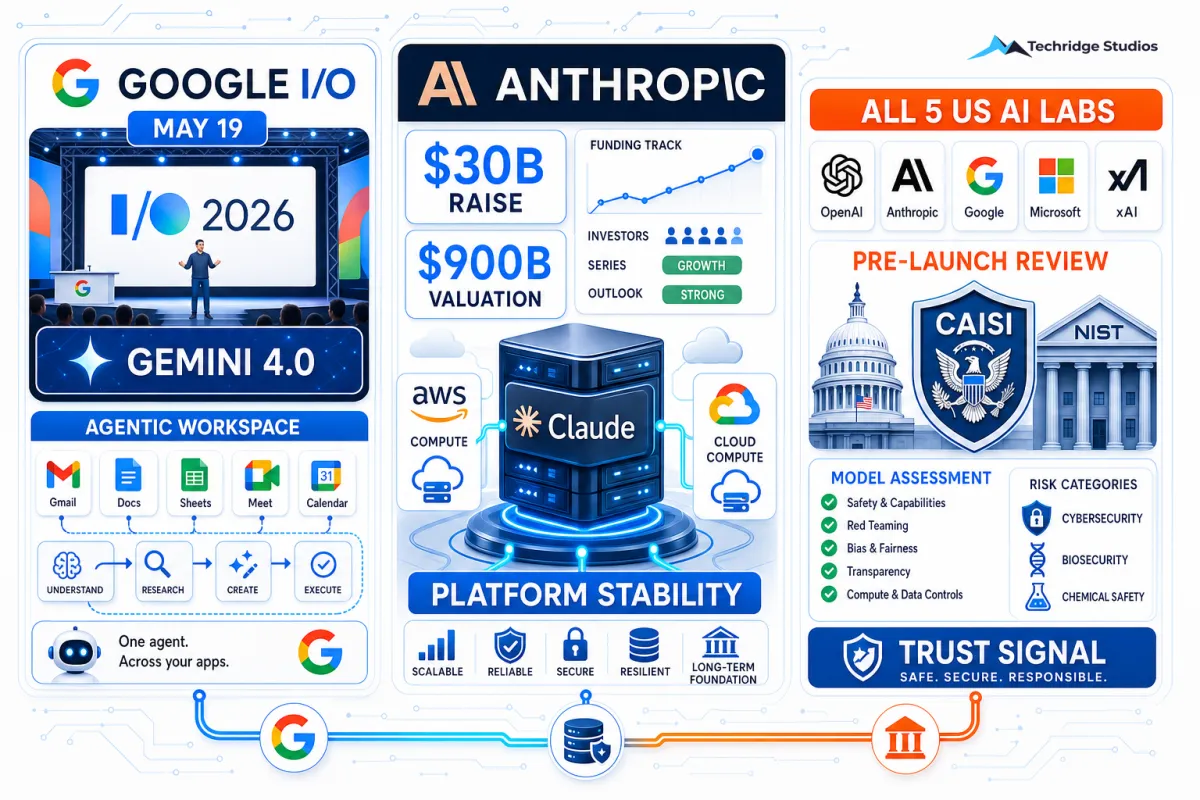
Google I/O 2026 opens Tuesday, May 19th, at 10 am Pacific at Shoreline Amphitheater in Mountain View, California, with a simultaneous livestream at io.google. Google has officially confirmed the keynote will cover "the latest Gemini model updates" and "agentic coding" — widely read as the public debut of Gemini 4.0 or an equivalently named model. Published roadmap signals and leaked materials point to a full lineup of announcements: a unified multimodal model with larger context windows and improved reasoning; Gemini Spark, a persistent AI agent capable of proactively handling workflows across apps without user navigation; Aluminum OS, the Android-based replacement for ChromeOS; and Android XR Glasses developed in partnership with Samsung, Warby Parker, and XREAL.
Google's May 12th Android Show already covered Android 17 and Gemini Intelligence for mobile, so the I/O keynote is focused entirely on model releases, hardware, and developer platform updates. Google Cloud pricing and expanded agentic integrations with Workspace are both expected. That last item is the most directly relevant to small businesses.
Millions of small businesses run on Google Workspace — Gmail, Docs, Sheets, Meet, Calendar, and Drive. A Gemini 4.0 upgrade with agentic Workspace integration means AI that can take multi-step actions across those apps without you having to manually navigate between them. Think draft-and-send, schedule-and-confirm, summarize-and-route — all happening inside the tools your team already pays for, without needing a separate AI subscription or custom integration.
The best play for any Google Workspace user this week: watch the keynote or the recorded highlights, identify one or two workflows that a new agentic Workspace feature could handle, and test it before rolling it into your standard operating procedure. The risk of moving too fast is building a workflow around a feature that is still being refined. The risk of not watching at all is watching a competitor use Google's free feature update while you are still doing it manually.
UPDATE: Anthropic Is Closing In on a 900 Billion Dollar Valuation — What That Means for Businesses on Claude
Bloomberg reported on May 12th, 2026, that Anthropic is in advanced talks to raise at least 30 billion dollars at a valuation of more than 900 billion dollars. As of May 18th, the round has not closed, and no term sheet has been signed, but multiple sources confirm it is expected to close within the next two weeks. The round is being co-led by Sequoia Capital, Dragoneer Investment Group, Greenoaks Capital, and Altimeter Capital. Google and Amazon remain Anthropic's two largest strategic investors, with combined commitments of up to $ 55 billion.
This story requires context to be understood properly. The "Anthropic $50B Round" that circulated in late April and early May was an early-stage report of a potential raise. The current development is materially different: a confirmed 30 billion-dollar raise at a 900 billion-dollar-plus valuation, with a specific end-of-May close timeline. Three months ago, Anthropic was valued at $ 380 billion. The near-tripling of its valuation in one quarter is driven by real fundamentals: Anthropic disclosed in May that Q1 2026 revenue grew 80x year-over-year, with annualized recurring revenue now above $ 44 billion and more than 1,000 customers spending $ 1 million or more annually.
Dario Amodei has stated the capital will go toward compute infrastructure — specifically the Amazon Web Services and Google Cloud commitments coming online through 2027. Anthropic is also reportedly exploring an initial public offering as early as October 2026.
For small businesses, the decision-relevant takeaway is vendor stability. Any business that has already built workflows on Claude — payroll planning, contract review, customer communication, content generation — should understand that Anthropic is being capitalized as long-term infrastructure, not a startup that might pivot or run out of runway. The risk that made some early SMB adopters hesitant ("what if they disappear or get acquired?") is functionally resolved by a round of this scale and composition. If anything, the concern shifts in the opposite direction: at a near-trillion dollar valuation, Anthropic is under significant pressure to perform — which means continued model investment, expanded integrations, and competitive pricing to retain and grow enterprise and SMB customers.
All Five US Frontier AI Labs Are Now Under Government Pre-Launch Review
On May 5th, 2026, the Center for AI Standards and Innovation (CAISI) — the AI safety and evaluation arm of the National Institute of Standards and Technology at the US Department of Commerce — finalized pre-deployment review agreements with Google DeepMind, Microsoft, and xAI. They joined OpenAI and Anthropic, both of which had prior CAISI evaluation agreements in place. The program has already completed more than 40 model assessments.
Here is how the process works: before any major model is released publicly, the lab submits it to CAISI for government evaluation. Evaluations focus on national security risk categories, including cybersecurity, biosecurity, and chemical weapons concerns. Labs often submit models with reduced or removed safeguards to allow thorough capability assessment — the safeguards are restored before public release. Agreements are voluntary, but all five labs signed. The EU is in separate discussions with Anthropic about access to its Mythos model.
The business-relevant interpretation has two parts. First, it is a trust signal. Every major AI model release in the United States now goes through a structured evaluation before it reaches your team. That evaluation is specifically designed to surface dangerous or misaligned capabilities. Businesses using AI in client-facing, healthcare, financial, or legal workflows now have an additional layer of accountability behind the tools they deploy. Second, it slightly extends the window between a model announcement and API availability. Labs need evaluation time before launch. For teams building production workflows on frontier models, that means a few extra days or weeks between "we heard about this model" and "we can integrate it." That is a small trade-off, and for most SMBs, it does not change anything in practice — you are not usually deploying on the day a model launches anyway.
The broader structural signal is that AI has moved from a research category into a regulated infrastructure category. That is ultimately good for businesses because it reduces the risk of deploying a tool that could lead to regulatory exposure or reputational harm. The informal wild west of AI releases is over.
What This Means for Your Business
The three stories this week share a common thread: the AI ecosystem is consolidating. Google is about to push a major capability update into tools you already pay for. Anthropic is being funded at a scale that makes it infrastructure-grade. And the government has formalized an oversight layer that reduces the risk of a surprise capability failure in production.
The action step is simple: watch Google I/O tomorrow. If you are on Google Workspace, any new agentic tool that handles multi-step tasks inside Docs, Gmail, or Sheets is worth a 30-minute test. If you are on Claude, note that your platform just became significantly better-capitalized. And if you are still evaluating which AI tools to commit to, the vendor stability and regulatory trust signals this week point toward Google and Anthropic as the two platforms most likely to be enterprise-grade anchors for the next several years.
Do not try to do everything at once. Pick one workflow. Test one tool. Build one system. That is how AI becomes a business advantage instead of a burden.
Sources
Android Authority — https://www.androidauthority.com/what-to-expect-from-google-io-2026-3664979/
CNBC — https://www.cnbc.com/2026/05/05/ai-oversight-trump-google-microsoft-xai.html