Google Rewrites Search, AI Shrinks Specific Jobs, and Grok Goes Free
Three shifts happened in AI this week with direct, measurable consequences for every small business. Google rebuilt how customers discover you. Government data confirmed which roles AI is already displacing. And a free tool became a credible replacement for paid office software. Here is what each means and what to do about it.
Google Declared the Era of Ten Blue Links Over
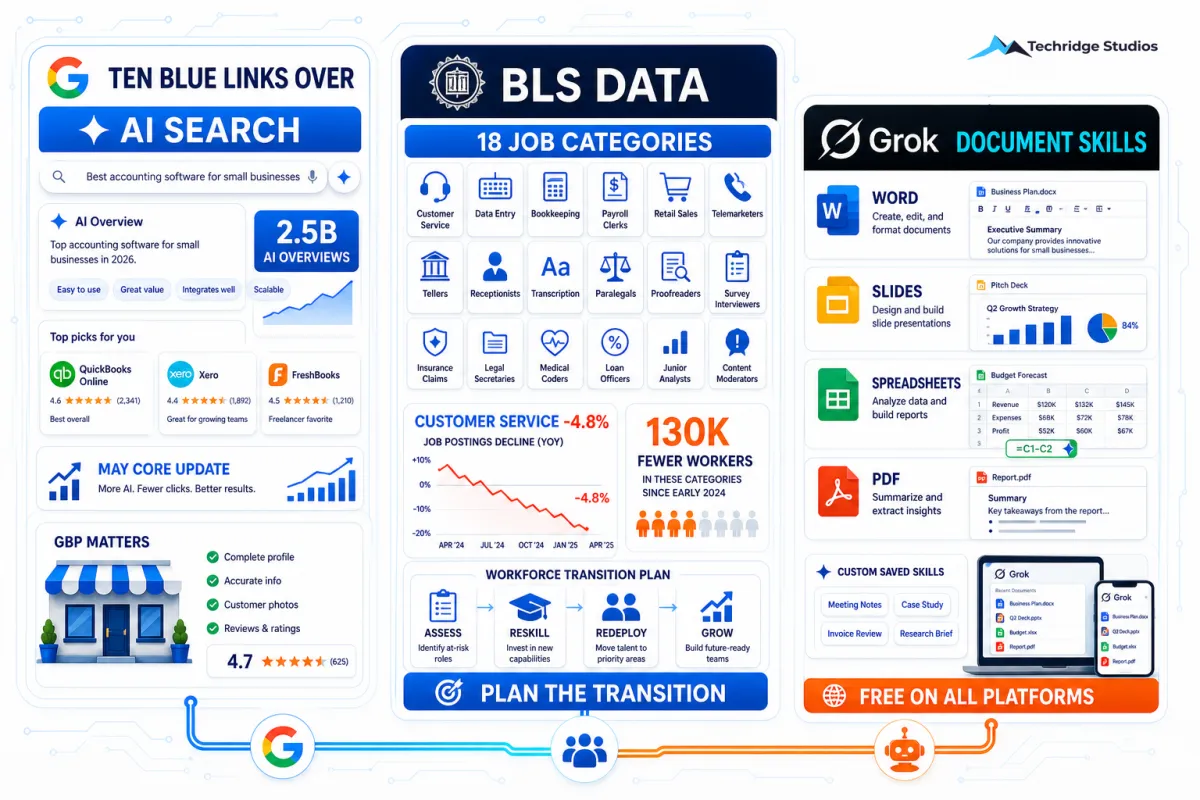
On May 19, 2026, Google opened its annual developer conference with a declaration most search professionals had been anticipating for years: the ten blue links era is over. In its place, Google is rolling out AI-powered information agents that run in the background 24 hours a day, monitoring topics and surfacing answers without users needing to type a query. Generative UI delivers dynamic, interactive results instead of static links. AI Overviews — the AI-generated summaries that now appear above traditional results — have already reached 2.5 billion monthly users. Conversational AI Mode, which handles complex, multi-turn queries, has surpassed 1 billion users and is expanding broadly this summer.
Two days after the keynote, Google quietly launched its May 2026 core update — its second major ranking update of the year. Google confirmed the rollout started May 21 and would take approximately two weeks. Combined with the AI search redesign, this creates a double shift for businesses whose customers rely on Google to find them.
For small business owners, the practical implications are immediate. Google's own guidance is clear: the content that earns visibility in AI-powered search reflects genuine expertise, first-hand experience, and specific knowledge that AI cannot generate on its own. Generic product descriptions, keyword-stuffed service pages, and thin blog posts are being deprioritized. What wins is content only your business can write — customer stories, operational expertise, and direct answers to the specific questions your customers are actually asking.
The Google Business Profile has also become more critical than ever. AI Overviews and information agents draw heavily from structured local data. Every field of your Business Profile — hours, services, products, photos, and review responses — directly influences whether your business appears in AI-generated answers. Audit yours this week and treat it as a live marketing asset, not a set-and-forget listing.
U.S. Government Data Confirms AI Is Already Shrinking Specific Jobs
The debate about whether AI is replacing human workers has been running at full volume for three years. On May 15, 2026, Bloomberg reported on new Bureau of Labor Statistics data that moved the argument from speculation to measured fact.
The BLS had previously identified 18 occupations it classified as highly exposed to AI displacement. Those 18 categories — representing roughly 10 million U.S. jobs — declined 0.2 percent in aggregate between May 2024 and May 2025. Over that same period, overall U.S. employment grew 0.8 percent. The divergence is exactly what economists modeling AI-driven displacement predicted.
The sharpest individual decline was in customer service representatives: 130,180 fewer workers, a 4.8 percent drop in a single year. Graphic designers and legal secretaries were also among the 18 occupations on the list. Inc. published a detailed breakdown of all 18 roles in May, making the data accessible to business owners who do not read government labor reports.
The important framing here is that these declines are not all attributable to AI in isolation. Economic conditions, business cycles, and offshoring all contribute. But the divergence from overall employment growth is significant, and it tracks the specific occupations where AI capabilities have advanced the fastest — text generation, image creation, data entry, call routing, and legal document processing.
For small business owners, this data serves a specific planning purpose. If you employ people in customer service, graphic design, sales support, or administrative roles that appear on the BLS list, the automation of those functions is already underway at scale in the broader market. Deciding how to respond now, on your terms, is better than being forced to respond later. That might mean upskilling current staff into AI-adjacent roles, phasing in AI tools alongside your team, or redeploying people to higher-value functions where human judgment remains essential.
Grok Launched Free Document Creation — Word, Slides, Spreadsheets, and PDFs
On May 18, 2026, xAI released Grok Skills alongside updates to its Responses API. The update added built-in document creation tools available on web, iOS, and Android at no additional cost.
The built-in capabilities include full generation and editing of Word documents with heading structures and table support; PowerPoint-style slide decks with visual hierarchy and speaker notes; Excel-compatible spreadsheets with formulas, data analysis functions, charts, and conditional formatting; and PDF operations, including creation, merging, splitting, and text extraction. Users can also create and save custom skills — saved instructions that Grok applies consistently across future conversations, meaning you set your formatting and style preferences once and Grok applies them automatically going forward.
Engadget covered the launch of what Grok calls its Studio interface. InfoQ published technical details on the Grok Skills release. Full rollout to all Grok users was expected by mid-to-late May 2026.
The business implication is straightforward. Grok is now a direct competitor to Microsoft 365 for everyday document production tasks. Small businesses that currently pay for office software subscriptions to produce proposals, client reports, meeting summaries, and internal documentation can test whether Grok handles these tasks at a comparable level of quality at no additional cost. Start with a document you produce regularly and run it through Grok. If the output meets your standards, you can realize a cost reduction immediately.
What This Means for Your Business
Three independent signals are pointing in the same direction this week. Customer discovery is moving to AI-first search. Certain job functions are being absorbed by AI at a pace now visible in government employment data. And the productivity tools that once required monthly subscriptions are increasingly available for free.
The next action is simple: pick one of the three and move. If Google traffic drives your business, start with a Google Business Profile audit today. If your team includes roles on the BLS list, schedule a conversation about automation and upskilling before the end of May. If you pay for office software, spend 30 minutes with Grok this weekend, testing your most common document type.
The businesses that pull ahead are not the ones that read the most AI news. They are the ones who convert one story into one action at a time.
Sources
TechCrunch — https://techcrunch.com/2026/05/19/google-search-as-you-know-it-is-over/
Search Engine Land — https://searchengineland.com/google-may-2026-core-update-rolling-out-now-478430
Inc.com — https://www.inc.com/soren-kaplan/the-bureau-of-labor-statistics-just-flagged-18-jobs-ai-is-already-shrinking-is-yours-on-the-list/91346529